

Slow research doesn't just frustrate your team. It costs you market share. When insights take weeks or months to surface, competitors move first, budgets get wasted on assumptions, and strategic decisions get made in the dark. Marketing leaders today face a brutal tradeoff: thoroughness versus speed. The good news is that tradeoff is disappearing. Modern AI tools are reshaping every step of the marketing research process, cutting timelines from months to days without sacrificing rigor. This guide walks you through each stage, from defining your problem to implementing findings, with practical shortcuts and AI-powered accelerators built in at every turn.
Table of Contents
- Preparing for research: Setting goals, defining the problem, and establishing requirements
- Step-by-step marketing research process: From design to insights
- Sampling, data collection, and dealing with uncertainty
- Analyzing and implementing research findings for strategic impact
- Why traditional research steps aren't enough in 2026: The real competitive edge
- Accelerate your research with Gather's AI-native platform
- Frequently asked questions
Key Takeaways
| Point | Details |
|---|---|
| Clear goals first | Start with defined objectives and research questions for efficient, actionable results. |
| Leverage AI | Integrating AI through each step accelerates insight generation and reduces manual work. |
| Choose sampling wisely | Selecting the right sampling strategy ensures data reliability and precision for decision-making. |
| Iterate for success | The best teams use rapid experimentation, flexible design, and AI tools to stay ahead in 2026. |
Preparing for research: Setting goals, defining the problem, and establishing requirements
Every research project that goes sideways shares one common failure: it started without a clear question. Before you touch a survey tool or schedule a single interview, you need to know exactly what decision your research is supposed to support. That sounds obvious, but most teams skip this step or rush through it.
Recognizing the issue is the crucial first step in the marketing research process. This means translating a fuzzy business problem into a specific, researchable question. "We need to understand our customers better" is not a research question. "Why are B2B buyers in the mid-market segment churning within 90 days of onboarding?" is.
Before you move forward, inventory your prerequisites:
- Business objective: What decision will this research inform?
- Stakeholders: Who needs to act on the findings, and what do they care about?
- Existing data: What do you already know from your CRM, POS, or past studies?
- Budget and timeline: What constraints will shape your methodology?
- Success criteria: How will you know the research answered the question?
Here's a quick framework for translating problems into research goals:
| Business problem | Research question | Method fit |
|---|---|---|
| Low trial conversion | What stops users from converting? | Qualitative interviews |
| High churn rate | Why do customers leave early? | Exit surveys + AI analysis |
| New product launch | Will this resonate with our target segment? | Concept testing |
| Brand perception gap | How do we compare to competitors? | Brand health tracker |
The Gather research platform is built to support this stage directly, helping teams structure research questions and match them to the right methodology before a single data point is collected.
Pro Tip: Write your research question on a whiteboard and ask every stakeholder to confirm it answers their actual business need. If even one person disagrees, you haven't defined the problem yet.
Step-by-step marketing research process: From design to insights
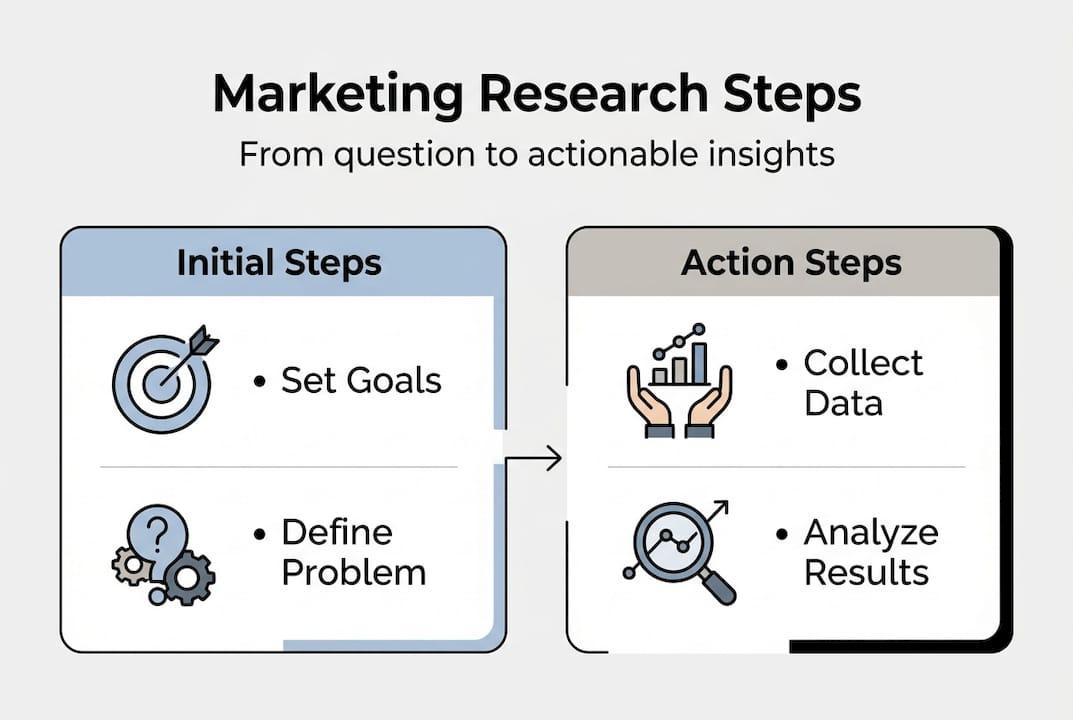
With your goals locked in, the process itself becomes much easier to navigate. The five essential steps are: recognize the issue, formulate a strategy, execute research, evaluate findings, and implement solutions. Simple in theory. Complex in practice. Here's how to move through each one without losing momentum.
- Recognize the issue. Nail down your research question and confirm stakeholder alignment before anything else.
- Formulate a strategy. Choose your methodology: qualitative, quantitative, or mixed. Define your sample, your instruments, and your timeline.
- Execute research. Collect data through interviews, surveys, focus groups, or behavioral analysis. This is where AI tools create the biggest time advantage.
- Evaluate findings. Analyze patterns, surface insights, and validate conclusions against your original question.
- Implement solutions. Turn insights into decisions, campaigns, or product changes, then track outcomes.
AI is reshaping steps three and four most dramatically. Gen AI is transforming how researchers analyze data, generate synthetic personas, and surface patterns at scale. Notably, 47% of researchers now use AI tools regularly, and that number is climbing fast.
| Stage | Traditional timeline | AI-accelerated timeline |
|---|---|---|
| Study design | 1 to 2 weeks | 1 to 2 days |
| Data collection | 3 to 6 weeks | 3 to 7 days |
| Analysis | 2 to 4 weeks | Real-time to 48 hours |
| Reporting | 1 to 2 weeks | Same day |
For teams exploring AI-driven research studies, the efficiency gains aren't marginal. They're structural. You can run more studies, test more hypotheses, and iterate faster than any agency-dependent process allows. Browse AI market research use cases to see how teams are applying this in practice.
Pro Tip: Use AI-moderated interviews for exploratory phases. Adaptive probing captures nuance that static surveys miss, and you get structured outputs without manual transcription.
Sampling, data collection, and dealing with uncertainty
Even a perfectly designed study fails if the sample is wrong. Sampling is where many marketing teams cut corners, and it's where research credibility lives or dies.

For most standard studies, random or stratified sampling works well. But when you're targeting hard-to-reach groups, like niche B2B buyers, churned users, or early adopters, you need different tools. Cluster and snowball sampling help reach difficult audiences, and larger, more representative samples consistently yield more precise insights.
Here's a practical breakdown of sampling approaches by use case:
- Random sampling: Best for broad consumer studies with accessible populations
- Stratified sampling: Use when you need proportional representation across segments
- Cluster sampling: Efficient for geographically dispersed or organizationally grouped audiences
- Snowball sampling: Ideal for niche or hard-to-find respondents who refer others
- AI-assisted synthetic sampling: Useful for early-stage concept testing when live audiences aren't yet available
Uncertainty is a real challenge in research design. When you're entering a new market or testing a genuinely novel concept, you may not have enough prior data to design a confident study. In these cases, pilot studies are your best friend. Run a small-scale version first, identify gaps in your instrument, and refine before full deployment.
"The quality of your sample determines the quality of your insight. A biased sample doesn't just give you wrong answers. It gives you confidently wrong answers."
For concept testing validation, combining traditional sampling rigor with AI-powered analysis gives you both statistical confidence and interpretive depth. AI can flag anomalies in response patterns that human analysts might miss in large datasets.
Pro Tip: Always run a data quality check before analysis. Flag incomplete responses, outliers, and straight-liners (respondents who select the same answer repeatedly). Cleaning your data before analysis saves hours of rework later.
Analyzing and implementing research findings for strategic impact
Data collection is the middle of the story, not the end. The real value of marketing research lives in what you do with the findings. This is where many teams stumble, either drowning in data or rushing to conclusions that the data doesn't actually support.
Here's a structured approach to moving from raw data to strategic action:
- Organize findings by research question. Don't analyze everything at once. Map each data set back to the specific question it was designed to answer.
- Identify patterns, not just data points. Look for themes across responses, not isolated quotes or single statistics.
- Generate insight statements. An insight isn't a finding. "60% of users felt confused during onboarding" is a finding. "Users lose confidence at the moment of first configuration because instructions assume prior technical knowledge" is an insight.
- Validate before presenting. Cross-reference qualitative themes with quantitative signals. If they conflict, investigate before concluding.
- Build a decision-ready output. Stakeholders need recommendations, not raw data. Frame every insight as an implication and every implication as a potential action.
AI analysis now enables faster, deeper insight generation, including the ability to create synthetic personas, build digital twins of customer segments, and automate pattern discovery across large datasets. This means your team spends less time coding responses and more time making decisions.
Use AI research reports to deliver board-ready outputs that combine narrative summaries with visual dashboards. For ongoing tracking, tools like the brand health tracker and content preference report give you longitudinal visibility without rebuilding studies from scratch each cycle.
Pro Tip: Never present findings without a recommended action. If your research can't drive a decision, it wasn't scoped correctly. Go back to your original research question and check whether the data actually answers it.
Why traditional research steps aren't enough in 2026: The real competitive edge
Here's something most research guides won't tell you: following the steps perfectly is not what separates winning marketing teams from the rest. Process compliance is table stakes. The real edge comes from how fast you learn and how willing you are to act on incomplete information.
The teams we see outperforming their competitors aren't running flawless research programs. They're running faster ones. They treat each study as a learning loop, not a one-time deliverable. They use AI to compress the time between question and answer. And they're willing to make a confident call on 80% certainty rather than waiting for 100%.
Rigidity is the enemy. A team that spends six weeks perfecting a survey instrument while a competitor launches and learns from a real audience has already lost. The executive market research advice that matters most in 2026 is this: build a research culture that prizes iteration over perfection, and use AI to make iteration cheap enough to do constantly.
Multi-source validation, rapid pilot testing, and AI-powered synthesis aren't just efficiency tools. They're competitive infrastructure.
Accelerate your research with Gather's AI-native platform
If this guide has shown you anything, it's that the gap between slow research and fast research isn't about effort. It's about infrastructure. The right platform removes the friction at every stage, from defining your question to delivering board-ready insights.
Gather is built for exactly this. The AI-native research platform automates study design, runs AI-moderated interviews with adaptive probing, and delivers structured analysis in days, not months. Whether you're running concept tests, brand tracking, or customer discovery, you can explore AI-powered research use cases to see how teams like yours are moving faster. Start with a customer research study and experience the difference between research that informs and research that transforms.
Frequently asked questions
What are the five main steps of marketing research?
The five steps are: recognize the issue, formulate a strategy, execute research, evaluate findings, and implement solutions. Each stage builds on the last, and skipping any one of them increases the risk of acting on flawed insights.
How does AI improve the marketing research process in 2026?
AI enables faster analysis, synthetic persona generation, and automated pattern discovery. With 47% of researchers using AI tools regularly, it's now a standard part of competitive research programs, not a novelty.
What sampling methods work for hard-to-reach audiences?
Cluster and snowball sampling are the most effective approaches for niche or difficult-to-access groups. Larger, more representative samples consistently produce more accurate and actionable insights.
When should exploratory research or test marketing be used?
Exploratory research fits best when the problem is unclear or poorly defined and you need qualitative input before committing to a full study design. Test marketing is the right call when you need real-world validation of a new product or campaign before a full-scale launch.