

Most marketing teams still believe that quality audience research takes months, costs a fortune, and requires an external agency. That belief is costing you speed, relevance, and competitive ground. Rapid audience research flips that assumption entirely. It gives marketing and business teams the ability to gather real, actionable customer insights in days, not quarters. In this guide, you will learn exactly what rapid audience research is, how it reshapes marketing decisions, what role AI plays in making it scalable, and how to bring it into your team's workflow without sacrificing the quality your stakeholders expect.
Table of Contents
- What is rapid audience research?
- How rapid audience research transforms marketing decisions
- The role of AI and automation in rapid audience research
- Best practices for adopting rapid audience research in your team
- What most teams get wrong about rapid audience research
- Accelerate your insights with Gather's rapid audience research platform
- Frequently asked questions
Key Takeaways
| Point | Details |
|---|---|
| Speed vs. quality | Rapid audience research delivers fast insights when paired with rigorous processes and human oversight. |
| AI-driven scale | AI and automation make high-quality, continuous research feasible for mid-sized teams. |
| Actionable impact | Fast audience insights unlock smarter, more agile marketing and product decisions. |
| Practical adoption | Clear processes and objective-driven cycles are key to successful implementation. |
What is rapid audience research?
Rapid audience research is a streamlined, often AI-assisted approach to gathering actionable customer or user insights in a matter of days, not weeks or months. Instead of commissioning a lengthy study with a six-week fieldwork phase and a 40-page report that arrives after the campaign has already launched, rapid research delivers focused answers to focused questions on a timeline that actually matches how marketing teams operate.
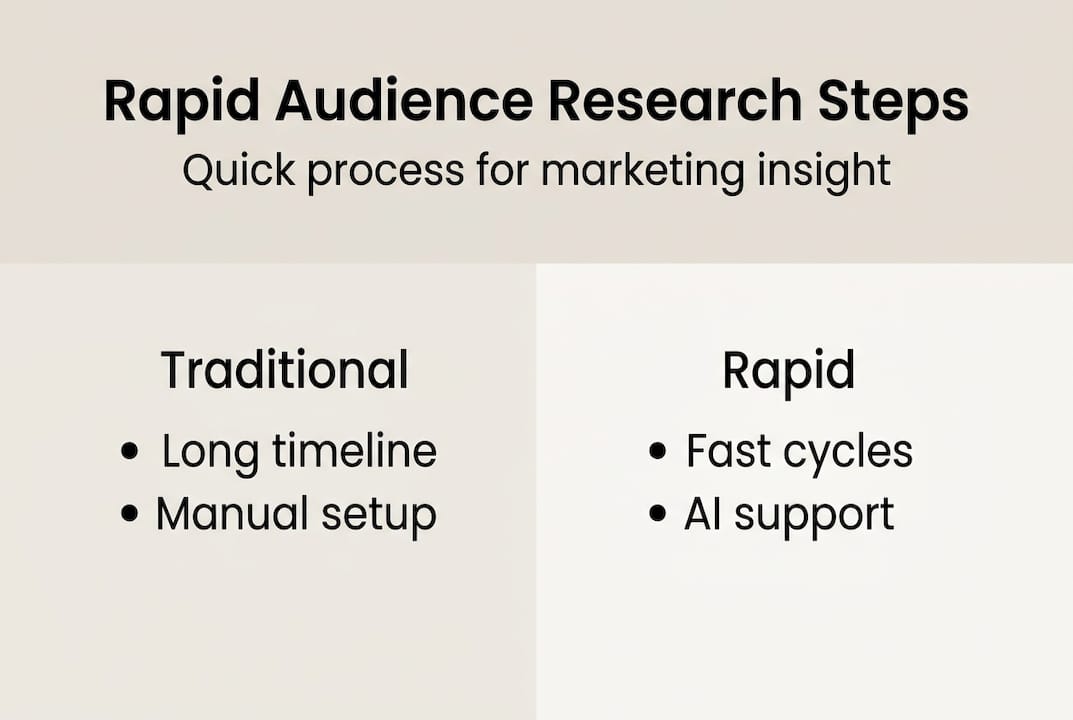
The contrast with traditional research is stark. Traditional methods rely on manual survey design, slow panel recruitment, human-coded analysis, and agency-managed reporting. Rapid audience research compresses all of that. It uses automation, AI analysis, and pre-built methodology frameworks to cut the cycle from months to days.
| Dimension | Traditional research | Rapid audience research |
|---|---|---|
| Timeline | 6 to 12 weeks | 2 to 10 days |
| Cost | High (agency fees) | Significantly lower |
| Deliverable | Long-form report | Focused, actionable summary |
| Flexibility | Low | High, iterative |
| Team dependency | External agency | Internal or platform-led |
Who benefits most? Marketing teams running live campaigns, product teams validating features, and business leaders who need directional data before a board meeting. Rapid research is not a replacement for deep strategic studies. It is the tool you reach for when speed matters and the question is specific.
As noted in the GitLab Handbook, rapid research enables continuous tactical validation for product and marketing teams, making it a repeatable capability rather than a one-off project.
"Rapid validations are short, focused research efforts designed to answer a specific question quickly, without sacrificing rigor." GitLab UX Research Team
For a deeper look at why so many teams are hitting a wall with traditional approaches, the customer research crisis study is worth reviewing. You can also explore audience research reports to see how modern teams are structuring their insight programs.
How rapid audience research transforms marketing decisions
With a foundational understanding established, see how rapid audience research changes the way modern marketing teams work.
The biggest shift is in decision speed. When you can test a message, validate a creative concept, or understand a segment's reaction within a week, your campaign strategy becomes genuinely responsive. You stop guessing and start iterating based on real signals.
Consider what this looks like in practice. A team preparing a product launch runs a rapid concept test on Monday. By Thursday, they have structured feedback from 50 target customers. By Friday, they have revised the headline and adjusted the value proposition. The campaign launches the following week with validated messaging instead of hopeful assumptions.

Programs like Google's rapid research have enabled continuous tactical validation across product and marketing functions, proving that speed and rigor are not mutually exclusive.
Here is how rapid audience research improves specific marketing outcomes:
- Message testing: Validate which value proposition resonates before spending on paid media.
- Creative validation: Test ad concepts with real audience segments before production investment.
- Campaign pivots: Identify underperformance signals early and adjust targeting or copy.
- Segment understanding: Quickly profile a new audience before entering a market.
- Feature feedback: Gather directional input on product changes from actual users.
| Marketing decision | Without rapid research | With rapid research |
|---|---|---|
| Message selection | Gut feel or A/B test after launch | Pre-validated with target audience |
| Creative approval | Internal opinion | Audience-backed feedback |
| Campaign pivot | Weeks of data collection | Days of focused insight |
Pro Tip: Structure every rapid research sprint around a single hypothesis. "We believe [audience segment] will respond better to [message A] because [reason]." This keeps the study focused and makes the output immediately actionable for ad testing insights.
The audience research platform you choose matters here. Platforms built for speed, like AI-native engines, reduce the friction between question and answer. Explore AI-driven research use cases to see how teams are applying this in real marketing contexts.
The role of AI and automation in rapid audience research
Rapid audience research isn't just about speed. It's powered by emerging technologies. Here's how AI and automation are redefining what's possible.
The core reason rapid research is now viable at scale is AI. Without automation, compressing a research cycle from eight weeks to eight days would require an unrealistic number of human hours. AI handles the heavy lifting: survey design, participant screening, response analysis, thematic clustering, and report generation.
According to Gather's 2026 original study, AI-driven engines make large-scale, continuous audience analysis affordable and accessible for teams that previously couldn't justify the cost of traditional research.
Here are the core AI-driven features that make rapid research possible:
- Automated study design: AI selects the right methodology based on your research question.
- AI-moderated interviews: Conversational AI conducts interviews at scale, with adaptive follow-up probing.
- Thematic clustering: AI groups open-ended responses into patterns without manual coding.
- Real-time structured analysis: Insights surface as data comes in, not after fieldwork closes.
- Automated reporting: Board-ready summaries generated without analyst hours.
- CRM and POS integration: Research targets your actual customers, not generic panels.
These capabilities are not theoretical. The rapid research automation frameworks already in use at leading tech companies demonstrate that AI-assisted cycles can run continuously without burning out research teams.
Pro Tip: Never let automation replace human interpretation entirely. AI is excellent at pattern recognition, but a strategist needs to connect those patterns to business context. Use concept testing tools and content preference analysis as inputs, then apply your team's judgment to translate findings into decisions.
The AI-native research engine at the center of platforms like Gather is what makes this possible without a dedicated research department.
Best practices for adopting rapid audience research in your team
Knowing the capabilities, here's how you can bring rapid audience research into your team's workflow efficiently.
Adoption fails most often not because of technology, but because of process. Teams jump into a rapid research sprint without clear objectives, and the output ends up being interesting but not actionable. Avoid that by following a structured approach from the start.
As the GitLab Handbook notes, effective rapid research is driven by a clear process and regular cycles, not ad hoc requests.
"The most successful rapid research programs treat each sprint like a mini-project: scoped, time-boxed, and tied to a specific decision." GitLab UX Research
Here is a step-by-step approach to getting started:
- Define the decision first: What business or marketing decision will this research inform? If you can't name it, the study isn't ready.
- Write one clear research question: Narrow scope produces sharper insights. Avoid multi-topic studies in rapid cycles.
- Select your audience segment: Use your CRM or customer data to target the right respondents, not a generic panel.
- Choose the right method: Quick surveys for quantitative signals, AI-moderated interviews for qualitative depth.
- Set a time box: Commit to a two-week maximum. Longer cycles defeat the purpose.
- Debrief and document: Capture the insight, the decision it informed, and the outcome. This builds institutional knowledge over time.
Common pitfalls to avoid include skipping user context (assuming you know the audience without verifying), over-automating (letting AI summarize without human review), and running research after the decision is already made.
Explore tools for rapid research that support this workflow, and review CMO research content for leadership-level frameworks on building a continuous insight program.
What most teams get wrong about rapid audience research
Before you start sprinting, here's what most marketing teams don't realize about rapid audience research.
The most common mistake is treating speed as the goal. Speed is a byproduct of good process, not the objective itself. Teams that optimize for fast answers often end up with shallow ones. They collect data, glance at a dashboard, and move on without synthesizing what the findings actually mean for their strategy.
Rapid research creates long-term value only when teams invest as much in interpreting insights as they do in collecting them. A two-day turnaround on survey data is meaningless if no one connects it to the campaign brief, the customer journey, or the competitive context.
We've also seen teams fall into the automation trap. They set up AI-driven workflows, get comfortable with automated summaries, and gradually stop asking hard questions about what the data is missing. Automation surfaces patterns. It doesn't tell you why those patterns exist or what to do about them.
The original study on research crisis found that most teams underinvest in the synthesis layer, which is where the real strategic value lives. Fast data collection paired with slow, thoughtful interpretation is the combination that actually moves the needle. Sprint on collection. Walk on synthesis.
Accelerate your insights with Gather's rapid audience research platform
Ready to make faster, smarter decisions with rapid audience research?
Gather's AI research platform is built specifically for marketing and business teams that need board-ready insights without the agency timelines. From automated study design to AI-moderated interviews and real-time reporting, Gather handles the entire research lifecycle in one place. You bring the question. Gather brings the answer.
Explore platform use cases to see how teams like yours are running rapid research cycles across campaign testing, audience segmentation, and product validation. Or start with the customer research study to understand the gap between what teams need and what traditional methods deliver. Book a demo and see how fast insight can actually move.
Frequently asked questions
How fast can rapid audience research deliver insights?
GitLab's Rapids program runs in two-week cycles, and many AI-powered tools can surface directional insights within 48 to 72 hours of launching a study. The timeline depends on study complexity and audience size.
Does rapid audience research sacrifice data quality?
Not when it's well-designed. AI makes continuous research more reliable by removing human coding errors and processing responses at scale, but human oversight on interpretation remains essential for maintaining strategic accuracy.
What tools are most effective for rapid audience research?
Gather's platform delivers AI-native rapid research with end-to-end automation, making it especially effective for fast-paced marketing teams that need structured, actionable output without a dedicated research department.
When should a team choose rapid over traditional audience research?
Choose rapid research for tactical decisions that need quick feedback, like campaign message testing or product feature validation. Continuous tactical validation is where rapid research delivers its strongest return, while traditional methods remain better suited for foundational strategic studies.