

TL;DR:
- True business insights explain why events happen and suggest specific actions.
- Valuable insights are novel, explanatory, enduring, and actionable.
- Combining AI with human judgment enhances decision-making and strategic innovation.
Most marketing teams have more data than they know what to do with. Dashboards overflow, reports stack up, and yet real clarity stays elusive. The problem isn't a shortage of information. It's that raw data doesn't tell you what to do next. True business insights go further: they explain the why behind what happened and point toward a specific, high-value response. As marketing insights research confirms, insights must be novel, explanatory, and contextualized by human judgment to drive real action. This guide breaks down how to build, recognize, and act on insights that actually move the needle.
Table of Contents
- What are business insights? Moving from data to action
- The anatomy of a valuable insight: Criteria and pitfalls
- How business insights transform marketing: Real-world applications
- Data, intuition, and AI: Striking the right balance in decision-making
- Why most teams still miss the mark: The overlooked art of interpretation
- Accelerate your business insights with Gather
- Frequently asked questions
Key Takeaways
| Point | Details |
|---|---|
| Insights drive action | True business insights explain why things happen and guide practical next steps. |
| Quality over quantity | More data does not always mean better insights—context and clarity matter most. |
| AI needs human judgment | AI tools accelerate discovery, but human interpretation makes insights valuable and relevant. |
| Balanced decision-making | Combining analytics, intuition, and transparent team discussion delivers the strongest business outcomes. |
What are business insights? Moving from data to action
Let's start with a definition that actually holds up in practice. A business insight is an actionable explanation derived from data. It doesn't just describe what happened. It explains why it happened and suggests how you should respond. That distinction matters more than most teams realize.
Think of it as a three-level hierarchy:
- Data: Raw numbers and events. "Web traffic dropped 22% last month."
- Information: Organized data with context. "Traffic dropped 22%, primarily from organic search."
- Insight: Actionable meaning. "A Google algorithm update penalized thin content pages, and redirecting budget to high-authority content will recover traffic within 60 days."
The third level is where decisions get made. The first two levels are just setup.
"Insights must be novel, explanatory, enduring, and contextualized by human judgment. Raw data tells you what happened. Insights tell you why and how to respond." — What Are Marketing Insights
The key word in that definition is enduring. A genuine insight holds up over time and across contexts. It's not a one-time data spike. It's a pattern with meaning. That's why human judgment is non-negotiable. Automated tools can surface anomalies, but they can't decide which anomalies matter for your specific business goals.
For marketing and research teams, this means building marketing research strategies that prioritize interpretation, not just collection. The goal isn't a bigger dashboard. It's a sharper question answered with precision.
One practical example: a retail brand notices repeat purchase rates falling. The data shows the drop. The information shows it's concentrated in a specific product category. The insight reveals that a competitor launched a loyalty program targeting the same segment, and the response is to redesign the brand's own retention offer. That's the difference between watching a problem and solving it.
Tracking this kind of pattern over time is also where tools like brand health tracking add real value. When you monitor brand perception continuously, you catch the early signals before they become expensive problems.
The anatomy of a valuable insight: Criteria and pitfalls
Now that you know what insights are, it's critical to know how to spot a good one and avoid common confusion.
Not every finding qualifies as an insight. A useful framework is to test each candidate against four criteria:
- Novel: Does it tell you something you didn't already know?
- Explanatory: Does it answer why, not just what?
- Enduring: Will it still be relevant in six months?
- Actionable: Does it change what you do next?
If your finding fails even one of these tests, it's probably information, not an insight. That's not a failure. It's a signal to keep digging.
| Quality | Weak finding | Strong insight |
|---|---|---|
| Novel | "Sales are down." | "Price-sensitive buyers are switching after checkout friction increased." |
| Explanatory | "Email open rates fell." | "Subject line fatigue from 5x/week sends is suppressing opens by 18%." |
| Enduring | "Trending topic drove traffic." | "Long-form guides consistently outperform news posts by 3x over 12 months." |
| Actionable | "Customer satisfaction dropped." | "Post-purchase follow-up gaps are causing 30% of churn within 90 days." |
One of the most common pitfalls is information overload. More data creates noise, not clarity. Benchmarking studies consistently show that loss-makers and edge cases need to be handled individually rather than folded into aggregate analysis. When you try to explain everything, you end up explaining nothing.
Another trap is confusing correlation with causation. Two metrics moving together doesn't mean one is driving the other. A third variable is often responsible, and acting on the wrong assumption wastes budget fast.

The analyst's role matters enormously here. How you define variables, which data you include, and how you frame the question all shape the outcome. Reviewing market intelligence examples from high-performing teams shows that the best insights come from teams willing to challenge their own assumptions.
Pro Tip: Before presenting any finding as an insight, ask: "Does this actually change what we do next?" If the answer is no, keep digging.
How business insights transform marketing: Real-world applications
Understanding what makes an insight valuable is critical. Now, let's see how applying these insights drives real impact in modern marketing teams.
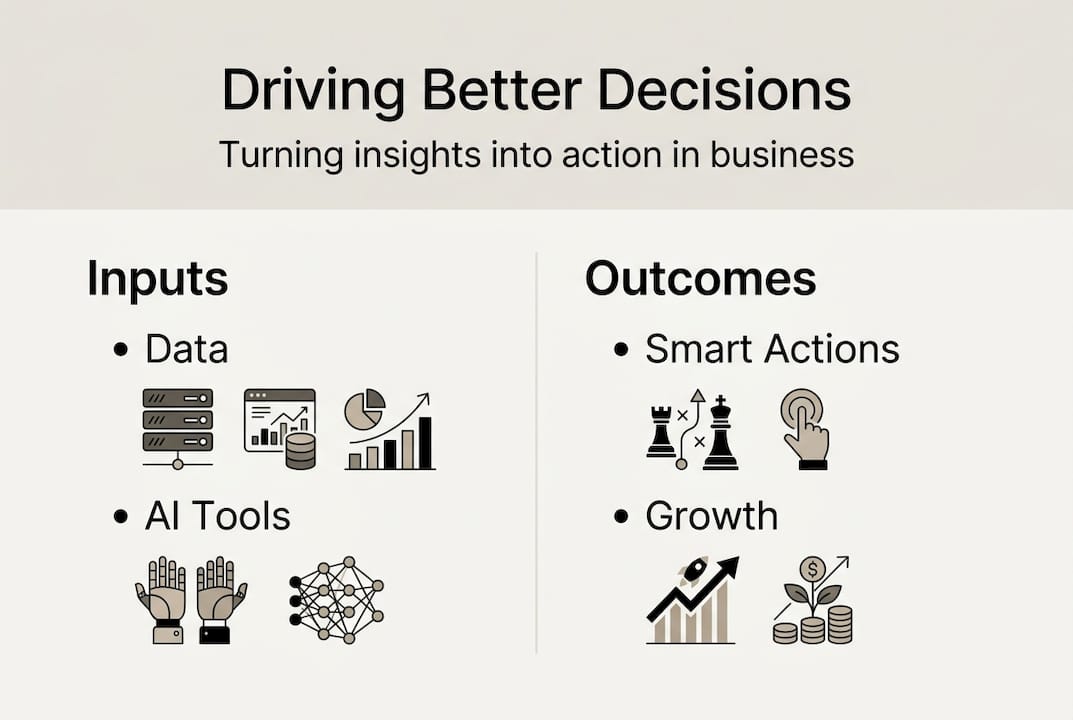
The shift from data collection to insight-driven action is already underway. AI use in marketing currently sits at 17.2% and is projected to reach 44.2% within three years. Teams adopting AI-assisted research are already seeing measurable results: sales productivity up 8.6%, customer satisfaction up 8.5%, and overhead costs down 10.8%.
Those numbers reflect something important. AI doesn't just speed up analysis. It changes the quality of questions teams can ask.
Here's how the insight-to-action cycle typically works for high-performing marketing teams:
- Frame the business question. Start with a specific decision you need to make, not a vague topic to explore.
- Collect targeted data. Pull from CRM, customer interviews, behavioral analytics, and competitive signals.
- Identify patterns and anomalies. Use AI tools to surface what's unusual or consistent across segments.
- Apply human judgment. Contextualize findings against market conditions, brand strategy, and customer psychology.
- Formulate the insight. State the why and the recommended action in one clear sentence.
- Test and iterate. Run the action, measure the outcome, and refine the insight.
| Marketing application | Insight type | Outcome |
|---|---|---|
| Campaign optimization | Audience behavior | 20-30% lift in conversion rates |
| Product messaging | Competitive positioning | Faster product-market fit |
| Customer retention | Churn prediction | Reduced acquisition costs |
| Pricing strategy | Price sensitivity | Higher margin per transaction |
For teams exploring driving growth with market insights, the pattern is consistent: the teams that win aren't the ones with the most data. They're the ones with the clearest process for turning data into decisions. Streamlining that process with a structured rapid marketing research process cuts weeks off the typical insight cycle.
Data, intuition, and AI: Striking the right balance in decision-making
Real-world cases highlight outcomes, but the true power of insights depends on how decisions are made. Let's break down the roles of AI, intuition, and analytics.
Data-driven decision-making has a real weakness that rarely gets discussed: analysis paralysis. When every decision requires statistical significance and stakeholder sign-off, speed suffers. Meanwhile, markets move. Competitors launch. Customers churn.
"Data-driven decisions offer objectivity but risk analysis paralysis. Intuition excels in uncertainty and speed. The best outcomes come from balancing both." — Business Analytics Institute
Intuition isn't the enemy of rigor. It's the product of experience. A seasoned marketing leader who senses that a campaign message will land flat isn't guessing randomly. They're pattern-matching against years of market exposure. The risk is when intuition operates without any data check, and when data operates without any human check.
AI sits in an interesting middle position. It accelerates pattern recognition at a scale no human team can match. But as marketing insights research makes clear, over-reliance on automated analysis can stifle the creative interpretation that produces breakthrough insights.
The most effective teams use AI to:
- Surface unexpected patterns across large datasets
- Reduce time spent on manual data cleaning and synthesis
- Run multiple analytical scenarios simultaneously
- Flag anomalies that warrant deeper human investigation
But they rely on human judgment to decide which patterns matter, what context changes the interpretation, and which action is worth the risk.
Pro Tip: When a data finding and your gut instinct conflict, don't default to either. Use the tension as a prompt to ask a better question. That friction often leads to the most valuable insights.
For teams building this capability, agile audience research methods offer a practical framework. Pairing fast qualitative interviews with quantitative signals gives you both the numbers and the narrative. Platforms built as AI-native research tools are designed specifically to support this kind of hybrid workflow. Grounding your analysis in an original customer research study adds a layer of proprietary context that generic benchmarks can't provide.
Why most teams still miss the mark: The overlooked art of interpretation
Even well-resourced teams with strong tools and clean data regularly produce findings that don't change behavior. The bottleneck isn't technology. It's interpretation.
How analysts define variables, frame questions, and choose which data to include all shape the insight that emerges. Analyst choices significantly impact results, and crowdsourced analysis shows high variability even when teams work from the same dataset. Transparency about those choices isn't optional. It's what separates trustworthy insights from confident-sounding guesses.
Teams that outperform don't just run better tools. They debate findings. They pressure-test interpretations. They ask whether the insight would hold if one key assumption changed. That culture of healthy skepticism is harder to build than any tech stack, but it's the real competitive advantage.
The uncomfortable truth is that insight quality is a human skill. AI can accelerate the process. Dashboards can organize the inputs. But the moment of genuine understanding, where data becomes direction, still requires a person willing to think critically and question the obvious answer. Investing in strategic research approaches that build this culture pays compounding returns over time.
Accelerate your business insights with Gather
These lessons matter most when you can put them into action. Gather is built for exactly that.
Gather's AI-native platform automates the heavy lifting of research design, interview execution, and insight delivery, so your team spends less time processing and more time deciding. Whether you're running competitive analysis, customer discovery, or segmentation research, Gather turns complex business questions into board-ready findings in days. Explore the business use cases most relevant to your team, or start with an original research study to build a proprietary insight foundation your competitors don't have access to.
Frequently asked questions
How are business insights different from analytics or reporting?
Business insights go beyond reporting what happened. They explain why it matters and guide what you should do next, making them directly actionable rather than descriptive.
Why is human judgment important for business insights?
Human judgment ensures insights are relevant, novel, and contextual. Automated tools can surface patterns, but they can't decide which patterns matter for your specific strategy and goals.
What's a common mistake when using business insights in marketing?
A frequent mistake is pulling in too much data at once. More data creates noise rather than clarity, making it harder to identify the one finding that should drive your next decision.
How does AI affect the quality of marketing insights?
AI speeds up pattern recognition and reduces manual analysis time, but the best insights still depend on human-led interpretation. AI adoption in marketing improves productivity, yet organizational readiness and critical thinking remain the deciding factors in insight quality.