

TL;DR:
- Insight delivery turns raw data into timely, actionable recommendations that drive decisions.
- A structured process involving clear questions, analysis, context, and accountability boosts performance.
- Organizational culture and accountability are critical for ensuring insights lead to meaningful action.
Most marketing teams are drowning in data but starving for direction. Dashboards multiply, reports stack up, and yet the question "what should we actually do next?" goes unanswered. The gap between collecting data and acting on it is where competitive advantage is won or lost. Insight delivery is the discipline that closes that gap, turning raw numbers into clear, timely recommendations that drive real decisions. In this article, we break down exactly what insight delivery is, how the process works, where it creates measurable ROI, and how your team can start implementing it today.
Table of Contents
- Defining insight delivery: More than data sharing
- How the insight delivery process works
- Insight delivery in action: Marketing use cases
- Measuring impact: Metrics and benchmarks for success
- The hidden challenge: Why 'insights' often go unused
- Accelerate your success with Gather's insight delivery solutions
- Frequently asked questions
Key Takeaways
| Point | Details |
|---|---|
| Insight delivery defined | It is the process of turning raw data into timely, actionable recommendations for teams. |
| Proven business impact | Applied insight delivery brings up to 86% better performance and 7X ROI within months. |
| AI accelerates success | AI reveals patterns and makes predictive recommendations for more impactful actions. |
| Benchmarks matter | Tracking the right metrics shows the true value and optimization opportunities of insight delivery. |
Defining insight delivery: More than data sharing
Let's get precise. Insight delivery is the structured process of transforming data into timely, actionable recommendations that reach the right decision-maker at the right moment. It is not the same as data delivery, which hands off raw numbers without context. It is not the same as reporting, which tells you what happened. Insight delivery answers two harder questions: why did it happen, and what should you do next?
This distinction matters more than most teams realize. Insight-led marketing explains the "why" behind performance shifts, enabling predictive strategy rather than reactive metrics. That shift from reactive to proactive is the entire value proposition.
Here is a quick comparison to make the difference concrete:
| Type | What it delivers | Example |
|---|---|---|
| Data delivery | Raw numbers | "CTR dropped 12% this week" |
| Reporting | Summary of what happened | "Q2 email performance declined" |
| Insight delivery | Actionable recommendation | "Segment A disengaged after price change; test a loyalty offer" |
The four elements that separate a true insight from a data point are:
- Context: The finding is placed within the business situation it affects
- Actionability: It suggests a specific next step or decision
- Relevance: It speaks directly to a current priority or question
- Timing: It reaches the decision-maker before the window to act closes
When all four are present, insight delivery becomes a powerful driver of better decisions across campaigns, product launches, and customer strategy. When even one is missing, the finding sits in a slide deck and collects dust.
Insight delivery also enables personalization at scale. When your team understands not just what customers did but why they did it, you can tailor messaging, offers, and timing with precision. That is the difference between a campaign that resonates and one that gets ignored.
Pro Tip: Before sharing any finding with a stakeholder, ask yourself: "Does this suggest a specific action?" If the answer is no, you have data, not an insight. Reframe it until it points somewhere.
How the insight delivery process works
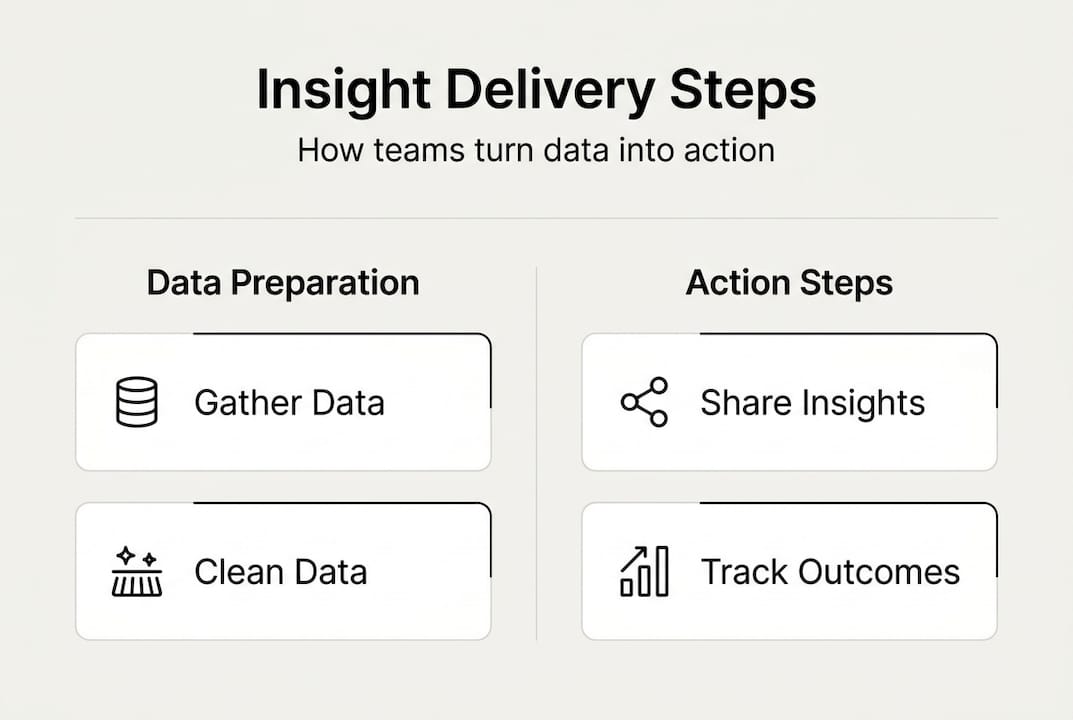
Top-performing teams do not stumble into great insights. They follow a repeatable process. Here is how the end-to-end workflow actually looks:
- Define the business question. Everything starts with clarity on what decision needs to be made. Vague questions produce vague insights.
- Gather relevant data. Pull from CRM records, survey responses, behavioral analytics, or qualitative interviews, depending on the question.
- Analyze and identify patterns. This is where AI earns its place. Machine learning models surface non-obvious correlations and flag anomalies that human analysts would miss or take weeks to find.
- Contextualize findings. Analysts layer in market conditions, competitive dynamics, and historical benchmarks so the numbers mean something.
- Formulate actionable recommendations. The insight is packaged with a clear "so what" and a suggested next step.
- Deliver to the right stakeholder. Format and channel matter. A CMO needs a one-page summary. A campaign manager needs a tactical brief.
- Facilitate action and track outcomes. Close the loop by monitoring whether the recommended action was taken and what results followed.
The role of AI in this process is not to replace human judgment. It is to accelerate steps two through four so that human experts can spend their time on steps five through seven, where interpretation and persuasion actually live. Following a structured rapid insights process compresses timelines without sacrificing depth.

The business case for this workflow is well-documented. Teams that apply structured insight delivery have seen 86% performance lift, 7X ROI in three months, and 52% faster lead conversion.
| Metric | Benchmark lift |
|---|---|
| Campaign performance | Up to 86% improvement |
| ROI | Up to 7X in 3 months |
| Lead conversion speed | 52% faster |
Pro Tip: Build a "closed-loop" feedback system. Feed real-world campaign results back into your models regularly. Insights that are never tested never improve, and models that are never updated drift out of alignment with reality.
Insight delivery in action: Marketing use cases
Theory is useful. Examples are better. Here is where insight delivery creates a real competitive edge for marketing teams.
Campaign personalization. Instead of segmenting by demographics alone, insight delivery tells you which message will resonate with which customer based on behavioral signals and past responses. The result is not just better open rates. It is a fundamentally different relationship with your audience.
Media mix modeling. Traditional media planning relies on historical spend data. Insight delivery layers in real-time performance signals to recommend where the next dollar should go, not where the last dollar went.
Customer journey mapping. Insight delivery identifies the specific moments where customers disengage or convert, giving your team the information needed to intervene at the right point in the funnel.
Predictive content testing. AI models can simulate how different audience segments will respond to creative variations before a campaign launches. You are delivering the right offer to the right customer at the right time, not guessing after the fact.
The common thread across all these use cases is the shift from lagging indicators to leading recommendations. Lagging indicators tell you what already happened. Leading recommendations tell you what to do before it happens. That shift is what separates teams that react from teams that lead.
The numbers back this up. Global brands applying AI-powered insights have recorded 86% performance improvements, 7X ROI, and dramatically faster lead times. One specific case study documented 7X ROI in just three months, driven entirely by acting on structured insights rather than intuition.
For teams building out their capabilities, grounding your approach in proven marketing research strategies makes the difference between a one-time win and a repeatable system. Understanding content preference analysis is one practical starting point for teams focused on engagement. A solid data-driven marketing guide can also help frame the broader strategic context.
"7X ROI in three months." That is not a theoretical ceiling. That is a documented outcome from teams that committed to structured insight delivery.
Measuring impact: Metrics and benchmarks for success
You cannot manage what you do not measure. Once your team starts investing in insight delivery, you need a clear framework for evaluating whether it is working.
Start with these four core metrics:
- ROI per campaign cycle. Track revenue or pipeline generated relative to research and execution costs. Benchmark against pre-insight delivery baselines.
- Lead conversion speed. How many days does it take from first touch to qualified lead? A 52% reduction is achievable with structured insights guiding targeting and messaging.
- Engagement rate. Click-through, open, and response rates tell you whether your insights are translating into more relevant communications.
- Campaign effectiveness score. A composite metric that combines performance lift, reach efficiency, and conversion rate into a single trackable number.
Here is a benchmark table to orient your team:
| KPI | Baseline (no insight delivery) | With insight delivery |
|---|---|---|
| Campaign performance lift | 0% | Up to 86% |
| ROI | 1X | Up to 7X |
| Lead conversion speed | Standard | 52% faster |
| Engagement rate | Industry average | Significantly above average |
Teams that review these metrics on a monthly cadence, rather than quarterly, catch underperformance early and adjust faster. Reviewing ad testing results alongside brand health metrics gives you both the short-term and long-term picture.
The 86% improvement and 7X ROI figures are not outliers. They represent what happens when teams stop treating insights as a deliverable and start treating them as a driver of continuous improvement.
Implement regular review cycles. Assign someone to own each metric. Tie performance reviews to outcomes, not just activity.
The hidden challenge: Why 'insights' often go unused
Here is something most articles on this topic skip entirely. The biggest obstacle to insight delivery is not technology. It is not data quality. It is organizational behavior.
We have seen teams invest heavily in research platforms and still watch insights sit untouched in shared folders. Why? Because no one owns the action. The insight arrives, it impresses the room, and then everyone goes back to what they were already doing.
The uncomfortable truth is that insight delivery is a cultural and operational challenge as much as a technical one. Teams that treat it as a software problem will be disappointed. Teams that pair the technology with clear accountability structures, defined decision rights, and psychological safety to act on uncomfortable findings, those are the teams that see actionable insights actually move the needle.
The advantage does not go to the team with the best data. It goes to the team with the clearest process for turning data into decisions, and the discipline to follow through.
Pro Tip: For every insight delivered, assign one owner and one deadline. If an insight does not have a named person responsible for acting on it within a defined timeframe, it will not get acted on. Tie that accountability to an outcome metric so the loop actually closes.
Accelerate your success with Gather's insight delivery solutions
If the gap between data and action sounds familiar, you are not alone. Most marketing and business teams are sitting on more research capacity than they realize, they just need the right infrastructure to activate it.
Gather's AI-native platform is built specifically for teams that need to move from business question to board-ready insight in days, not months. Whether you are running AI-moderated interviews, mapping customer journeys, or benchmarking campaign performance, Gather handles the entire research lifecycle automatically. Start with the Customer Research Crisis study to understand where most teams lose momentum, explore Gather use cases tailored to your industry, or take a closer look at the Gather platform to see how it fits your workflow.
Frequently asked questions
How is insight delivery different from regular business intelligence?
Insight delivery goes beyond reporting numbers by providing actionable recommendations and predictive strategy that explain the "why" behind performance and point toward the next best action.
What ROI can be expected from insight delivery?
Benchmarked teams have seen up to 7X ROI and 86% performance improvements within a single campaign cycle of implementing structured insight delivery.
What's the first step for implementing insight delivery?
Start by defining the specific business question your team needs to answer, then align stakeholders around which decisions require faster, deeper strategic input before selecting tools or methods.
How does AI improve insight delivery?
AI detects patterns and predicts outcomes at a speed no human team can match, accelerating the translation of raw data into actionable insights and freeing analysts to focus on interpretation and decision facilitation.