

TL;DR:
- Scalable market intelligence provides continuous, real-time insights that adapt to evolving business needs.
- It uses automation, AI, and integration to deliver faster, flexible, and cost-effective market data.
- Organizations leveraging this approach make quicker decisions, improve campaign relevance, and stay ahead of competitors.
Traditional market research is becoming obsolete faster than most leaders realize. By the time a quarterly study wraps up, the market has already shifted. Scalable market intelligence changes that equation entirely. Instead of waiting months for a final report, your team gets continuous, AI-driven insights that keep pace with real business decisions. This article breaks down what scalable market intelligence actually means, how the platforms behind it work, and what separates companies that use it effectively from those still stuck in slow research cycles.
Table of Contents
- Defining scalable market intelligence
- How scalable market intelligence platforms work
- Scalable market intelligence vs. traditional market research
- How leading companies use scalable market intelligence
- Our perspective: The hidden challenge and true opportunity
- Next steps: Transform your market intelligence
- Frequently asked questions
Key Takeaways
| Point | Details |
|---|---|
| Definition clarified | Scalable market intelligence is about delivering fast, actionable insights at enterprise scale using AI and automation. |
| AI-driven advantage | AI platforms enable rapid data analysis, empowering leaders to act on market changes with unmatched speed. |
| Real-world impact | Leading businesses improve campaigns, product launches, and customer understanding through scalable intelligence strategies. |
| Avoid common traps | Success requires the right mindset and clear goals, not just new technology. |
Defining scalable market intelligence
Scalable market intelligence is the ability to gather, analyze, and act on market data at any volume or speed your business requires, without proportionally increasing cost, headcount, or time. The word "scalable" is doing a lot of work here. It does not just mean handling more data. It means your research process can expand across geographies, customer segments, and business questions without breaking down or requiring a full team rebuild.
According to Gather's AI-native research engine, scalable market intelligence in the marketing industry specifically refers to systems that adapt dynamically to changing research needs while delivering consistent, structured output. That is a meaningful distinction from legacy approaches, which are typically rigid and project-bound.
The core components of a scalable system include:
- Automation: Study design, data collection, and reporting happen without heavy manual intervention
- Real-time data: Insights are generated as data flows in, not weeks after fieldwork closes
- Integration: The platform connects to existing tools like CRMs, POS systems, and customer databases
- Adaptability: Research methodology adjusts based on the question, audience, and urgency
For business leaders managing multiple markets and product lines, these components are not nice-to-haves. They are operational requirements.
Traditional research projects often take 6 to 12 weeks to complete. By that point, the strategic window the research was meant to inform has already closed.
The contrast with traditional market research is stark. Legacy approaches rely on fixed methodologies, manual analysis, and siloed data. Scalable intelligence platforms treat research as a continuous process, not a one-time project. That shift in thinking is what allows organizations to move from reactive to proactive decision-making.
Examples of scalable processes include automated survey deployment across customer segments, AI-moderated interviews that run in parallel across time zones, and real-time dashboards that surface competitive signals without analyst intervention.
How scalable market intelligence platforms work
After framing what scalable market intelligence is, it helps to understand how these platforms actually deliver results. The architecture is more straightforward than it sounds, but the execution is where most organizations either win or struggle.
A typical scalable intelligence platform operates in a clear sequence:
- Define the business question: The platform converts your strategic question into a structured research design, selecting the right methodology automatically
- Identify and reach the audience: Integration with CRM or POS data allows precise targeting of specific segments, whether that is churned users, B2B buyers, or Gen Z customers
- Execute data collection: AI-moderated interviews, surveys, or behavioral tracking run simultaneously across your audience without manual facilitation
- Analyze in real time: As responses come in, the platform structures and codes qualitative data, identifies patterns, and flags key themes
- Deliver actionable output: Reports are generated in branded, board-ready formats, often within days of launching the study
The role of AI here is not cosmetic. AI interview tools enable adaptive probing, meaning the platform asks follow-up questions based on what a respondent says, just like a skilled human moderator would. That depth of insight at scale was previously impossible without enormous fieldwork budgets.

Marketing professionals who leverage market intelligence for ROI consistently point to integration as the most underrated feature. When the platform talks to your existing data systems, you eliminate the painful process of stitching together data from five different sources after the fact.
Pro Tip: Avoid pilot paralysis by setting a hard deadline on your evaluation phase. Pick one specific business question, run a full cycle on the platform, and measure the output quality against your current process. If it delivers faster and cleaner insights, you have your answer. Endless trials without defined success criteria are how organizations stay stuck.
Scalable market intelligence vs. traditional market research
With a clear picture of how these platforms work, it is worth comparing scalable intelligence directly against legacy research methods. The differences go beyond speed.
| Dimension | Traditional research | Scalable market intelligence |
|---|---|---|
| Timeline | 6 to 12 weeks per study | Days to 2 weeks |
| Cost structure | High fixed cost per project | Variable, scales with usage |
| Data scope | Single question, single moment | Continuous, multi-segment |
| Methodology flexibility | Fixed at project start | Adaptive throughout |
| Output format | Static reports | Dynamic dashboards and branded decks |
| Integration | Manual data merging | Native CRM and POS connectivity |
The business impact of that timeline difference is significant. A product team preparing for a launch cannot wait 10 weeks for customer validation. A marketing leader responding to a competitive move needs insight in days, not a quarter. Marketing research strategies built around legacy timelines simply cannot support the pace of modern business.
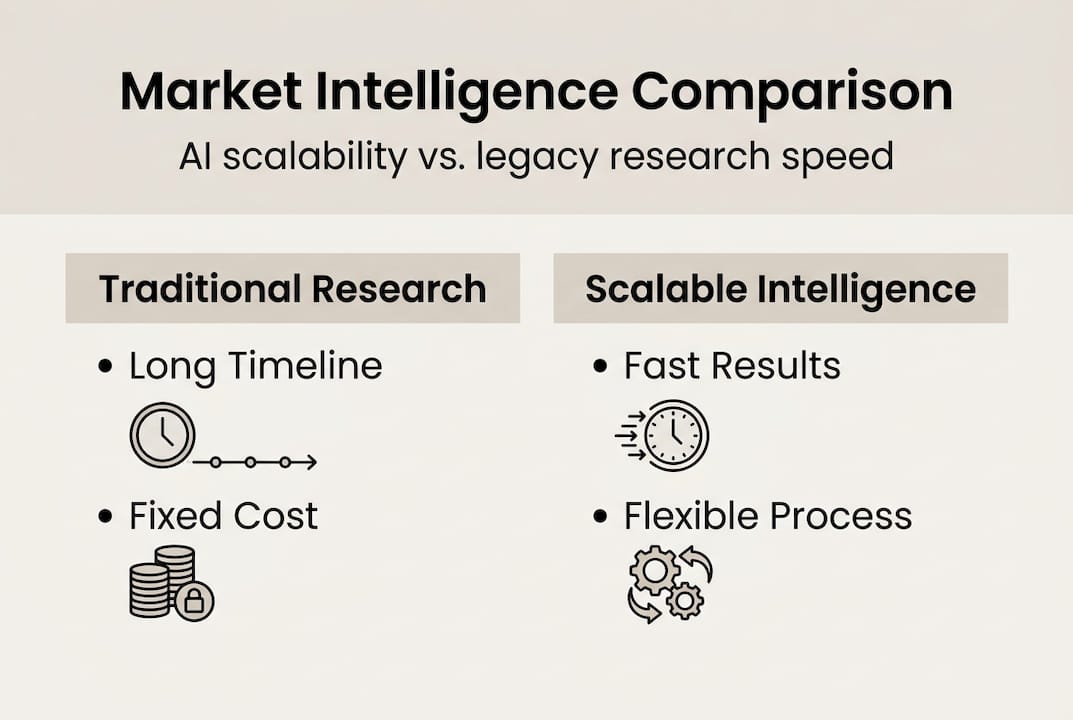
The cost structure difference is equally important. Traditional research charges a flat fee per project regardless of how much of the output you actually use. Scalable platforms charge based on what you run, which means you can run smaller, more targeted studies more frequently instead of consolidating everything into one massive annual project.
Consider a consumer goods company that previously ran two large segmentation studies per year. After switching to a scalable platform, they ran eight targeted studies across different product lines and regions in the same period, at comparable total cost. The result was faster campaign pivots and better-informed product decisions. Market intelligence examples like this are becoming the standard expectation, not the exception.
One data point worth noting: companies that shift to continuous intelligence models report a measurable improvement in campaign relevance and a reduction in wasted research spend, because insights are tied directly to active decisions rather than scheduled reporting cycles.
How leading companies use scalable market intelligence
Comparisons are useful, but real-world application is where the value becomes concrete. Leading organizations are using scalable market intelligence across a wide range of strategic functions.
Common applications include:
- Customer segmentation: Running continuous audience studies to track how segment needs shift across seasons, regions, or economic conditions
- Competitive tracking: Monitoring how customers perceive competitor moves in near real time, without waiting for a quarterly brand tracker
- Product launches: Validating messaging, pricing sensitivity, and feature priorities with target buyers before committing to full-scale campaigns
- Churn analysis: Interviewing churned customers at scale to identify patterns that inform retention strategy
The data behind these use cases is compelling. Organizations using market intelligence use cases at scale consistently report faster time-to-insight, which translates directly into faster campaign execution and reduced risk on major decisions.
| Use case | Typical outcome |
|---|---|
| Pre-launch messaging validation | 30% reduction in post-launch creative revisions |
| Competitive perception tracking | Faster response to competitor positioning shifts |
| Churn interview programs | Clearer retention levers identified within weeks |
| Segment-level needs analysis | More precise targeting in paid and owned channels |
How do leaders actually turn these insights into action? The best teams build a direct link between research output and decision workflows. Insights do not sit in a report folder. They flow into campaign briefs, product roadmaps, and executive presentations. Platforms that generate business insights in structured, board-ready formats make that handoff much easier.
The key challenge to watch for is insight overload. When a platform generates data continuously, teams can become reactive to every signal rather than focusing on the questions that matter most. High-performing organizations set a clear research agenda at the start of each quarter and use the platform to answer those specific questions, rather than letting data availability drive the agenda.
Our perspective: The hidden challenge and true opportunity
Most conversations about scalable market intelligence focus on the technology. That is the wrong place to start.
The organizations that get the most value from these platforms are not the ones with the most sophisticated tech stack. They are the ones that have done the harder work of aligning on what questions actually matter. We have seen companies deploy powerful AI research platforms and still produce mediocre insights, because no one stopped to ask: what decision does this research need to support?
The common traps are predictable. Over-automating without human review of edge cases. Ignoring context that does not show up in structured data. Treating every insight as equally urgent. These are process and culture failures, not technology failures.
The counterintuitive lesson is this: start with the decision, not the data. Before you run a single study, write down the specific action you will take based on what you learn. That discipline forces clarity and makes smarter decisions with market intelligence the natural output, not the hopeful outcome.
High-maturity companies treat market intelligence as an ongoing strategic function, not a research project. That mindset shift is what separates leaders from laggards.
Next steps: Transform your market intelligence
If the gap between your current research process and what scalable market intelligence can deliver feels significant, you are not alone. Most marketing and business leaders are operating with tools and timelines that were designed for a slower world.
Gather is built specifically to close that gap. From AI-moderated interviews to automated, board-ready reporting, the platform gives your team the speed and depth that modern decisions require. Explore the Gather platform to see how it works end to end, review Gather use cases that map directly to your industry, or download the Customer Research Crisis study to understand the full cost of slow research. The shift from project-based research to continuous intelligence is closer than most teams think.
Frequently asked questions
What does 'scalable' mean in market intelligence?
'Scalable' means the ability to grow research processes and insights to accommodate more data, broader audience needs, and faster decision cycles without significant increases in manual effort or cost, as defined by AI-native research platforms.
How does AI enhance market intelligence?
AI automates data collection, adaptive questioning, and real-time analysis, giving business leaders faster, richer insights than any manual process can match at scale.
What's the difference between market research and market intelligence?
Market research answers a specific, time-bound question, while market intelligence provides continuous, integrated insight streams that support ongoing strategic decision-making across the organization.
Can small teams benefit from scalable market intelligence?
Yes. Automation and AI-driven platforms remove the need for large research operations, making sophisticated market intelligence accessible and efficient even for lean marketing teams.