

TL;DR:
- Market intelligence is a continuous process of analyzing external forces to inform strategic decisions.
- Using AI tools to automate data collection improves insights and increases profitability by 18 to 22%.
- Effective practice involves clear objectives, integrated data, and timely analysis to avoid silos and delays.
Market intelligence is widely mistaken for a glorified data dump, a quarterly report that sits in a shared drive and collects digital dust. That misunderstanding costs organizations real money. AI-enhanced market intelligence is linked to 18 to 22% higher profitability, a gap that separates companies that act on insight from those that merely collect it. This guide breaks down what market intelligence actually means, which frameworks deliver results, how to measure ROI, and how modern AI tools are compressing timelines that used to take months into days. If you lead a marketing or business team, this is the playbook you need.
Table of Contents
- What is market intelligence?
- Key market intelligence frameworks and tools
- How market intelligence drives results: ROI and practical impact
- Best practices for efficient market intelligence
- Fresh perspective: Why most market intelligence misses the mark
- How Gather empowers your market intelligence journey
- Frequently asked questions
Key Takeaways
| Point | Details |
|---|---|
| Actionable insights matter | Market intelligence means turning data into valuable decisions, not just gathering information. |
| Frameworks drive clarity | Using tools like SWOT and Porter’s Five Forces ensures your analysis is focused and repeatable. |
| AI boosts profitability | Automated, AI-driven market intelligence is proven to deliver up to 22% higher profits. |
| Efficiency is key | Tiered data collection and cross-functional teams prevent common intelligence failures. |
| Action over analysis | The real benefit comes when organizations act on intelligence quickly and decisively. |
What is market intelligence?
Market intelligence is the ongoing process of collecting, analyzing, and applying data about the forces shaping your market: competitors, customers, regulatory shifts, and macro trends. The word ongoing matters. This is not a one-time project. It is a continuous system that feeds strategic decisions at every level of your organization.
Many leaders confuse market intelligence with related disciplines. Here is a quick breakdown:
- Market intelligence monitors the broader environment continuously, covering competitors, industry trends, and customer sentiment across time.
- Marketing research is project-based and answers specific questions, such as how customers respond to a new product concept.
- Business analytics focuses on internal performance data, like sales conversion rates or operational efficiency metrics.
All three matter. But market intelligence is the only one that gives you a persistent, outward-facing view of the competitive landscape. It is your radar, not just your rearview mirror.
The strategic value is direct. When you understand market intelligence examples from real organizations, a pattern emerges: leaders who act on structured intelligence spot opportunities earlier, mitigate risks before they become crises, and optimize resource allocation with confidence instead of guesswork.
Three analytical frameworks give structure to this work. SWOT (Strengths, Weaknesses, Opportunities, Threats) maps internal capabilities against external conditions. PESTLE (Political, Economic, Social, Technological, Legal, Environmental) scans the macro environment for forces outside your control. Porter's Five Forces evaluates the competitive intensity of your industry by examining supplier power, buyer power, new entrants, substitutes, and rivalry. Competitive analysis frameworks like these structure both competitive and macro analysis so your team is never staring at raw data without a lens.
Pro Tip: Data overload is a real threat. Before you launch any intelligence initiative, define the decision it needs to support. A framework chosen without a clear objective produces noise, not insight.
Key market intelligence frameworks and tools
Now that we have defined market intelligence and its role, let's examine the leading frameworks and tools used to extract actionable insights.
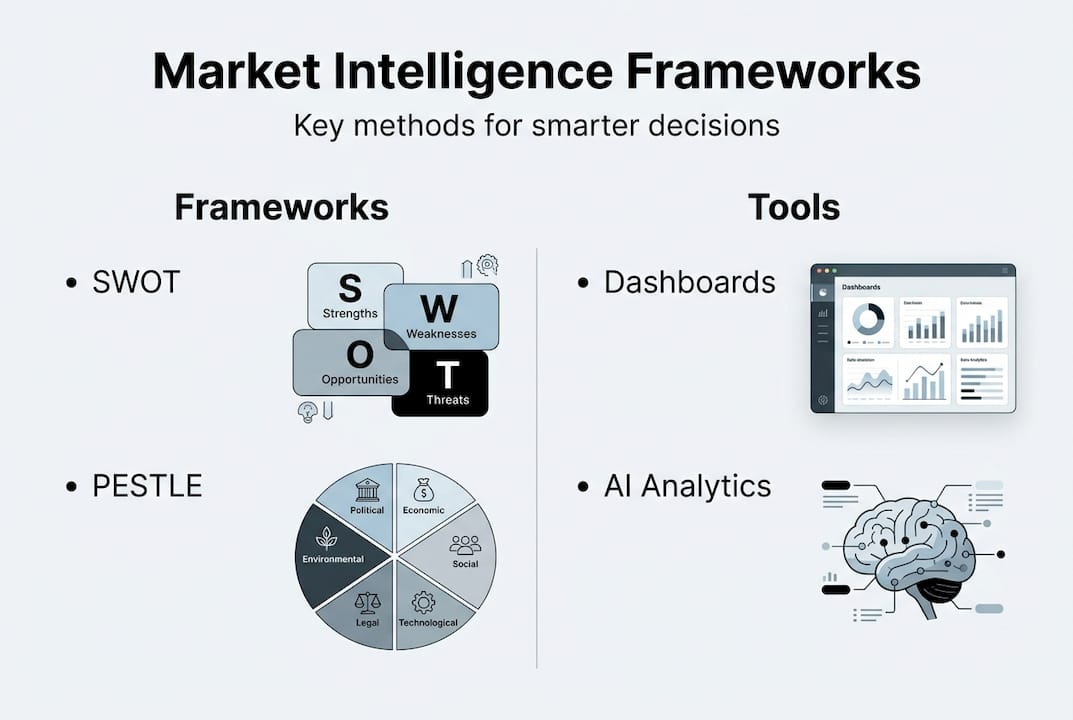
The core frameworks used by high-performing teams are Porter's Five Forces, SWOT, VRIO, Strategic Group Analysis, and PESTLE. Each serves a distinct purpose:
| Framework | Best used for | Key output |
|---|---|---|
| Porter's Five Forces | Industry attractiveness | Competitive pressure map |
| SWOT | Strategic positioning | Opportunity and risk matrix |
| VRIO | Internal capability audit | Sustainable advantage assessment |
| Strategic Group Analysis | Competitor clustering | Positioning gaps and white space |
| PESTLE | Macro environment scanning | External risk and opportunity register |
Choosing the right framework depends on the decision you are making. Entering a new market? Start with Porter's Five Forces and PESTLE. Evaluating whether to double down on a product line? VRIO tells you whether your capabilities are truly defensible. Mapping where competitors cluster? Strategic Group Analysis reveals the gaps worth targeting.
Modern tools have changed how quickly teams can move through these frameworks. AI-driven platforms automate data collection from news feeds, social media, earnings calls, and customer reviews. Dashboard solutions surface patterns in real time instead of waiting for a monthly analyst report. Understanding the full marketing research process steps helps teams sequence these tools correctly so nothing falls through the cracks.
The practical setup looks like this:
- Weekly tactical feeds: Monitor competitor pricing, social sentiment, and news mentions.
- Monthly synthesis: Identify emerging patterns across tactical data.
- Quarterly strategic reviews: Run full framework analyses to update positioning and resource allocation.
A market intelligence platform built for this cadence removes the manual burden from your team and ensures fast insight delivery at every tier.
Pro Tip: Match your framework to your decision objective before you collect a single data point. Competitive pressure questions call for Porter's Five Forces. Macro uncertainty calls for PESTLE. Mixing them without purpose creates confusion, not clarity.
How market intelligence drives results: ROI and practical impact
With an understanding of frameworks, it is time to demonstrate their tangible benefits by exploring how market intelligence translates into financial and operational gains.
The numbers are striking. AI-enhanced market intelligence delivers 18 to 22% higher profitability compared to organizations relying on traditional or ad hoc research methods. In the grocery sector, customer and sales analytics (CSA) driven by structured market intelligence generated a weekly revenue impact ranging from €38,000 to €1.4 million through product mix optimization alone.
"Intelligent analysis transforms scattered data into strategic advantage."
Those are not outlier results. They reflect what happens when intelligence is connected to action. Here is how that plays out across industries:
| Industry | MI application | Measurable outcome |
|---|---|---|
| Retail | Competitor pricing analysis | 12% margin improvement |
| B2B SaaS | Churn pattern detection | 20% retention increase |
| Consumer goods | Trend forecasting | 30% faster product launches |
| Financial services | Regulatory monitoring | Reduced compliance risk |
The mechanisms behind these outcomes follow a consistent pattern. Better intelligence means:
- Higher margins: You price with confidence because you understand what competitors charge and what customers will pay.
- Reduced risk: Early signals from macro monitoring prevent costly strategic missteps.
- Faster response: Real-time data cuts the lag between a market shift and your team's reaction.
- Smarter resource allocation: You invest in segments and products where the data shows genuine opportunity.
The key to driving business decisions with intelligence is not having more data. It is having the right data connected to a clear decision framework. Real-world MI examples consistently show that the organizations outperforming their peers are not necessarily the ones with the biggest research budgets. They are the ones that move fastest from insight to action.

Best practices for efficient market intelligence
Having seen the results market intelligence can bring, let's cover actionable best practices to ensure your efforts are efficient and impactful.
Efficiency in market intelligence is not about doing more. It is about doing the right things in the right sequence. Here is a step-by-step setup that works:
- Define your intelligence objectives. What decisions will this data inform? Pricing? Market entry? Product prioritization? Start here, not with data sources.
- Map your data sources. Identify internal sources (CRM, POS, customer feedback) and external sources (industry reports, competitor monitoring, social listening).
- Automate collection. Use AI tools to pull from external sources continuously. Manual collection is slow and error-prone at scale.
- Integrate and centralize. Feed all sources into a single dashboard so analysts are not reconciling spreadsheets from five different systems.
- Schedule tiered reviews. Tiered data collection, with tactical reviews weekly and strategic reviews quarterly, optimizes both responsiveness and depth.
- Translate insights into actions. Every intelligence cycle should end with a clear recommendation, not just a summary.
- Measure and refine. Track whether your intelligence is actually improving decisions. Adjust sources and frameworks based on what is working.
The most common pitfalls are predictable. Information silos form when sales, marketing, and product teams each run their own research without sharing findings. Analysis delays occur when manual workflows create bottlenecks between data collection and reporting. Over-reliance on static reports means teams are always reacting to last quarter's reality instead of this week's signals.
AI and efficient insight delivery platforms solve all three problems simultaneously. Automated ingestion eliminates silos. Real-time dashboards eliminate delays. Continuous monitoring replaces static reports. The market research reports that used to take weeks to produce can now be generated in days.
Pro Tip: Build a cross-functional intelligence team that includes someone from marketing, product, and finance. Diverse perspectives catch blind spots that single-function teams miss every time.
Fresh perspective: Why most market intelligence misses the mark
Here is an uncomfortable truth most vendors will not tell you: the majority of market intelligence projects fail not because of bad data, but because of bad habits around how that data gets used.
Organizations invest heavily in tools and customer research infrastructure, then produce reports that nobody reads past the executive summary. The problem is a cultural one. Teams are rewarded for producing intelligence, not for acting on it. That incentive structure guarantees paralysis.
The real competitive advantage is not a better dashboard. It is a shorter gap between insight and decision. Smart organizations are redesigning their intelligence workflows so that every analysis cycle ends with a specific action assigned to a specific owner with a specific deadline. They are treating intelligence as a verb, not a noun.
Volume is the enemy of clarity. The organizations winning with market intelligence in 2026 are not the ones with the most data feeds. They are the ones that have ruthlessly prioritized the signals that connect directly to their top three strategic decisions. Everything else is noise, and noise is expensive.
How Gather empowers your market intelligence journey
Ready to close the gap between insight and action? Gather was built specifically for marketing and business teams that cannot afford to wait months for answers.
Gather's AI-native platform automates the entire research lifecycle, from study design and interview execution to real-time analysis and board-ready reporting. It integrates directly with your CRM and POS data so your intelligence is always grounded in your actual customers, not generic panels. Whether you need to understand churn patterns, test a new market, or map competitive positioning, explore market intelligence use cases to see how teams like yours are moving from questions to decisions in days. You can also review a customer research study to see the platform's impact in a real business context.
Frequently asked questions
What is the difference between market intelligence and marketing research?
Market intelligence is broader and ongoing, covering competitors, trends, and macro forces continuously, while marketing research is typically project-based and focused on answering a specific business question.
How do AI tools improve market intelligence outcomes?
AI automates data collection and analysis at scale, which is why AI-enabled MI is linked to 18 to 22% higher profitability compared to traditional methods.
What are the most important frameworks for market intelligence?
The core frameworks are Porter's Five Forces, SWOT, VRIO, Strategic Group Analysis, and PESTLE, each suited to a different type of strategic question.
How often should market intelligence data be updated?
A tiered collection approach works best: weekly updates for tactical monitoring and quarterly deep-dive reviews for strategic planning.
What's the main risk of poor market intelligence?
Weak or delayed intelligence creates information silos and competitive disadvantage, leaving teams unable to respond to market shifts before they become costly problems.