

TL;DR:
- Market research compliance involves ethical, legal, and professional standards beyond simple consent forms.
- Ongoing updates and integrated workflows are essential to maintain compliance in evolving regulations and AI use.
- Proper compliance enhances research quality, protects data, and reduces risks of fines, reputation damage, and invalid results.
Most marketing and business teams believe their research is already compliant. They get consent forms signed, anonymize a few fields, and move on. But market research compliance is about following ethical, professional, and legal standards to ensure integrity and protect data subjects, and that definition covers far more ground than a checkbox ever could. Regulatory frameworks are evolving fast, AI is reshaping how research gets done, and the gap between what teams assume is compliant and what actually qualifies is growing. This guide walks through what compliance really requires, where teams typically stumble, and how to build it into your research process from the start.
Table of Contents
- What is market research compliance and why it's essential
- Core principles and professional standards
- Key requirements and common compliance scenarios
- Edge cases, AI, and changing requirements
- Navigating gray areas: consent, legitimate interests, and enforcement
- Why most teams miss hidden compliance risks in market research
- How Gather can help you meet market research compliance demands
- Frequently asked questions
Key Takeaways
| Point | Details |
|---|---|
| Compliance is essential | Proper compliance protects participants, builds trust, and shields your business from legal risks. |
| Follow updated standards | Stay current with codes like ICC/ESOMAR and evolving rules for AI and new data types. |
| Compliance is ongoing | Make compliance part of every research step, not just a final checklist. |
| Complex cases need care | Special groups, AI, and international work demand extra attention and explicit safeguards. |
What is market research compliance and why it's essential
Market research compliance means adhering to ethical, legal, and professional standards across every stage of your research, from study design to data storage to reporting. It is not a single law or a single document. It is a layered set of obligations that spans international codes, national privacy laws, and industry self-regulation.
The core goals are straightforward. You want to build trust with participants, protect the data you collect, and ensure your findings are credible and usable. As the international research code puts it, market research compliance ensures integrity, transparency, trust, and data protection. That is the foundation everything else rests on.
Why does this matter for your team specifically? Consider what is at stake:
- Regulatory fines that can reach 4% of global annual turnover under GDPR
- Reputational damage that erodes customer trust and partner confidence
- Invalidated research that cannot be used because data was collected improperly
- Legal liability for your organization and individual researchers
Non-compliance is rarely intentional. It usually happens because teams rely on outdated templates, skip data protection impact assessments, or assume that anonymizing data at the output stage covers them throughout the process. It does not.
The compliance landscape is also shifting. The 2025 update to the ICC/ESOMAR Code introduced new rules specifically addressing AI-generated and synthetic data, protections for vulnerable groups, and guidance for cross-border research. If your team produces market research reports or runs ongoing trackers like a brand health compliance program, these updates apply to you directly.
"Compliance is not a legal department problem. It is a research quality problem. When your data collection process fails ethical or legal standards, your insights are built on a cracked foundation."
The good news is that compliance, done right, actually improves research quality. Transparent consent processes increase response honesty. Proper data governance makes findings more defensible. And teams that embed compliance early spend far less time fixing problems later.
Core principles and professional standards
Every major compliance framework shares a common set of principles. Knowing them gives you a mental model that applies whether you are working under GDPR, the ICC/ESOMAR Code, or the MRS Code of Conduct.
The core principles include researcher responsibility, transparency, and legal compliance, as outlined in the ICC/ESOMAR International Code. In practice, this means:
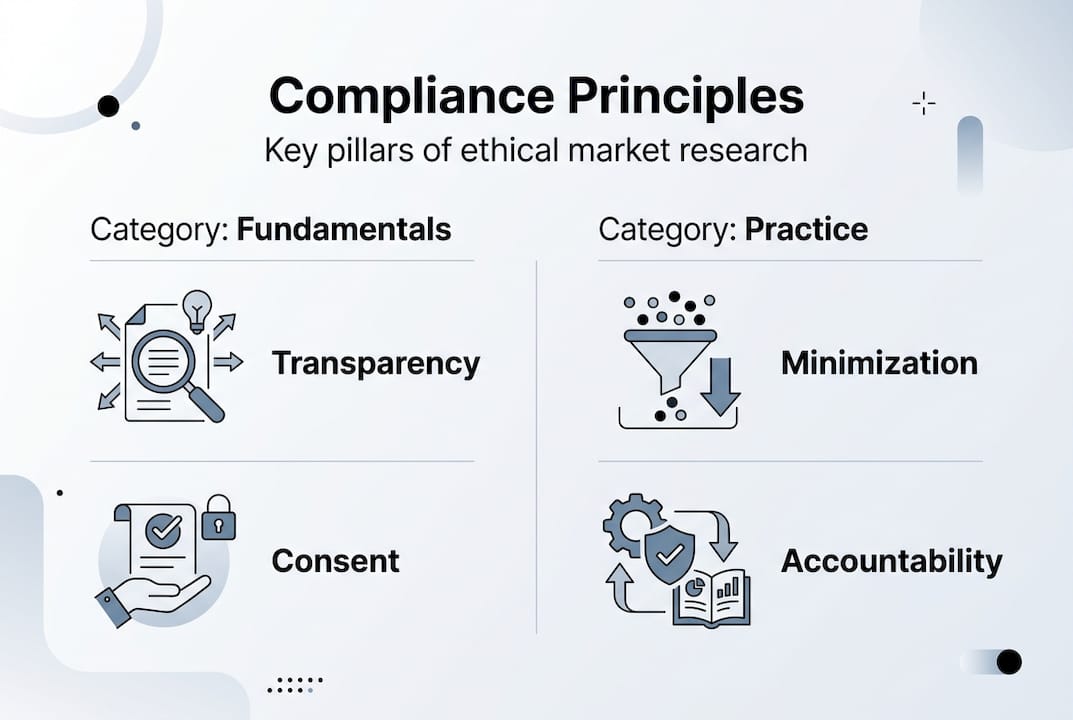
Informed consent: Participants must know what data you are collecting, why, and how it will be used before they agree to take part.
Data minimization: Collect only what you actually need. Holding excess data increases risk without adding research value.
Transparency: Be clear about who is conducting the research, what the purpose is, and how results will be used.
Accountability: Someone in your organization must own compliance. That means documented processes, not just good intentions.
It helps to understand where legal requirements end and self-regulatory standards begin. The table below breaks this down:
| Standard | Type | Scope | Key focus |
|---|---|---|---|
| GDPR | Legal | EU and EEA data subjects | Lawful basis, data rights, security |
| ICC/ESOMAR Code | Self-regulatory | Global | Ethics, transparency, participant rights |
| MRS Code of Conduct | Self-regulatory | UK | Professional conduct, B2B research guidelines |
| ISO 27001 | Standard | Global | Information security management |
Self-regulatory codes often go further than the law requires. The MRS, for example, sets standards around how researchers communicate with participants that exceed what GDPR technically mandates. Following only the legal minimum is a risk strategy, not a compliance strategy.
Pro Tip: When building your marketing research strategies, map each research activity to both the relevant legal requirement and the applicable self-regulatory standard. This dual-layer check catches gaps that single-framework reviews miss.
The 2025 ICC/ESOMAR update added specific guidance on AI use, requiring researchers to disclose when AI is involved in data collection or analysis, and to document the logic behind automated decisions that affect participants.
Key requirements and common compliance scenarios
Understanding principles is useful. Knowing what they look like inside an actual research project is what saves you from problems. Here is how compliance requirements map to typical research process steps.
The most common requirements your team will encounter include:
- Informed consent collection before any data is gathered, with a clear record of when and how consent was given
- Data minimization review during study design to remove unnecessary personal identifiers
- Legal basis documentation for each data processing activity, especially for cross-border projects
- Data Protection Impact Assessments (DPIAs) for high-risk research involving sensitive categories or large-scale profiling
- Secure storage protocols aligned with ISO 27001 or equivalent standards
- Audit trails that log who accessed data, when, and for what purpose
As the GDPR market researcher's guide makes clear, compliance requires informed consent, data minimization, proper legal grounds, and secure storage. These are not optional extras for large enterprises. They apply to any organization collecting personal data from EU residents, regardless of company size.
Consider a practical scenario: your team runs a B2B panel with respondents from Germany, Brazil, and Singapore. Each jurisdiction has its own data transfer rules. Germany falls under GDPR. Brazil operates under LGPD. Singapore uses the PDPA. You need a documented legal basis for transferring data between these jurisdictions, not just a single consent form.

| Jurisdiction | Framework | Key transfer requirement |
|---|---|---|
| Germany (EU) | GDPR | Standard Contractual Clauses or adequacy decision |
| Brazil | LGPD | Consent or contractual necessity |
| Singapore | PDPA | Contractual protection or binding rules |
Using a data management platform that logs consent, manages data access, and supports audit trails is no longer a luxury. It is a practical necessity for teams running multi-market research. The marketing compliance guide from IntelligenceBank reinforces that audit readiness should be built into workflow design, not retrofitted after the fact.
Edge cases, AI, and changing requirements
Standard research with consenting adult participants is manageable. But what happens when your project involves AI moderation, health data, or respondents under 18? The rules shift, and the stakes go up.
AI-moderated interviews, like those used in platforms that automate qualitative research at scale, require specific disclosures. Participants must know they are interacting with an automated system. You must also document the logic behind any AI-driven decisions that affect how data is processed or interpreted. This is not just best practice. AI transparency, explicit consent for special data, and extra protections for vulnerable groups are required under current regulatory guidance.
Here is a quick breakdown of edge cases your team should plan for:
- Special category data (health, political opinions, religion): Always requires explicit consent, never just legitimate interest
- Research with minors: Parental or guardian consent is mandatory, plus additional safeguards on data retention and access
- Synthetic or AI-generated respondent data: Must be clearly labeled as such in reporting and cannot be presented as real participant responses
- International data transfers: Require documented safeguards regardless of whether the transfer feels routine
- Disguised sales approaches (sugging): Presenting a sales pitch as research is prohibited under all major codes and erodes sector-wide trust
Pro Tip: Before launching any agile audience research project, run a five-minute edge case check. Ask: does this involve special data, vulnerable groups, AI, or cross-border transfers? If yes to any, add a compliance review step before fieldwork begins.
The ESOMAR compliance standards updated in 2025 now explicitly address synthetic data and AI involvement, filling a gap that had left many teams uncertain about their obligations. Staying current with these updates is part of the job.
Navigating gray areas: consent, legitimate interests, and enforcement
The trickiest compliance decisions rarely involve clear violations. They involve judgment calls, particularly around when consent is required versus when legitimate interest applies.
Here is how to think about it. Consent is more transparent but complex for secondary research. Legitimate interests can apply unless participant rights override them, as the GDPR market researcher's guide notes. In plain terms: if you are reusing data collected for one purpose in a new study, consent is usually the safer choice. Legitimate interest requires a documented balancing test, and if participants would reasonably object, it will not hold.
Four steps to navigate this gray area:
- Document your legal basis for each processing activity before the project starts, not after
- Run a balancing test when relying on legitimate interest, and keep the record
- Distinguish anonymization from pseudonymization: truly anonymized data falls outside GDPR, but pseudonymized data (where re-identification is possible) does not
- Build escalation paths so researchers know when to flag a decision to legal or compliance teams
"The teams that get burned are not the ones who ignored compliance. They are the ones who assumed their standard process covered a non-standard situation."
Enforcement is real. GDPR violations can result in fines up to 4% of global annual turnover. Beyond fines, regulatory investigations consume time and damage relationships with clients and participants. Market intelligence examples from high-performing teams consistently show that compliance is treated as a quality input, not a legal hurdle.
Self-regulatory bodies like ESOMAR and MRS can also investigate complaints and, in serious cases, remove membership or certification. For agencies and research firms, that consequence can be as damaging as a fine.
The ethical frameworks from ICC/ESOMAR make clear that researchers carry personal responsibility, not just organizational responsibility, for the integrity of their work.
Why most teams miss hidden compliance risks in market research
Here is the uncomfortable reality: most compliance failures in market research come from teams that thought they were doing everything right. They had consent forms. They had privacy policies. They followed the same process they used last year. The problem is that last year's process was built for last year's rules.
Templates get outdated fast. The 2025 ICC/ESOMAR update, new AI disclosure requirements, and ongoing GDPR enforcement decisions have all shifted what adequate compliance looks like. A consent form written in 2023 may not cover AI-moderated interviews or synthetic data use.
The teams that consistently avoid compliance problems share one trait: they treat compliance as an ongoing, integrated part of research design, not an end-of-project checklist. They review customer research blind spots regularly, update their templates when frameworks change, and assign clear ownership for compliance decisions at the project level.
Compliance is not a one-time setup. It is a practice. Teams that build adaptability into their workflows, rather than relying on static documentation, are the ones that stay ahead of regulatory change without slowing down their research output.
How Gather can help you meet market research compliance demands
Translating compliance principles into daily research practice is where most teams struggle. Knowing the rules is one thing. Having a system that enforces them consistently is another.

Gather's AI research platform is built with compliance embedded from the start. The platform supports audit trails, secure data storage, and AI transparency disclosures as part of the standard research workflow, not as add-ons. You can explore research compliance use cases to see how teams are running compliant, AI-moderated research at scale. The 2026 research compliance study covers the latest requirements in detail. And the platform tools give your team the infrastructure to run fast, reliable, and fully compliant research without building everything from scratch.
Frequently asked questions
What is the main goal of market research compliance?
The main goal is to ensure research is conducted ethically, protecting participant data and building trust. The ICC/ESOMAR International Code defines this as ensuring integrity, transparency, and data protection across all research activities.
When do I need consent for market research?
Consent is required when collecting personal data unless you have another lawful basis, but it is always needed for special category data or research with vulnerable participants. Informed consent is a foundational requirement for lawful data collection under GDPR.
What are the risks of non-compliance in market research?
Risks include large fines, reputation damage, and the loss of public or client trust. Non-compliance fines can reach up to 4% of global annual turnover under GDPR.
How do AI and automation affect market research compliance?
AI requires transparency about its use, logic, and data handling, and may demand new safeguards. AI-moderated research must disclose automated involvement to participants and document decision logic.
What frameworks guide market research compliance?
The ICC/ESOMAR International Code, GDPR, and industry standards like MRS outline best practices. Both regulatory and self-regulatory frameworks apply, and following only the legal minimum is rarely sufficient for full compliance.