

TL;DR:
- Systematic B2B market research enables faster, smarter decisions that drive higher growth and revenue.
- Combining qualitative and quantitative methods provides deep insights and scalable validation for strategic actions.
- AI technologies drastically shorten research timelines, increasing agility and competitive advantage.
Most B2B marketing managers work hard but still struggle to find insights that actually move the needle. Meanwhile, companies using systematic market research grow 3-10x faster than those flying blind. The gap between guessing and knowing is wider than most teams realize. This guide walks you through what B2B market research really means, which methods deliver the strongest results, how AI is reshaping the research timeline, and how to turn findings into decisions that drive real revenue. Whether you're building your first research program or refining an existing one, you'll leave with a clear path forward.
Table of Contents
- What is B2B market research and why it matters
- Key methodologies for B2B market research
- Leveraging AI and technology for faster insights
- Putting B2B market research into action: Best practices
- What most B2B marketers miss about market research
- Unlock smarter market research with Gather
- Frequently asked questions
Key Takeaways
| Point | Details |
|---|---|
| Systematic research drives growth | Companies using systematic B2B market research grow up to 10 times faster than those without. |
| AI accelerates actionable insights | Advanced AI tools reduce manual work and make large-scale data analysis practical for busy teams. |
| practical application is key | Integrating research findings directly into marketing decisions gives you an edge over competitors. |
| Best practices prevent common errors | Following proven frameworks helps avoid bias and incomplete datasets, making your research results more reliable. |
What is B2B market research and why it matters
B2B market research is the structured process of collecting, analyzing, and interpreting information about your business buyers, competitors, and market conditions. The goal is simple: replace assumptions with evidence so your team makes faster, smarter decisions.
But B2B research is fundamentally different from B2C research. Consumer research targets millions of individual buyers driven by emotion and habit. B2B research focuses on smaller, harder-to-reach audiences: procurement teams, C-suite executives, IT directors, and department heads who make rational, committee-based buying decisions over months or even years. The stakes per deal are higher, the buying process is longer, and the data is much harder to collect.
Here's what well-executed B2B market research actually helps you do:
- Identify unmet customer needs before your competitors do
- Size and prioritize market segments with real numbers, not intuition
- Refine your positioning so messaging resonates with key decision-makers
- Reduce product launch risk by validating assumptions early
- Track competitor moves and shifting customer preferences in near real time
The business case is hard to ignore. Exploring marketing research strategies shows that teams with structured insight programs consistently outperform those relying on anecdotal feedback. And the market intelligence benefits go beyond marketing: better research improves product decisions, sales enablement, pricing strategy, and customer retention.
"The difference between a good year and a great decade is usually a company that knows its market better than anyone else in the room."
Leading B2B marketers treat research as a continuous business function, not a one-time project. They build feedback loops between customer conversations, market data, and strategic planning. The result is compounding: each research cycle makes the next one sharper and more valuable.
Key methodologies for B2B market research
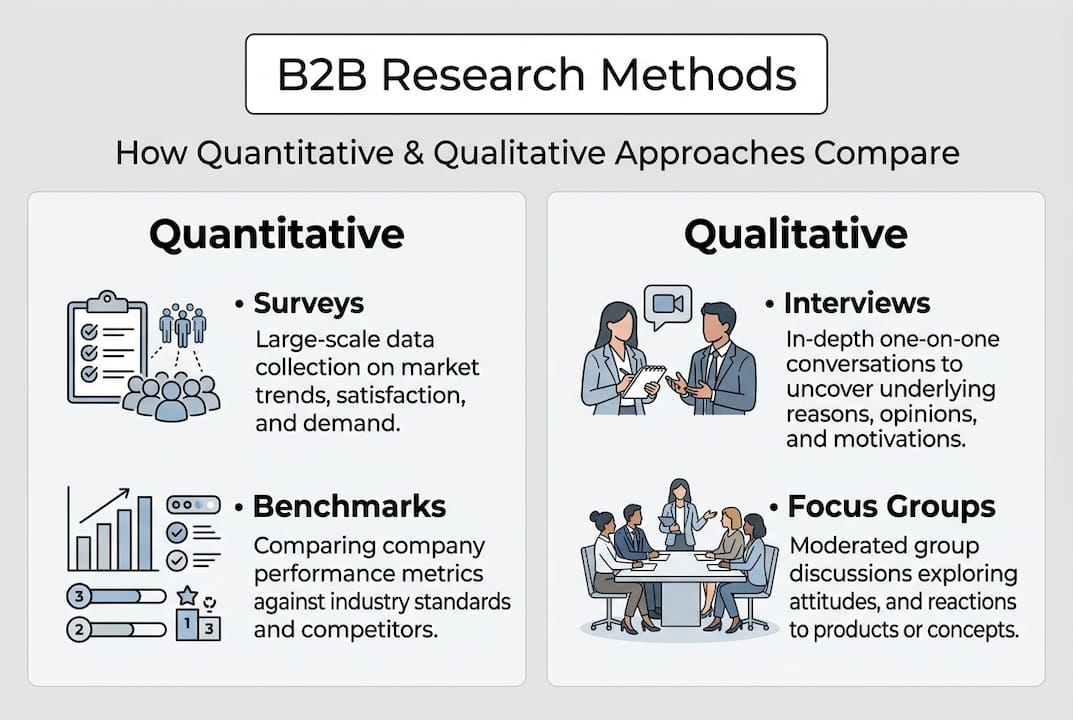
Every B2B research program draws from two broad families of methods: quantitative and qualitative. Understanding when to use each one is one of the most practical skills a marketing manager can develop.
Quantitative methods involve structured surveys, benchmarking studies, and large-sample data collection. They produce numbers you can slice, trend, and present to leadership with confidence. Qualitative methods include in-depth interviews, focus groups, and open-ended discovery sessions. They surface the "why" behind the numbers and reveal insights that no survey checkbox would ever capture.
Here's a side-by-side comparison to guide your planning:
| Method | Best for | Key strength | Limitation |
|---|---|---|---|
| Online surveys | Benchmarking, segmentation | Scalable, fast | Misses nuance |
| In-depth interviews | Needs discovery, positioning | Deep insight | Time-intensive |
| Focus groups | Concept testing, messaging | Real-time reactions | Groupthink risk |
| Secondary research | Market sizing, trends | Low cost | May be outdated |
| Competitive analysis | Positioning, pricing | Strategic clarity | Data gaps |
Practically speaking, the strongest B2B research programs combine both approaches. Start with qualitative interviews to build hypotheses, then run quantitative surveys to validate them at scale.
One of the most common questions is: how many respondents do you actually need? The right research sample size depends on your goals, but peer-reviewed data from 2013 to 2023 shows the median B2B sample is 272 respondents for quantitative studies. Chasing 1,000+ responses rarely adds proportional value in B2B contexts where your total addressable audience may only be a few thousand companies.
Here's a practical sequence for running your first integrated research project:
- Define your core business question (not just "what do customers think," but "why are we losing deals to Competitor X?")
- Choose your primary method based on whether you need depth or scale
- Design your screener to qualify the right respondents
- Pilot-test your survey or interview guide with 3 to 5 internal stakeholders
- Collect data, flag outliers, and analyze by segment
- Synthesize findings into 3 to 5 decision-ready insights
Pro Tip: Never let perfect be the enemy of useful. A 150-person survey completed in two weeks will outperform a 500-person study that takes six months to design and field.
Leveraging AI and technology for faster insights
Traditional B2B market research is slow. Recruiting respondents, running interviews, transcribing calls, coding themes, and writing reports can take eight to twelve weeks. By the time insights land in the boardroom, the market has moved.

AI changes that calculus dramatically. Platforms built on AI-native architectures can automate study design, run AI-moderated interviews with adaptive follow-up questions, and deliver structured analysis in days. The manual bottlenecks that historically consumed most of the research timeline are gone.
Here's how AI-powered tools compare to traditional approaches on key dimensions:
| Dimension | Traditional research | AI-powered research |
|---|---|---|
| Time to insight | 8 to 12 weeks | 3 to 7 days |
| Analyst hours required | High (40 to 100+) | Low (5 to 15) |
| Scalability | Limited | High |
| Depth of probing | Moderate | Adaptive and dynamic |
| Reporting format | Manual | Automated, board-ready |
The business impact is measurable. B2B marketing leaders who prioritize data-driven insights achieve 11% revenue growth versus under 1% for laggard teams. Speed is not just a convenience. It is a competitive weapon.
AI tools also enable capabilities that traditional research simply cannot replicate:
- Sentiment detection across thousands of open-ended responses in minutes
- Predictive analysis to model likely customer behavior under different scenarios
- CRM and POS integration to target research at specific segments like churned users or high-value accounts
- Real-time dashboards that let stakeholders explore findings as data comes in
Exploring the full marketing research process and reviewing market intelligence examples will show how leading teams use these tools to stay ahead.
Pro Tip: Treat AI as a research accelerator, not a replacement for judgment. Automated tools surface patterns fast, but a skilled marketer still needs to interpret findings in the context of business strategy.
The one pitfall to avoid: over-relying on automation for study design. If your research questions are poorly framed, AI will simply give you wrong answers faster. Front-load time on question design and let automation handle the heavy lifting downstream.
Putting B2B market research into action: Best practices
Collecting data is the easy part. The hard part is turning findings into decisions your organization will actually act on. Most research projects stall at the insight delivery stage because reports sit in inboxes instead of shaping strategy.
Here's a practical framework to close that gap:
- Align research goals to business decisions before you start. Every project should connect to a specific decision your team needs to make. "Understand the market" is not a goal. "Determine whether to enter the mid-market segment in Q3" is.
- Segment your findings by audience. A single monolithic report serves no one. Break insights down by persona, industry, company size, or customer lifecycle stage.
- Prioritize insights by business impact. Not every finding is equally valuable. Rank insights by how much they could shift revenue, retention, or competitive positioning.
- Build a 30-day activation plan. Assign owners, set timelines, and define how each key insight will change a campaign, product decision, or sales play.
- Track outcomes and feed them back into your next research cycle. Research only compounds in value when you close the loop between insight and outcome.
Common mistakes to watch out for:
- Confirmation bias: Designing research to validate existing beliefs rather than challenge them
- Incomplete datasets: Launching surveys without adequate segmentation, which makes findings unactionable
- Insight paralysis: Generating so much data that no clear priority emerges
- Single-point-in-time thinking: Treating a one-time study as a permanent truth in a fast-changing market
Pro Tip: Share a one-page "insight brief" with senior stakeholders instead of a 60-slide deck. One page forces prioritization and dramatically increases the chance your research actually influences a decision.
The evidence is consistent: companies that build this kind of structured, continuous research habit grow significantly faster and generate higher revenue growth than those that treat research as a periodic event. You can see this pattern repeated across market intelligence case studies and in structured programs like the brand health tracker.
What most B2B marketers miss about market research
Here's the uncomfortable truth: most B2B marketing teams treat research as a compliance activity. They run a study before a product launch, check the box, and move on. That is exactly the wrong mental model.
Research is not a pre-launch ritual. It is a continuous intelligence operation. The teams that win consistently are not the ones with the biggest research budget. They are the ones who have wired insights into every decision layer: messaging, pricing, content, sales enablement, and customer success.
The distinction between collecting data and generating actionable intelligence is real. Data says 42% of buyers cited "integration complexity" as a purchase barrier. Intelligence says your sales team should lead with a proof-of-concept integration offer on every enterprise demo.
Most marketers also underinvest in research quality and overinvest in research volume. Chasing larger samples or more frequent surveys is not the path to better decisions. Sharper questions, better-qualified respondents, and deeper analysis are. Reviewing competitive advantage strategies reveals the same pattern repeatedly: quality beats quantity every time.
Shift your mindset. Research is not a cost center. It is the fastest way to reduce the risk of expensive decisions.
Unlock smarter market research with Gather
Gather is an AI-native research platform built specifically for marketing and business teams who need insights fast without sacrificing quality. From automated study design and AI-moderated interviews to real-time analysis and board-ready reporting, Gather compresses the full research lifecycle from months into days.
Teams use Gather to run targeted research studies across precise audience segments, whether that's B2B decision-makers, churned users, or enterprise buyers in a specific vertical. The platform connects directly to your CRM and existing data sources for seamless audience targeting. Explore the full range of market research use cases or see the full platform capabilities to understand how Gather fits your existing workflow.
Frequently asked questions
How does B2B market research differ from B2C research?
B2B market research focuses on business needs, long sales cycles, and smaller sample sizes, while B2C targets consumer preferences and much larger populations. Decision-making in B2B typically involves multiple stakeholders and rational evaluation criteria rather than individual impulse.
What is the typical sample size for quantitative B2B research?
Based on peer-reviewed studies from 2013 to 2023, the median B2B quantitative sample is approximately 272 respondents. Larger samples rarely add proportional value given the narrower total addressable audiences in most B2B markets.
How does systematic market research impact business growth?
Firms using systematic research grow 3-10x faster than those without structured programs, and leading B2B marketers achieve 11% revenue growth compared to under 1% for those who deprioritize research.
What role does AI play in B2B market research today?
AI automates the most time-consuming parts of the research process, including interview moderation, data coding, and report generation, enabling teams to get actionable insights in days rather than weeks or months.
How can I use B2B market research to improve campaign performance?
By connecting research findings directly to campaign planning, you can sharpen audience targeting, refine messaging based on real buyer language, and allocate budget toward the segments and channels most likely to convert.