

TL;DR:
- A focused checklist ensures market research is purpose-driven and aligned with business goals.
- Combining primary and secondary methods provides a comprehensive and efficient research approach.
- Continuous, iterative research cycles with AI tools enable faster, more actionable market insights.
Market research has a complexity problem. Teams at mid-sized and large companies often launch into studies without a clear sequence, collecting data that answers the wrong questions or arrives too late to influence decisions. The result: months of effort, significant budget, and a report that sits unread. A focused checklist changes that dynamic entirely. Rather than treating research as an open-ended process, it forces prioritization at every stage, from objective-setting through iteration. What follows is a step-by-step framework designed to help marketing and business teams move faster, spend smarter, and extract insights that actually drive action.
Table of Contents
- Define clear objectives and your ideal customer profile
- Choose the right research methods: primary, secondary, and mix
- Collect and organize high-quality data efficiently
- Analyze your findings and translate them into action
- Review and iterate: Make research a continuous cycle
- A smarter checklist means smarter research results
- Turn checklist principles into action with Gather
- Frequently asked questions
Key Takeaways
| Point | Details |
|---|---|
| Clarify objectives first | Start every market research project by defining goals and your ideal customer to ensure results are actionable. |
| Blend research methods | Using both qualitative and quantitative approaches yields the most reliable and complete insights. |
| Leverage technology wisely | Adopt AI tools to accelerate data collection and analysis, but always validate results with human expertise. |
| Make research ongoing | Review and update research efforts regularly for continuous improvement and relevance. |
Define clear objectives and your ideal customer profile
Every research project that goes sideways can usually be traced back to one root cause: vague goals. When a team sets out to "understand customer sentiment" without defining what decision that understanding should inform, the research becomes a fishing expedition. You gather a lot of data, but none of it points clearly to a next step.
The fix is deceptively simple: connect every research question to a specific business outcome before you write a single survey item. Are you trying to reduce churn? Improve NPS scores? Validate a new product feature before launch? The answer shapes everything, from who you recruit to what you ask.
Here is a practical checklist for locking in your objectives and defining your Ideal Customer Profile (ICP) before research begins:
- Write a one-sentence problem statement (e.g., "We need to understand why enterprise customers churn within 90 days of onboarding").
- List the top three decisions this research must inform.
- Define your ICP: industry, company size, role, purchase behavior, and any relevant behavioral traits.
- Identify which segments within your ICP may respond differently (e.g., SMB vs. enterprise buyers).
- Get sign-off from leadership and product teams before moving forward.
That last point matters more than most teams realize. Internal misalignment at the objective-setting stage is one of the most common reasons research gets deprioritized or ignored after delivery. When stakeholders co-own the questions, they are far more likely to act on the answers.
The research process steps that consistently produce actionable output all share one trait: they treat objective-setting as a collaborative exercise, not a solo task for the research lead. Core market research steps begin with defining objectives and buyer personas precisely because everything downstream depends on getting this right.
Pro Tip: For each research question you draft, ask "What will we do differently if the answer is X versus Y?" If the answer is "nothing," cut the question. It is not earning its place in the study.
Choose the right research methods: primary, secondary, and mix
With your objectives and ICP mapped out, the next step is selecting research methods that yield both breadth and depth. The most common mistake here is defaulting to whatever method the team is most comfortable with, usually a survey, regardless of whether it is the right tool for the job.

Primary research means going directly to your audience: customer interviews, surveys, focus groups, or AI-moderated conversations. It gives you fresh, specific data tailored to your exact questions. Secondary research means drawing on existing sources: industry reports, CRM data, public studies, competitor analysis. It is faster and cheaper but may not answer your specific questions.
Here is a quick comparison to guide your method selection:
| Method type | Best use case | Typical timeline | Cost level |
|---|---|---|---|
| Primary: surveys | Quantitative validation, large samples | 1 to 2 weeks | Medium |
| Primary: interviews | Deep qualitative insight, new markets | 2 to 4 weeks | Medium to high |
| Secondary: reports | Market sizing, trend context | 1 to 3 days | Low |
| Mixed: qual + quant | Full picture, strategic decisions | 3 to 6 weeks | Medium to high |
For most strategic decisions, a mixed approach wins. Prioritizing mixed methods (qualitative plus quantitative, primary plus secondary) gives you the most complete view: secondary research provides context and benchmarks, while primary research fills the specific gaps that reports cannot address.
Common data sources worth building into your toolkit:
- Customer interviews and AI-moderated sessions
- NPS and CSAT surveys
- CRM behavioral data
- Third-party industry reports
- Social listening and review platforms
- Competitor pricing and positioning analysis
Pro Tip: For B2B research or long sales cycles, always sequence secondary research first. Read the available market reports, then use what you learn to sharpen your primary interview guide. You will ask far better questions and avoid covering ground that desk research already answers. Explore research strategies for advantage to see how leading teams structure this sequencing.
Collect and organize high-quality data efficiently
Once you have selected your methods, it is time to gather data without sacrificing speed or quality. These two goals used to feel like a trade-off. AI is changing that equation fast.
Before you launch any data collection effort, nail down your sample. For B2B research, median survey sample size benchmarks sit around 272.5 respondents, though a modest 30 to 40 can suffice in highly homogeneous markets. The key is justifying your sample size with a power analysis, a statistical method that confirms your sample is large enough to detect meaningful differences. Skipping this step is how teams end up with findings that look conclusive but are actually noise.
On the collection side, AI tools for market research are now handling tasks that used to require weeks of manual effort: recruiting participants, moderating interviews, transcribing responses, and structuring raw data into analyzable formats. With 89% of researchers using AI in some form, the question is no longer whether to adopt these tools but how to use them responsibly.
Key principles for efficient, high-quality data collection:
- Use screener questions to ensure respondents match your ICP before they enter the study.
- Standardize your data structure from the start so analysis does not require reformatting later.
- Build in a pilot round: test your survey or interview guide with 3 to 5 participants before full launch.
- Leverage scalable intelligence with AI to automate transcription, tagging, and initial pattern recognition.
- Cross-reference AI-generated summaries with human review to catch nuances the algorithm may flatten.
That last point is worth emphasizing. Automation accelerates rapid audience research, but it can also smooth over the outlier responses that often contain the most strategically valuable signals. Build in a human validation step, even a brief one, before you move to analysis.
Analyze your findings and translate them into action
Great data means little without clear, actionable takeaways. This is the stage where most research efforts either pay off or quietly fade into a shared drive folder.
Here is a practical sequence for turning raw findings into decisions:
- Clean your data: Remove incomplete responses, flag outliers, and standardize open-text entries before analysis begins.
- Run quantitative analysis: Use statistical tools or AI to identify patterns, correlations, and statistically significant differences between segments.
- Layer in qualitative review: Read interview transcripts or open-ended responses yourself. Numbers tell you what is happening; qualitative responses tell you why.
- Build an insight hierarchy: Separate observations (what the data shows) from insights (what it means) from recommendations (what to do about it).
- Create executive-ready outputs: Translate findings into a concise briefing with a clear narrative, visual summaries, and prioritized next steps.
- Integrate into business plans: Connect each recommendation to a specific team, timeline, and success metric.
"The goal of analysis is not to summarize data. It is to reduce the distance between a finding and a decision."
Analyzing and presenting insights effectively means cleaning data, applying statistical or AI interpretation, and integrating findings into active business planning rather than archiving them. The teams that get the most value from research treat the analysis phase as a translation exercise: turning numbers and quotes into language that moves stakeholders to act. AI-driven customer insights approaches can significantly compress this translation time when applied thoughtfully.
Review and iterate: Make research a continuous cycle
Translating findings to action is the start. True market leaders revisit and refine their approach continually rather than treating each study as a standalone project.
The teams that consistently outperform their competitors on market intelligence are not running bigger studies. They are running more frequent, more focused ones. Rapid execution for mid-to-large teams means using 2-week sprints to prevent costly errors, supplemented by quarterly or biannual deep-dives for strategic planning.
Here is a checklist for building a continuous research cycle:
- After each study, document what worked, what did not, and what questions remain unanswered.
- Schedule a quarterly review to assess whether your ICP definition still reflects your actual customer base.
- Use 2-week research sprints for rapid product or campaign decisions where speed matters more than depth.
- Reserve quarterly deep-dives for strategic questions: market sizing, competitive positioning, brand health.
- Track how often research findings are cited in business decisions as a measure of research ROI.
- Review the Customer Research Crisis study to benchmark your team's research maturity against industry peers.
Pro Tip: Integrate your research findings directly into your CRM or marketing automation platform. When insights live alongside customer data, they inform targeting, messaging, and segmentation in real time rather than sitting in a static report. This turns research from a periodic event into a living input for your go-to-market strategy.
A smarter checklist means smarter research results
Here is the uncomfortable truth about most market research checklists: they fail not because teams skip steps, but because they follow steps without thinking. A checklist is a scaffold, not a substitute for judgment.
The teams that get the most from structured research processes are the ones that treat each step as a decision point, not a box to check. They ask whether secondary research is actually sufficient before commissioning primary work. They challenge whether their sample truly represents the segment they care about. They push back on executive requests for data that confirms a decision already made.
AI-accelerated research has made it easier than ever to move fast, but experts consistently warn that over-reliance on automation risks missing the market nuances that only human validation can catch. Speed is only an advantage when the output is trustworthy.
The best research programs we have seen treat their checklist as a living document. It evolves with their market, their tech stack, and their team's growing sophistication. Review market intelligence examples from companies doing this well and you will notice a pattern: they iterate on their process as deliberately as they iterate on their products.
Turn checklist principles into action with Gather
If you are ready to put this market research checklist to work, the next challenge is execution at speed and scale.
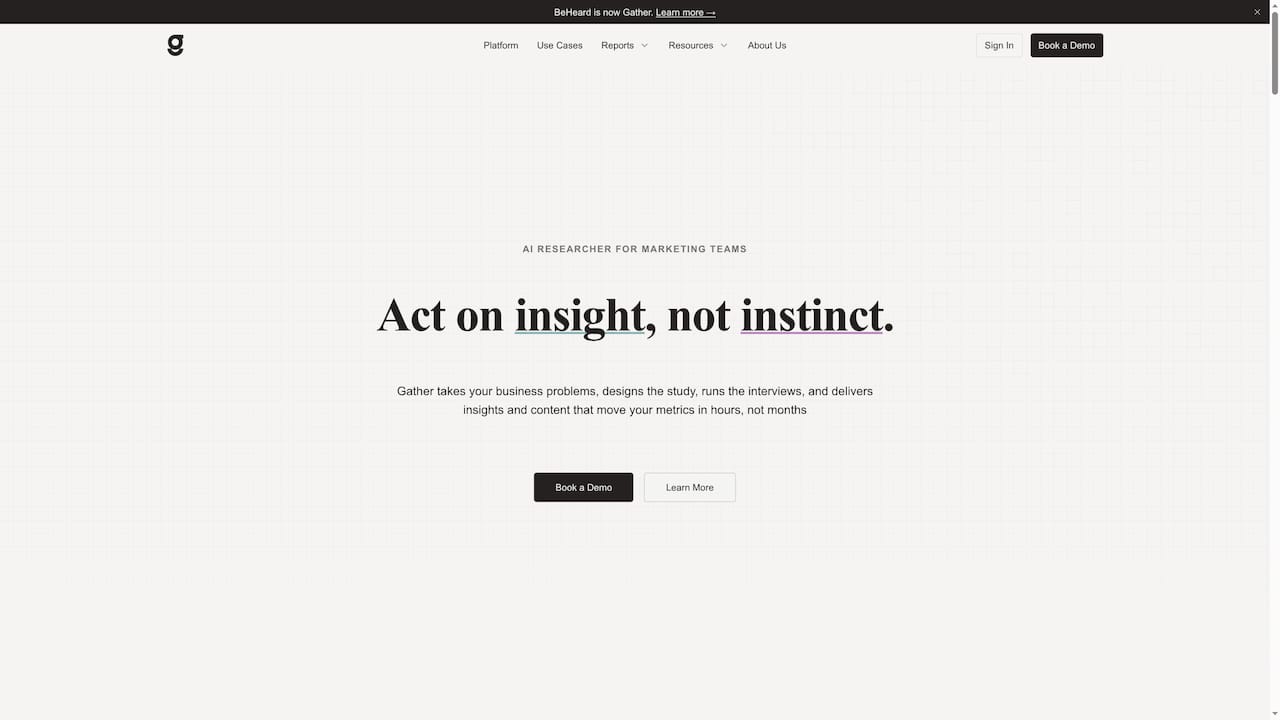
Gather's AI-native research platform handles every stage of the checklist, from study design and methodology selection through AI-moderated interviews, real-time analysis, and automated reporting. Instead of coordinating across agencies, tools, and timelines, your team gets board-ready insights in days. Explore Gather's use cases to see how teams like yours are running faster, more reliable research cycles. And if you want to understand where most research programs break down, the Customer Research Crisis study is a sharp place to start.
Frequently asked questions
What are the most critical steps in a market research checklist?
Defining objectives, selecting methods, collecting data, analyzing insights, and reviewing regularly form the essential sequence. Skipping or rushing any one step tends to compromise the quality of everything that follows.
How large should my survey sample be for credible market research results?
For B2B research, a median sample of around 273 is the benchmark, though 30 to 40 respondents can be sufficient in highly homogeneous markets. Always justify your sample size with a power analysis.
Should I use both qualitative and quantitative research methods?
Yes. Combining qual and quant methods gives you the most complete picture: quantitative data shows what is happening at scale, while qualitative responses explain the reasoning behind the numbers.
How often should market research be conducted in large companies?
Plan for quarterly or biannual deep-dives for strategic questions, with 2-week sprint cycles for faster, tactical decisions. Continuous research beats periodic research every time.