

TL;DR:
- AI accelerates customer insights by unifying structured and unstructured data for better decision-making.
- Clear goals, data quality, and organizational alignment are essential for effective insight adoption.
- Continuous measurement and iteration optimize insights and strengthen company-wide data-driven culture.
Customer data is growing faster than most teams can process it. Behavioral signals, purchase histories, support tickets, and social feedback pile up across disconnected systems, and the gap between raw data and real decisions keeps widening. For marketing and business professionals, that gap is expensive. AI is changing this equation, giving teams the ability to move from scattered inputs to sharp, reliable insights in days rather than months. This article walks you through the criteria, tools, and methods you need to build a faster, smarter customer insights engine that actually drives decisions.
Table of Contents
- Define your customer insight goals and criteria
- Unify structured and unstructured data for a true Customer 360
- Leverage AI and machine learning for predictive and proactive insights
- Turn insights into action: Effective delivery and adoption
- Measure and iterate: Optimize your insights process
- Our perspective: Why true insight requires more than just data and AI
- Move from insight to impact with Gather
- Frequently asked questions
Key Takeaways
| Point | Details |
|---|---|
| Unify all data sources | Integrate structured and unstructured data for a comprehensive customer view. |
| Leverage AI for speed | Use AI and machine learning to surface insights that humans might miss and scale analysis. |
| Focus on actionability | Deliver insights in ways stakeholders can act on to ensure decisions follow from data. |
| Iterate and measure | Continuously optimize by tracking KPIs and refining the insights process. |
Define your customer insight goals and criteria
Before you pick a tool or build a workflow, you need to know what success looks like. Too many teams invest in analytics platforms without first agreeing on what they are trying to learn or what they will do with the answers. That leads to expensive tools that generate reports nobody reads.
Start by clarifying your desired outcomes. Are you trying to speed up decisions, improve customer experience, or increase ROI on marketing spend? Each goal points to a different type of insight:
- Predictive insights tell you what is likely to happen next, such as which customers are at churn risk or which segments are ready to buy.
- Descriptive insights explain what has already happened, giving you a clear picture of past behavior and trends.
- Prescriptive insights recommend specific actions, like which offer to present to a given customer segment at a given moment.
Once you know the type of insight you need, evaluate your options against four core criteria. First, data timeliness: how current is the information feeding your analysis? Second, accuracy: are the outputs reliable enough to act on? Third, accessibility: can decision-makers actually reach and understand the insights? Fourth, actionability: do the insights connect clearly to a next step?
You should also factor in ROI impact. Some customer research strategies deliver fast wins but limited depth. Others require more investment but generate insights that shape strategy for years. Knowing which category you need helps you allocate budget and effort wisely.
Pro Tip: Bring stakeholders from sales, product, and customer success into your goal-setting conversations early. They often surface requirements that research and marketing teams miss, and their buy-in makes adoption far smoother later.
Unify structured and unstructured data for a true Customer 360
Once your goals are clear, the next challenge is pulling your data together. Most organizations sit on two very different types of information, and they rarely live in the same place.
Structured data includes anything that fits neatly into rows and columns: CRM records, transaction histories, loyalty program data, and web analytics. Unstructured data is everything else: customer reviews, support emails, social media comments, and open-ended survey responses. Both types matter, but unstructured data is where the richest signals often hide.
A unified Customer 360 view combines both, creating a single source of truth that makes driving better decisions significantly easier. The benefits are real and measurable. Unified Customer 360 platforms with AI can increase conversions 9x and reduce team size needs by 3x, according to Snowflake's research.
"A Customer 360 is only as powerful as the data you feed it. Garbage in, garbage out still applies, even with the best AI."
Common integration challenges include:
- Siloed systems that don't share data by default
- Inconsistent data formats across platforms
- Privacy and compliance requirements that restrict data movement
- Lack of internal ownership for data governance
- Legacy infrastructure that resists modern API connections
| Data type | Examples | Insight potential |
|---|---|---|
| Structured | CRM, POS, web analytics | Behavioral patterns, purchase trends |
| Unstructured | Reviews, emails, social posts | Sentiment, intent, unmet needs |
| Combined | Customer 360 | Predictive and prescriptive insights |
Pro Tip: Don't try to unify everything at once. Prioritize the data sources with the highest ROI impact first. For most teams, that means CRM data combined with customer feedback and support tickets. Build from there once you have a working foundation on your customer insights platform.
Leverage AI and machine learning for predictive and proactive insights
With unified data in place, AI can do what humans simply cannot at scale: spot patterns across millions of data points and surface the ones that matter most. This is where the real acceleration happens.

Machine learning models analyze customer behavior across every touchpoint and flag signals that would take a human analyst weeks to find. They can detect early churn risk before a customer cancels, identify cross-sell opportunities based on purchase sequences, and surface product improvement ideas buried in thousands of reviews. AI-driven Customer 360 models surface buying signals from customer reviews and can be used for predictive insights, turning passive feedback into proactive strategy.
Here is how to implement AI-driven analytics in a structured way:
- Audit your current data quality. AI models are only as good as the data they train on. Fix gaps and inconsistencies before you build.
- Define the specific prediction you want. Churn probability, next best offer, and sentiment score are all different models with different requirements.
- Start with a pilot segment. Test your model on one customer segment or product line before scaling.
- Validate outputs against known outcomes. Compare model predictions to historical results to check accuracy.
- Build feedback loops. Feed new outcomes back into the model so it improves over time.
For teams focused on delivering insights rapidly, AI removes the manual bottleneck entirely. Instead of waiting for an analyst to run a report, stakeholders get automated alerts when a threshold is crossed or a trend emerges. The marketing research process steps compress from weeks to hours when AI handles pattern detection and initial analysis.
Turn insights into action: Effective delivery and adoption
Generating great insights is only half the job. If those insights sit in a dashboard nobody checks or a report that arrives too late, they create zero value. Adoption is where most insight programs quietly fail.
The most common barriers are communication gaps, delivery delays, and lack of clarity about what action to take. Decision-makers need insights formatted for how they think and work, not how analysts prefer to present data. Unified, AI-powered Customer 360 approaches support proactive actions, such as flagging buying signals, which means the insight comes to the decision-maker rather than waiting to be discovered.
| Delivery method | Best for | Key advantage |
|---|---|---|
| Live dashboards | Operational teams | Real-time visibility |
| Automated alerts | Sales and CX teams | Immediate action triggers |
| Weekly briefings | Senior leadership | Strategic context |
| Embedded reports | Product teams | Decision-point relevance |
To drive adoption across your organization, follow these steps:
- Map insights to specific decisions. Every insight should connect to a question a stakeholder is already asking.
- Reduce friction in access. If someone needs three logins to see a dashboard, they won't use it.
- Train teams on interpretation. Data literacy varies. A brief onboarding session prevents misreads.
- Celebrate wins publicly. When an insight leads to a measurable result, share the story internally.
- Gather feedback on usefulness. Ask stakeholders regularly what is missing or confusing.
Pro Tip: Tailor delivery formats to the decision-maker's preferences. A VP of Sales wants a one-line alert with a recommended action. A product manager wants a trend chart with context. Insight delivery for faster decisions depends as much on format as it does on content. You can also explore agile marketing audience research frameworks to keep delivery cycles tight and relevant.
Measure and iterate: Optimize your insights process
Building a customer insights capability is not a one-time project. It is an ongoing process that improves with every cycle. The teams that get the most value from their insight investments are the ones that measure outcomes and adjust continuously.
Start by tracking both leading and lagging metrics:
- Leading metrics: Insight delivery speed, stakeholder engagement with reports, number of decisions informed by data
- Lagging metrics: Customer retention rate, conversion rate improvement, cost savings from avoided mistakes, revenue attributed to insight-driven campaigns
Sophisticated insight platforms enable ongoing improvement by tracking outcomes and enabling faster iterations, which means your process gets sharper with every research cycle.
| KPI | What it measures | How to interpret it |
|---|---|---|
| Insight-to-decision time | Speed of the process | Shorter = more agile organization |
| Decision reversal rate | Quality of insights | Lower = more reliable outputs |
| Retention lift | Business impact | Higher = insights driving real behavior change |
| Adoption rate | Team engagement | Higher = insights reaching the right people |
Closed feedback loops are the engine of improvement. After every major insight cycle, ask: Did the insight lead to action? Did that action produce the expected result? What would have made the insight more useful? These questions, asked consistently, compound into a market intelligence ROI advantage that is very hard for competitors to replicate.
Our perspective: Why true insight requires more than just data and AI
Here is something most vendors won't tell you: technology alone will not fix a broken insight culture. We see it regularly. Companies invest heavily in AI platforms, unify their data, and still struggle to generate insights that change behavior. The missing ingredient is almost never the algorithm.
The real unlock is organizational alignment. When sales, marketing, product, and customer success teams share a common definition of what a valuable insight looks like, and when they trust the process that produces it, adoption follows naturally. Without that alignment, even the best platform generates reports that get ignored.
A learning organization, one that treats insights for better business decisions as a shared responsibility rather than a research team's output, consistently outperforms teams that rely on technology alone. The companies winning with AI-driven insights are not just better at data. They are better at asking questions, sharing what they learn, and changing course quickly. That is a culture advantage, and it starts long before you pick a platform.
Move from insight to impact with Gather
The strategies in this article give you a clear path: set goals, unify your data, apply AI, deliver insights effectively, and measure what matters. But executing all of that without the right infrastructure is slow and resource-intensive.
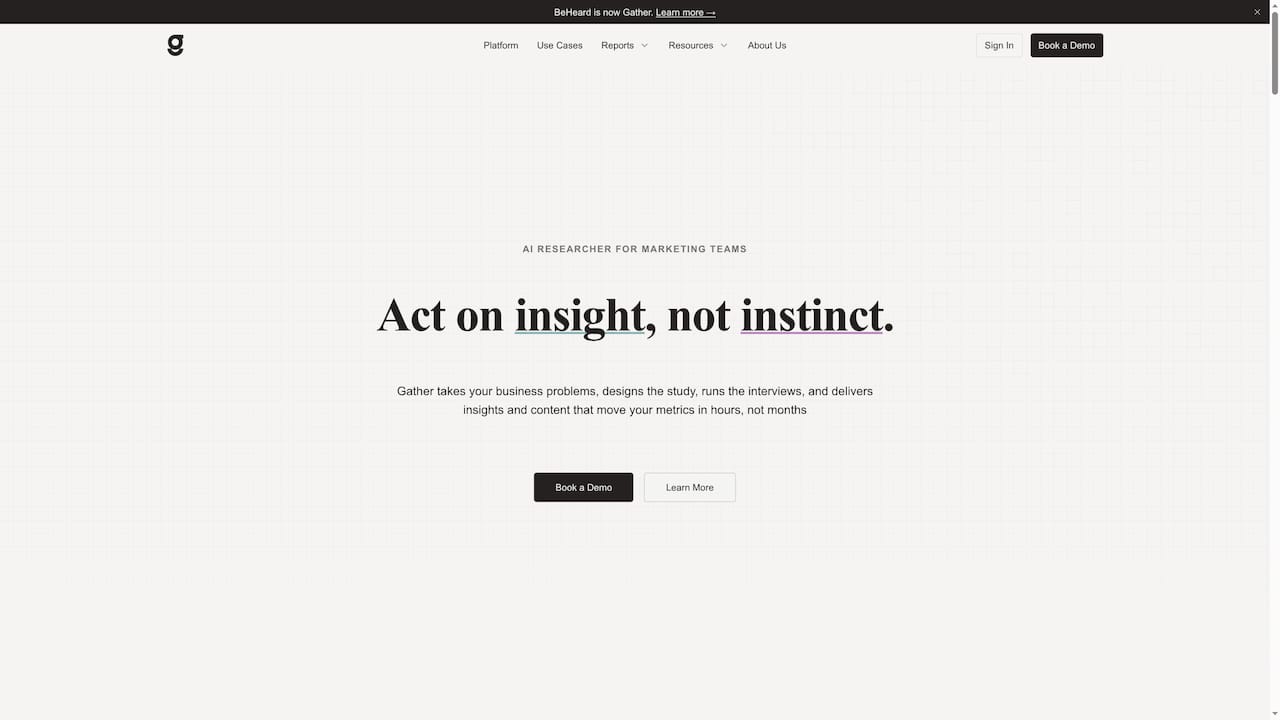
Gather's AI-native research engine automates the entire research lifecycle, from study design to board-ready reporting, in days rather than months. Whether you are exploring a new segment or tracking shifting customer sentiment, you can access our 2026 customer research study for benchmarks and frameworks that accelerate your work. Explore the full range of customer insight use cases to see how teams like yours are turning AI-driven research into faster, sharper decisions without relying on external agencies.
Frequently asked questions
What is the fastest way to improve customer insights in 2026?
Using AI-driven Customer 360 platforms that unify structured and unstructured data delivers rapid, more accurate insights. Unified platforms with AI increase conversion rates and reduce staffing needs significantly.
How can AI help identify actionable customer trends?
AI algorithms quickly surface buying signals, churn risks, and product opportunities by processing reviews and customer interactions at scale. AI-driven models surface buying signals from customer reviews for predictive insights.
What types of data should be unified for better insights?
Companies should unify both structured data like CRM records and sales history with unstructured data such as customer feedback and support tickets. Unified Customer 360 platforms combine both data types to maximize insight depth.
How do you measure the impact of customer insights programs?
Track KPIs like decision speed, conversion rate improvements, and customer retention to evaluate whether your insights process is generating real business value.