

TL;DR:
- Precise audience segmentation using AI enhances marketing targeting and decision-making.
- Combining demographic, psychographic, behavioral data with AI keeps segments current and actionable.
- Continuous monitoring and validation are essential for effective, dynamic research audience models.
Launching a campaign that misses the mark because you built it for "everyone" is one of the most expensive mistakes a marketing team can make. Vague audience definitions lead to diluted messaging, wasted budget, and products that land in the wrong hands. The fix is precise research audience segmentation, and the way modern teams do it has changed dramatically. This article walks you through a proven, step-by-step approach to segmenting research audiences efficiently, using AI-powered tools to move from fuzzy personas to sharp, decision-ready insights.
Table of Contents
- What is research audience segmentation and why does it matter?
- Get started: What you need before segmenting
- Step-by-step: How to segment research audiences efficiently
- Avoid common mistakes and ensure actionable results
- Our perspective: Why most segmentation efforts fall short—and what actually works
- Accelerate actionable audience segmentation with Gather
- Frequently asked questions
Key Takeaways
| Point | Details |
|---|---|
| AI enables deeper segmentation | AI-driven tools provide dynamic, actionable segments faster than manual methods. |
| Preparation is crucial | Gathering high-quality, diverse data sets and involving the right teams makes segmentation effective. |
| Follow a stepwise process | A structured, repeatable workflow ensures your segments are reliable and actionable. |
| Avoid shallow shortcuts | Relying only on demographics or skipping testing leads to missed opportunities. |
| Focus on actionable insights | Segments should drive concrete marketing, product, and sales outcomes—not just create data slices. |
What is research audience segmentation and why does it matter?
Audience segmentation is the process of dividing a broad target population into smaller, more defined groups based on shared characteristics, behaviors, needs, or attitudes. In a research context specifically, it determines who you study, how you tailor your questions, and which insights actually apply to each group. Without it, your findings are averaged to the point of uselessness.
Traditional approaches leaned heavily on demographic and geographic splits: age brackets, income ranges, zip codes. These are easy to apply, but they are shallow. Knowing that your buyer is a 35- to 44-year-old in the Midwest tells you almost nothing about why they choose your product over a competitor's. Psychographic and behavioral segmentation go deeper, capturing motivations, values, purchase triggers, and loyalty patterns. The tradeoff is that these models are data-intensive and harder to maintain at scale.
That is where AI changes the equation. AI tools enable real-time, dynamic segmentation that manual methods simply cannot match, particularly for mid-sized to large organizations managing thousands of customer signals simultaneously. The comparison below illustrates how each approach stacks up:
| Segmentation type | Data required | Depth of insight | Scalability | Best for |
|---|---|---|---|---|
| Demographic/Geographic | Basic CRM, census | Shallow | High | Quick filters, broad reach |
| Psychographic | Surveys, interviews | Moderate to deep | Medium | Brand positioning, messaging |
| Behavioral | CRM, clickstream, POS | Deep | Medium to high | Retention, upsell, churn |
| AI-powered/Dynamic | All of the above, real-time | Very deep | Very high | Ongoing research, complex markets |
Following audience segmentation best practices means recognizing that no single approach works in isolation. The strongest segmentation frameworks layer demographic filters with behavioral and psychographic data, then use AI to keep those layers current.
"AI-driven segmentation doesn't just sort people into buckets. It continuously updates those buckets as behavior changes, giving research teams a living model of their audience rather than a static snapshot."
When do companies outgrow manual segmentation? Usually when a research team runs more than two or three studies per quarter, when customer data lives across five or more systems, or when campaign performance starts diverging sharply from research predictions. Those are signals that your segmentation method has become the bottleneck. Companies that pair competitive research strategies with dynamic segmentation consistently close that gap faster.
Get started: What you need before segmenting
Knowing why segmentation matters, the first critical step is preparation, gathering the right resources and buy-in before you run a single query or field a single survey.
The data types you need fall into four categories:
- Quantitative data: Transaction records, usage metrics, NPS scores, survey responses at scale
- Qualitative data: Interview transcripts, open-ended survey responses, customer support logs
- CRM data: Account records, firmographics for B2B, lifecycle stage, deal history
- Behavioral data: Website clickstreams, app usage patterns, email engagement, POS data
The people you need at the table include your marketing strategists (who define the business question), research leads (who design the study), and data analysts (who validate segment integrity). Skipping any one of these roles creates gaps that surface later, usually at the worst possible moment.
On the tool side, platforms like Customer.io use natural language to generate audience segments, while YouGov AI Personas builds data-backed personas, and ATLAS.ti applies AI coding to qualitative data. Averi AI and Analyze360 use machine learning for behavioral clusters and predictive insights. Each platform has different input requirements, which your team needs to audit before choosing:
| Tool | Primary input | Key capability | Best fit |
|---|---|---|---|
| Customer.io | CRM, behavioral events | Natural language segment generation | Marketing activation |
| YouGov AI Personas | Survey, panel data | Data-backed persona profiles | Brand research |
| ATLAS.ti | Qualitative transcripts | AI-assisted coding, theme extraction | Deep qual analysis |
| Averi AI | Mixed behavioral data | ML clustering | Growth teams |
| Analyze360 | CRM, POS | Predictive behavioral segments | Retail, e-commerce |
Before you configure any tool, run a market research checklist to confirm your data is clean, current, and accessible. Stale or siloed data produces misleading segments that look statistically valid but lead you in the wrong direction.
Pro Tip: Build your dataset with future segmentation in mind from the very start. Tag behavioral events consistently, standardize CRM fields across teams, and document every data source. Teams that do this upfront spend 40% less time on data prep for every subsequent study, which accelerates rapid audience research at every stage of the product lifecycle.
Step-by-step: How to segment research audiences efficiently
Once you have the right foundation in place, follow this workflow to segment your research audiences effectively and consistently.
1. Collect and consolidate your data. Pull all relevant data into a single environment, whether that is a data warehouse, a CRM, or your AI research platform. Gaps in consolidation lead to segments that look complete but miss entire customer populations. For enterprise teams, this often means connecting CRM exports with behavioral event streams and any existing qual transcripts from past studies.
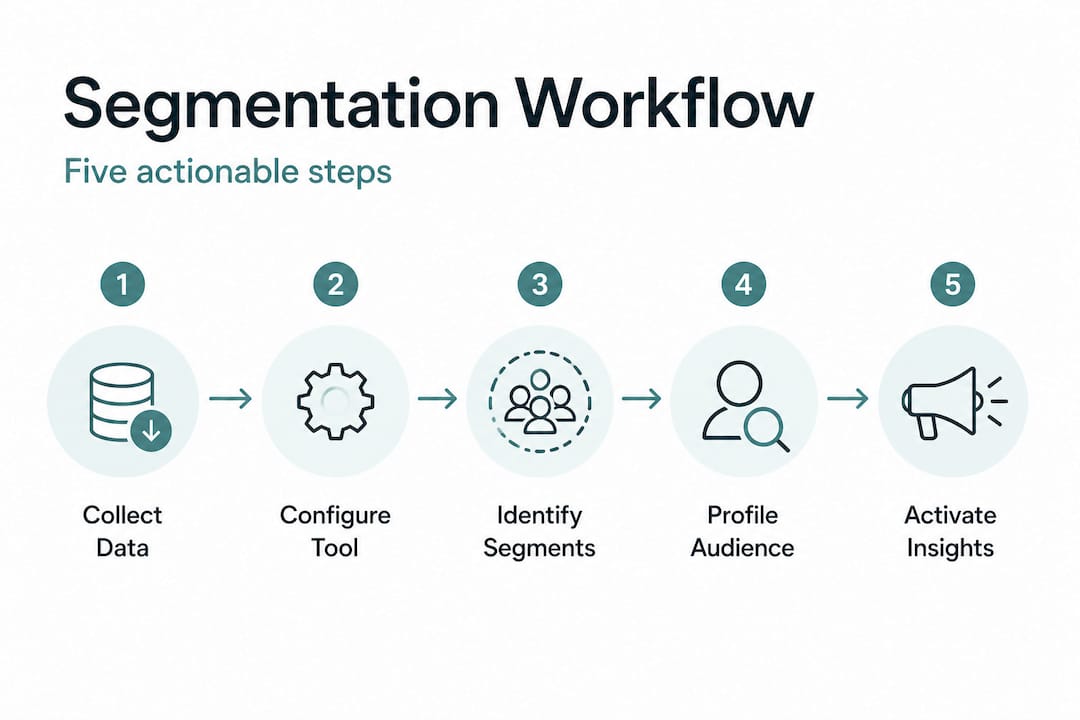
2. Select and configure your segmentation tool. Match the tool to your primary data type and business objective. If your research question is "why are high-value customers churning," you need a tool that handles behavioral and attitudinal data, not just demographics. Configure the tool's parameters around your hypothesis, not around what the tool makes easiest.
3. Identify segments using both AI and human judgment. Run your initial AI-generated clusters, then have your research lead review them against known business context. AI surfaces patterns in data. Humans know which patterns are commercially relevant. The best segments emerge from that combination, not from either alone.

4. Profile each segment with depth. Stable, sizable, and reachable segments deserve full profiles: quantitative characteristics, representative quotes, observed behaviors, unmet needs, and purchase triggers. Think of this as building detailed personas that go beyond a stock photo and a job title. A useful persona includes the tension that drives their decision-making.
5. Activate segments across marketing, sales, and product. A segment that stays in a research report is wasted. Map each segment to a specific campaign, messaging variant, product feature, or sales play. AI-driven insights become actionable when they connect directly to decisions your go-to-market teams are making right now. Build a simple activation brief for each segment that specifies the channel, the message, and the success metric.
Pro Tip: Before you launch a campaign against a new segment, validate it with a small-scale test. Run a targeted email or a short concept test with 50 to 100 respondents from that segment before committing full budget. Validating early saves significant spend and prevents the embarrassment of scaling a segment that does not behave the way the data suggested. Explore segmentation use cases to see how other teams have applied this approach across industries.
The most overlooked part of this process is stability. A segment that changes shape every 30 days is not a useful strategic asset. Monitor your segments quarterly and flag any that show dramatic shifts in size or behavior. Those shifts are signals worth investigating, not errors to ignore.
Avoid common mistakes and ensure actionable results
Even a well-executed segmentation plan can go off track if you fall into common traps or don't validate your results.
The most frequent mistakes research leaders make include:
- Skipping data preparation: Running segmentation on messy, incomplete, or inconsistent data produces unreliable clusters that mislead downstream decisions.
- Setting vague research goals: Segmentation without a clear business question behind it results in segments that are interesting but not useful.
- Choosing the wrong model: Using only demographic splits for a behavioral question, or using a behavioral model for a brand awareness study, creates a mismatch between the method and the insight you need.
- Failing to test and iterate: Treating your first set of segments as final is a common and costly error. Markets shift, customer priorities evolve, and so should your segments.
The consequences of shallow demographic segmentation are measurable and painful:
"Campaigns built on surface-level audience definitions consistently underperform because they speak to a label rather than a lived experience. When segments aren't grounded in behavior and motivation, marketing dollars chase the wrong people at scale."
To verify that your segments are truly actionable, run them against a four-part checklist before activation. Follow solid research process steps to confirm each criterion is met:
- Distinctness: Do the segments differ meaningfully from each other? Overlapping segments split your budget without adding clarity.
- Measurability: Can you quantify the size and behavior of each segment reliably?
- Accessibility: Can your marketing and sales teams actually reach these people through existing channels?
- Profitability: Is each segment worth the cost to target, given expected lifetime value or conversion rate?
Tracking performance after activation closes the feedback loop. Set specific KPIs for each segment's campaign, review results at 30 and 60 days, and feed those results back into your segmentation model. Teams that do this consistently build segments that improve over time rather than decay. Strong digital campaign optimization depends on this iterative discipline more than any single tool or tactic.
Our perspective: Why most segmentation efforts fall short—and what actually works
Addressing common mistakes brings us to a broader point, one most segmentation guides miss entirely.
The root problem is not methodology. It is the assumption that segmentation is a project with a finish line. Most companies build their audience segments once, maybe as part of a brand refresh or a product launch, and then treat them as permanent fixtures. They are not. Your audience is not static, and any model that treats it that way is already obsolete.
We have seen large marketing teams spend months building elaborate nine-segment frameworks, complete with color-coded personas and beautifully designed decks. Six months later, market conditions shift, a new competitor enters, or a cultural moment reframes what customers care about, and that framework is quietly retired. The teams that succeed treat segmentation like a continuous research practice, not a deliverable.
There is also a real danger in over-segmenting. The push for hyper-granular audience models sounds rigorous, but it often produces segments so narrow that no marketing channel can reach them cost-effectively. Forty-seven micro-segments might feel precise, but if only three of them are actually reachable at scale, the other forty-four are theoretical. Actionability and ROI matter more than granularity. A smaller number of well-validated, commercially meaningful segments will outperform a sprawling taxonomy every time.
The other overlooked reality is that buying an AI tool does not automatically modernize your segmentation. The tool is only as good as the process surrounding it. Teams that see strong results from AI segmentation have invested in process alignment, not just software. They have changed how research requests are scoped, how data is collected, and how insights are handed off to activation teams. The brand tracking evolution toward always-on intelligence applies here too. Quarterly segmentation reviews are table stakes. Monthly is better for high-velocity markets.
Prioritize segments that inform real decisions. If a segment cannot directly answer "what should we do next," it is not ready to activate.
Accelerate actionable audience segmentation with Gather
If you're ready to put advanced segmentation into practice, here's how Gather can help.
Gather's AI-native research platform is purpose-built for exactly this kind of work. It connects to your existing CRM and behavioral data sources, automates study design and interview execution, and delivers structured insights across segments in days, not months. Whether you are targeting churned users, B2B decision-makers, or Gen Z buyers, Gather identifies the right audience and surfaces the patterns that matter.
Explore Gather's research use cases to see how marketing and research teams are using the platform to segment audiences and act on insights faster than traditional methods allow. You can also access an original 2026 study that details how leading organizations are restructuring their research workflows around AI segmentation. When you're ready to move from static segments to living audience models, Gather is built for that transition.
Frequently asked questions
What data do I need to segment research audiences effectively?
You should gather quantitative data, qualitative insights, CRM records, and behavioral data to enable robust segmentation, since AI platforms require a combination of these sources to generate accurate, actionable clusters.
How does AI improve audience segmentation compared to manual methods?
AI enables dynamic, real-time segmentation that uncovers behavioral patterns manual methods miss, particularly important for mid-sized to large companies managing complex, high-volume customer data.
What is the most common mistake in segmenting research audiences?
Relying on shallow demographic-only segments without validating or iterating them is the most frequent error, resulting in campaigns that miss the real motivations driving customer behavior.
What outcomes should I expect from advanced segmentation?
Expect greater marketing relevance, more efficient spend allocation, and sharper insights that give every go-to-market team, from product to sales, a clearer picture of who they are serving and why.
Which AI platforms support research audience segmentation?
Popular platforms include Customer.io, YouGov AI Personas, ATLAS.ti, Averi AI, and Analyze360, each offering distinct capabilities ranging from natural language segment generation to predictive behavioral modeling.