

TL;DR:
- Well-designed interviews turn raw data into actionable market insights.
- Semi-structured formats with probing techniques unlock deeper, more specific insights.
- Speed and iteration in interview design lead to better results than perfection.
Most marketing and research teams have been there: you invest weeks designing and running customer interviews, only to walk away with vague answers like "it depends" or "we just like the product." The data looks rich on the surface but falls apart the moment a stakeholder asks, "So what should we do?" That gap between raw interview data and actionable insight is almost always a design problem, not a participant problem. A structured, flexible interview design process directly determines whether your research moves at the speed your business demands. This guide gives you a step-by-step framework, practical tools, and expert-tested techniques to run interviews that produce real, usable market intelligence.
Table of Contents
- What is interview design and why it matters for market insights
- Preparation: Defining objectives and selecting the right tools
- Step-by-step: Conducting effective interviews for deeper insights
- Analyzing and transforming interview data for strategic action
- A modern perspective: Why speed and structure matter more than perfection
- Get better results with Gather's research solutions
- Frequently asked questions
Key Takeaways
| Point | Details |
|---|---|
| Semi-structured design wins | Flexible, semi-structured interviews consistently yield the richest and fastest market insights. |
| Preparation is critical | Clearly defined objectives and robust guides lay the groundwork for effective data collection. |
| Use thematic analysis | Analyzing for recurring themes lets you quickly turn raw responses into actionable strategies. |
| Iterate, don’t wait | Testing and improving your guide with real interviews maximizes both insight quality and speed. |
What is interview design and why it matters for market insights
Interview design is the deliberate process of structuring how you ask questions, sequence topics, and guide conversations to generate data you can actually use. In a marketing and research context, it goes far beyond writing a list of questions. It means deciding who you talk to, what format the conversation takes, how you handle unexpected answers, and how you plan to analyze responses before the first interview even happens.
The quality of your design has a direct, measurable effect on the quality of your insights. A poorly designed interview produces surface-level answers because participants respond to what they think you want to hear, or because your questions are too broad to trigger specific, memorable responses. A well-designed interview creates conditions where participants reveal real decision-making logic, genuine frustrations, and unmet needs. Those are the inputs that drive product positioning, messaging strategy, and competitive differentiation.
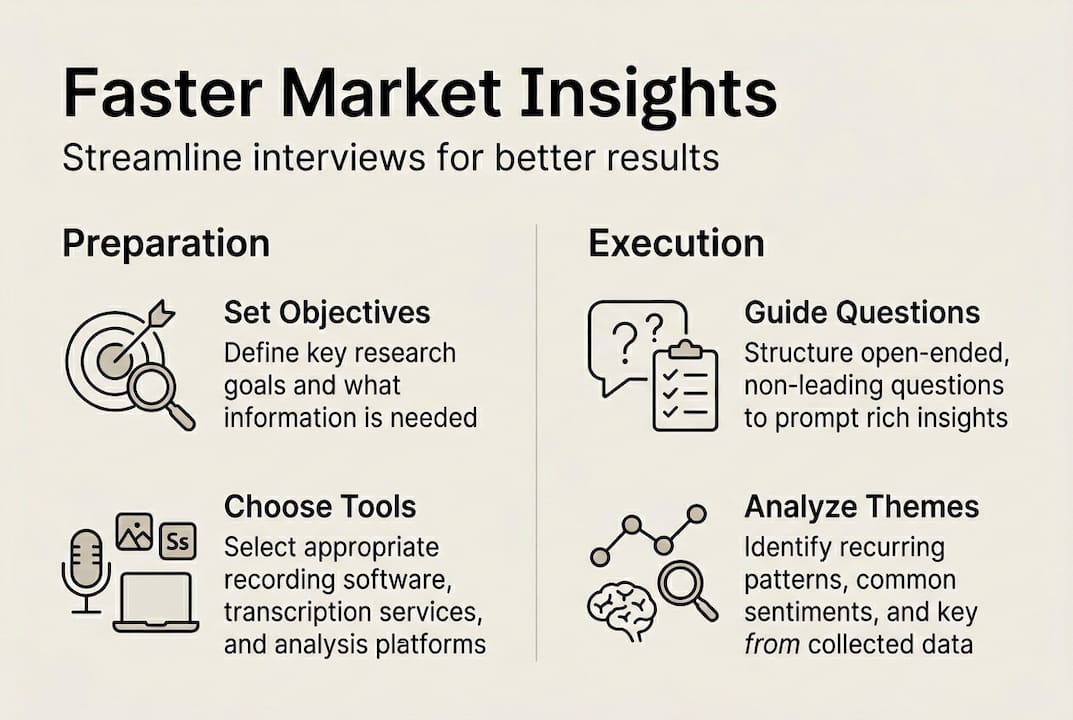
Understanding the marketing research process steps helps you see where interview design fits within a larger research lifecycle. It is one component, but it is the one that most directly shapes the usefulness of everything that follows.
Choosing the right interview format is a foundational decision. Here is a quick comparison:
| Interview type | Structure level | Best use in market research |
|---|---|---|
| Structured | High | Benchmarking, standardized surveys at scale |
| Semi-structured | Medium | Exploratory research, persona building, messaging tests |
| Unstructured | Low | Early discovery, hypothesis generation |
For most marketing and research teams, semi-structured interviews are the sweet spot. They give you consistency across participants while leaving room to follow a surprising thread. Semi-structured interviews allow flexibility for follow-up techniques like the silence technique, specificity probes, comparison frames, and story extraction to uncover deeper insights that a rigid script would miss entirely.
Some of the most powerful probing techniques include:
- Silence technique: Pausing for 3 to 5 seconds after an answer invites participants to elaborate without prompting.
- Specificity probes: Asking "Can you give me a specific example?" forces participants to move from abstract opinions to concrete experiences.
- Comparison frames: "How does that compare to how you handled it before?" surfaces contrast and context.
- Story extraction: "Walk me through the last time that happened" generates narrative data that is far easier to analyze and present.
These techniques are not just nice to have. They are the mechanism by which good interview design produces insights that are actually actionable. Exploring marketing research strategies that pair well with these techniques can help you build a more complete research program.
Preparation: Defining objectives and selecting the right tools
The most common reason interviews produce weak data is not bad moderation. It is unclear objectives. Before you write a single question, you need a crisp answer to this: what specific business decision will this research inform? "Understanding our customers better" is not an objective. "Identifying the top two barriers preventing mid-market B2B buyers from upgrading to our enterprise tier" is.
Once you have a sharp objective, participant selection becomes much easier. You are not looking for a representative sample of all customers. You are looking for people whose experience and perspective will directly illuminate your business question. For a B2B marketing team, that might mean targeting decision-makers at companies with 200 to 500 employees who evaluated your product in the last 90 days but did not convert.
Your market research checklist should include participant criteria, screener questions, and a recruitment plan before you finalize your guide. Skipping this step is one of the most expensive mistakes a research team can make.
Tool selection also matters. Here is a comparison of common interview guide formats:
| Tool type | Best for | Limitations |
|---|---|---|
| Manual (Word/Docs) | Small teams, one-off studies | Hard to scale, no analysis support |
| Digital (Airtable, Notion) | Organized teams, reusable templates | Still requires manual analysis |
| AI-enabled platforms | High-volume, rapid turnaround research | Requires setup and onboarding |
A strong interview guide includes four core sections: a standardized intro that sets context and ground rules, warm-up questions that build rapport, core topic questions tied directly to your objectives, and a closing that invites final thoughts. Thematic analysis works best when your guide is built with coding in mind, meaning your questions map to the themes you expect to find, while leaving room for surprises. Research shows that 5 to 10 interviews typically reveal recurring themes, so your guide does not need to be exhaustive. It needs to be focused.

Also keep in mind that market research compliance requirements, including privacy disclosures and consent, should be baked into your standardized intro, not treated as an afterthought.
Pro Tip: Run your guide with a colleague before the first real interview. Ask them to answer as if they were your target participant. You will almost always find at least one question that is accidentally leading or confusingly worded.
Step-by-step: Conducting effective interviews for deeper insights
Even a well-designed guide can fail in execution. Here is a practical, step-by-step approach to running interviews that consistently produce strong data.
-
Prep the environment. Whether you are conducting interviews remotely or in person, eliminate distractions. For remote interviews, test your recording setup, confirm the participant received a calendar invite with a clear link, and have your guide open in a separate window so you are not fumbling during the conversation.
-
Deliver a standardized intro. Every participant should hear the same opening: who you are, what the research is for (without biasing their answers), how long the session will take, and how their data will be used. This is also where you get verbal or written consent.
-
Set ground rules explicitly. Tell participants there are no right or wrong answers, that you want their honest experience, and that silence is okay. This single step dramatically reduces socially desirable responses.
-
Use your guide as a map, not a script. In a B2B marketing scenario, if a participant mentions an unexpected vendor comparison you had not anticipated, follow that thread. Your guide keeps you on track, but the richest insights often live just off the planned path.
-
Apply probing techniques deliberately. Semi-structured interviews allow flexibility for follow-up techniques including a silence technique of 3 to 5 seconds, specificity probes, comparison frames, and story extraction that surface the kind of nuanced data your analysis will depend on. Do not rush past a vague answer. Pause. Ask for an example. Ask what happened next.
-
Close with an open invitation. Always end with "Is there anything else you think I should know?" You will be surprised how often the most useful insight comes in the final two minutes.
For selecting research methodology that fits your timeline and objectives, the interview format you choose should align with both the depth of insight you need and the speed at which you need to deliver.
"Listen more than talk. The best insights often follow a well-timed pause."
Pro Tip: Use silence strategically. Most moderators jump in too quickly after a participant finishes speaking. Waiting 3 to 5 seconds after an answer often prompts the participant to add the specific detail or emotional context that makes the insight usable.
Analyzing and transforming interview data for strategic action
Conducting great interviews is only half the work. The analysis phase is where raw conversation becomes strategic direction, and it is where many teams lose momentum.
Thematic analysis is the standard method for qualitative interview data. Here is how to apply it efficiently:
- Transcribe and read. Get full transcripts for each interview. Read them once without coding to absorb the overall picture.
- Open coding. Go through each transcript and label segments with short descriptive codes. "Mentions price as barrier," "References competitor X," "Describes workaround behavior" are all valid codes.
- Group into themes. Cluster related codes into broader themes. In marketing research, common themes include:
- Decision drivers (what actually triggers a purchase)
- Pain points (friction in the current solution)
- Unmet needs (gaps no current product addresses)
- Perception gaps (how customers describe your product vs. how you do)
- Competitive context (which alternatives they considered and why)
- Identify patterns across participants. A theme mentioned by one person is an anecdote. A theme mentioned by six out of eight participants is a finding. Thematic analysis post-interview ensures patterns emerge for personas and market strategies, and it works best when your guide was built with these categories in mind.
- Translate findings into action. Each major theme should map to a recommendation. "Five of eight participants described the onboarding process as confusing" maps directly to a product or messaging recommendation, not just a research observation.
For building buyer personas from interviews, thematic analysis gives you the behavioral and attitudinal data that makes personas credible and useful rather than demographic placeholders.
Pro Tip: Create a simple post-interview analysis template with columns for participant ID, key quotes, codes, and themes. Filling it in immediately after each interview takes 15 minutes and cuts your final analysis time in half. Applying audience research lessons from agile teams can also help you build faster feedback loops into your analysis process.
A modern perspective: Why speed and structure matter more than perfection
Here is something most research guides will not tell you: obsessing over a perfect interview guide is one of the most common ways marketing teams delay insights that could already be in the hands of decision-makers.
We have seen teams spend three weeks refining a guide before running a single interview. By the time they had findings, the product decision had already been made based on gut instinct. That is not a research problem. That is a prioritization problem disguised as rigor.
The teams that consistently generate the most impact from qualitative research are not the ones with the most polished guides. They are the ones who run five interviews fast, learn what their guide is missing, revise it, and run five more. That iteration loop produces better insights than any amount of upfront theorizing.
A structured-yet-flexible guide that you are willing to adapt after the first two interviews will outperform a rigid, over-engineered one every time. As we have written about in our process for rapid insights, the research teams that move fastest are the ones who treat their first round of interviews as a calibration exercise, not a final exam.
In market research, progress beats perfection. Every time.
Get better results with Gather's research solutions
Interview design is only as effective as the tools and platforms that power execution. A strong framework gets you to the starting line, but the speed and quality of your insights depend on what happens next.
Gather's AI research platform automates the hardest parts of the research lifecycle, from study design and participant targeting to AI-moderated interview execution and automated reporting. Marketing and research teams use Gather to go from business question to board-ready insights in days, not months. Explore market research use cases to see how teams like yours are running smarter research at scale, or visit the research platform details to see how it works. You can also access an original customer research study to see the quality of insights Gather delivers.
Frequently asked questions
What is the best interview design approach for market research?
Semi-structured interviews are the most effective format for most marketing research because they balance consistency with the flexibility needed for deeper follow-up techniques like specificity probes and story extraction.
How many interviews do I need to start seeing actionable market patterns?
In most cases, 5 to 10 interviews are enough to surface recurring themes and actionable patterns, especially when your participant criteria are tightly defined.
How do I move from interview data to marketing strategy?
Apply thematic analysis to code responses, group recurring patterns into themes, and map each theme to a specific marketing or product recommendation, which can then inform buyer personas and campaign strategy.
What are common mistakes when designing research interviews?
The most frequent mistakes are writing leading questions, skipping a pilot test of the guide, and failing to use specificity probes during the interview to push past vague or surface-level responses.