

TL;DR:
- Multi-segment research compares multiple audience groups simultaneously for deeper, more strategic insights.
- It enhances decision-making speed, market understanding, and campaign precision compared to single-segment analysis.
- AI-powered tools enable rapid, scalable, and reliable multi-segment research, reducing timelines from months to days.
Most marketing teams treat research as a linear exercise: pick your core audience, run your study, act on the findings. It's a clean process. It's also leaving serious competitive intelligence on the table. The brands pulling ahead in 2026 aren't just analyzing one audience segment in isolation. They're running simultaneous, comparative research across multiple segments, finding the friction points, the white space, and the strategic leverage that single-market analysis simply cannot reveal. This guide breaks down what multi-segment research is, how it works in practice, and exactly how your team can make it work at scale.
Table of Contents
- What is multi-segment research?
- Why leading teams are shifting to cross-segment analysis
- How multi-segment research works: Framework and process
- Pitfalls and edge cases: Avoiding common traps
- What most guides miss about multi-segment research
- Take your research further with advanced AI-native solutions
- Frequently asked questions
Key Takeaways
| Point | Details |
|---|---|
| Comparative insights | Analyzing multiple segments gives you side-by-side market clarity not possible with single-segment studies. |
| AI-driven analysis | Emerging AI tools make comparative, iterative segment analysis faster and more actionable for marketing teams. |
| Balance depth and focus | Too many segments or weak data leads to confusion; smart frameworks and pilot-testing are essential. |
| Strategic agility | Cross-segment research lets you adapt campaigns quickly as audience needs shift. |
| Platform support | Purpose-built research engines reduce complexity and scale multi-segment insights for teams. |
What is multi-segment research?
Multi-segment research means analyzing two or more distinct audience segments at the same time, within a single research effort, so you can compare their behaviors, needs, and responses side by side. It's not just running the same survey twice. It's designing your research with comparative logic baked in from the start, so your methodology, questions, and analysis are all built to surface differences that actually matter for decision-making.
This approach is very different from traditional market research, which typically focuses on one primary audience. A standard study might interview loyal customers about satisfaction. Multi-segment research would interview loyal customers AND churned users AND first-time buyers simultaneously, then map where their experiences diverge and why. That contrast is where the real insight lives.
It's also different from generic market research that pools everyone together and reports averages. Averages can hide everything. A product that gets a 7/10 satisfaction rating overall might score 9/10 with one segment and 4/10 with another. Without segment-level breakdowns, you'd never know the product is actually failing a significant part of your market.
Here's what multi-segment research enables that other approaches don't:
- Direct comparison of pain points across different audience types, revealing which problems are universal versus segment-specific
- Market opportunity mapping by showing where unmet needs are concentrated in high-value groups
- Faster hypothesis testing, since you can validate or disprove assumptions across multiple audiences in a single research cycle
- Resource prioritization, because comparative data tells you which segment offers the highest return on marketing investment
Understanding the marketing research process steps is the foundation, but multi-segment design takes that process further by adding the comparative layer that transforms findings into strategic advantage.
The numbers back this up. Over 60% of BI cases now use cross-segment analysis for comparative insights rather than tracking trends in a single population. That shift reflects something important: business intelligence teams have learned that the most valuable insights come from contrast, not just description. And the market research checklist for any serious study now includes segment design as a core step, not an afterthought.
Stat callout: Cross-sectional analysis now drives more than 60% of business intelligence cases globally, reflecting the industry's shift from trend-watching to comparative insight generation.
Strong audience research for marketing depends on understanding which audiences to study together, and that's a strategic question that deserves as much attention as your methodology.
Why leading teams are shifting to cross-segment analysis
The highest-performing marketing teams aren't just asking "what does our audience want?" They're asking "how do different audiences compare, and what does that tell us about where to go next?" That reframe changes everything about how research gets done and what it produces.
Cross-segment analysis outperforms trend-only approaches because trends can be misleading without context. A decline in purchase intent might look alarming in aggregate, but cross-segment analysis might reveal it's only happening with one specific demographic while another is actually trending up. That distinction determines whether you overhaul your strategy or just refine your targeting.
Consider the business case. Marketing teams using AI in digital marketing combined with multi-segment frameworks are consistently reporting faster campaign iteration cycles and more precise audience targeting. The intelligence gained from comparative analysis directly feeds into more adaptive marketing strategies that can shift based on segment-level signals rather than blunt aggregate data.
Here are the core benefits of cross-segment versus single-segment analysis:
| Dimension | Single-segment research | Multi-segment research |
|---|---|---|
| Insight depth | Surface-level for one group | Comparative across groups |
| Speed to decision | Moderate | Faster with parallel execution |
| Risk mitigation | Limited | Stronger, spots blind spots early |
| Market opportunity | Narrow view | Broader, identifies white space |
| Campaign agility | Reactive | Proactive and adaptive |
| Resource alignment | Assumption-driven | Data-driven by segment ROI |
The brand health tracking use case illustrates this well. Brands that track health metrics across B2B buyers, end users, and channel partners simultaneously get a much sharper picture of where brand perception breaks down in the value chain. Without that multi-segment view, they might optimize for one audience at the expense of another.

Leading teams also use multi-segment research to de-risk campaigns before major spend. Running comparative qualitative interviews with two or three distinct segments before a campaign launch often surfaces objections or messaging gaps that would cost far more to discover post-launch. Think of it as cheap insurance with a strategic upside.
Pro Tip: When selecting segments, don't default to the biggest audiences. Prioritize segments with distinct behavioral differences or divergent potential impact. A smaller segment that responds dramatically differently than your core market might be telling you something far more important than your largest cohort's familiar preferences.
Effective marketing research strategies now treat multi-segment design as a standard, not a premium option. Teams that still rely on single-segment studies are operating with one eye closed.
How multi-segment research works: Framework and process
Let's get practical. Multi-segment research has a distinct workflow, and understanding each step helps your team execute it without common missteps.
Step 1: Define the research problem with comparative intent. Don't start with segments. Start with the business question. What are you trying to decide? Then ask: would the answer differ by audience type? If yes, multi-segment design is appropriate. If not, single-segment may suffice.
Step 2: Identify and validate your segments. Select two to four segments maximum for your initial study. More than four typically creates analysis complexity that outweighs the insight value. Segments should be meaningfully different in behavior, role, or relationship to your product. Examples: new customers vs. churned customers, Gen Z buyers vs. Millennial buyers, small business owners vs. enterprise decision-makers.
Step 3: Set comparative hypotheses. Before collecting data, articulate what you expect to find differently across segments. This sharpens your methodology and prevents post-hoc rationalization of messy results. Write hypotheses like: "We expect churned users to cite pricing as the primary exit reason, while active users will cite value."
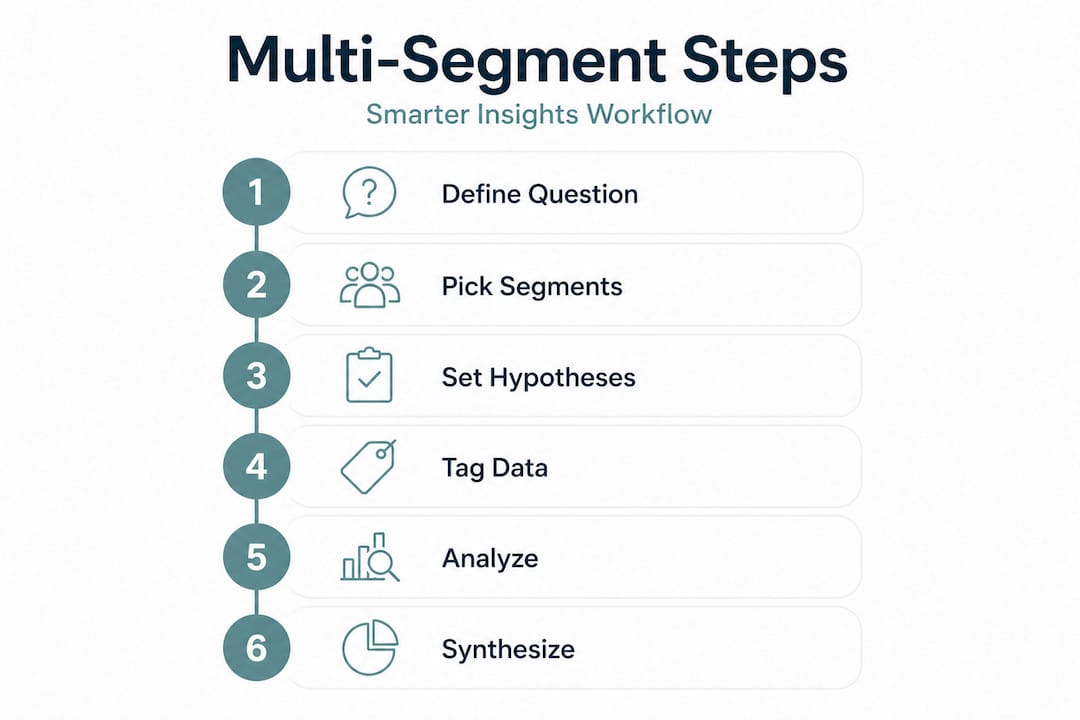
Step 4: Gather and clean data with segment integrity. Segment tagging must be consistent throughout data collection. Marketing data issues at the collection stage corrupt the entire comparative analysis. Use clear criteria for segment assignment and audit the data before analysis begins.
Step 5: Apply comparative analytical frameworks. Use side-by-side analysis of key themes, sentiment scores, and behavioral patterns across segments. Look for convergences (universal truths) and divergences (segment-specific signals). Both are valuable for different strategic purposes.
Step 6: Synthesize and act. Translate findings into segment-specific recommendations AND a unifying strategic view. The synthesis is where most teams underinvest. Raw comparisons aren't strategy. You need to interpret what the differences mean for your business priorities.
The role of AI in this process has shifted from supporting to accelerating. Agentic AI for market analysis enables iterative deepening across segments, meaning the system can follow up on emerging themes in real time rather than waiting for a human analyst to loop back weeks later. That speed changes what's possible.
Here's how classic multi-segment research compares to AI-agentic approaches:
| Dimension | Classic approach | AI-agentic approach |
|---|---|---|
| Study design | Manual, days to weeks | Automated, hours |
| Interview execution | Human-moderated | AI-moderated, adaptive |
| Analysis speed | Weeks post-collection | Real-time during collection |
| Iteration | One-shot study | Continuous refinement |
| Scalability | Limited by team size | Scales to any segment count |
| Cost per insight | High | Substantially lower |
For teams exploring AI-driven research methods, the agentic model is not a future concept. It's available now through platforms built specifically for this kind of work. The AI research platform model enables research that would previously require multiple agencies and months of timeline to complete in days.
For concrete examples of what this looks like in practice, market intelligence examples show how teams in retail, SaaS, and financial services have used comparative segment data to reallocate budgets, reframe positioning, and catch market shifts early. The automated marketing observability guide is also a useful reference for teams building the data infrastructure that makes multi-segment research reliable at scale.
Pro Tip: Use automation for rapid iteration across segments, but always validate your top findings manually before making major strategic decisions. AI accelerates discovery. Human judgment still governs interpretation.
Pitfalls and edge cases: Avoiding common traps
Even teams with the right intentions and frameworks can generate noise instead of insight. The traps here are predictable, which means they're also avoidable.
The most common problem is over-segmentation. More segments feel like more precision, but they often produce the opposite. Over-segmentation risks include creating segments that are too small to be statistically or commercially meaningful, generating campaign complexity that costs more than it returns, and fragmenting your marketing execution to the point of operational paralysis.
Here's what to watch for:
- Too many segments at once: Keep initial studies to two to four segments. You can always expand in follow-up cycles.
- Poorly defined segment boundaries: If you can't clearly articulate why two customers belong to different segments, your analysis will blur.
- Weak or incomplete input data: Prioritizing speed over data quality is a recurring mistake that produces confident-sounding but unreliable conclusions.
- Vanity segments: Segments defined by convenience rather than behavioral or strategic relevance generate findings that don't translate to action.
- Skipping validation: Marketing data errors at the tagging or collection stage can silently corrupt your entire comparative framework.
"The real risk of multi-segment research isn't that you'll find too little. It's that you'll find too much, and without discipline, complexity overwhelms actionability." The goal is not to understand every nuance of every segment. It's to find the differences that actually change what you should do.
Before investing in a full multi-segment rollout, stress-test your proposed segment scheme by asking two questions: First, would a meaningful strategic or tactical decision change based on how this segment responds differently? Second, do you have enough quality data to represent this segment accurately? If the answer to either question is no, that segment isn't ready for the study.
Pro Tip: Always pilot-test new segmentation schemes on a small slice of your audience before committing to a global rollout. A two-week pilot with limited scope will surface data quality issues, segment ambiguity, and methodology gaps before they become expensive mistakes at scale.
What most guides miss about multi-segment research
Here's the uncomfortable truth most playbooks skip over: segmenting further does not automatically mean targeting smarter. The conventional advice to "go deeper on your segments" is correct in principle but dangerously incomplete in practice.
The real art of multi-segment research is not in identifying more segments. It's in identifying which differences between segments actually drive outcomes that matter. Experienced teams know that most segment-level differences are noise. Only a fraction are signal. The challenge is developing the discipline to tell them apart before you build a campaign architecture around them.
We've seen teams build elaborate segment-specific messaging frameworks based on research that revealed meaningful differences in language preference but zero difference in purchase motivation. Those differences were real. They just weren't the ones that moved conversion. The research was technically correct and strategically irrelevant.
The winning approach blends two modes. First, broad scanning: run comparative research across multiple segments with an open mind about what might surface. Don't go in with tunnel vision. This is where you catch surprises that no one on your team was looking for. Second, sharp focus: once you've identified where segment differences actually affect behavior, decision-making, or loyalty, concentrate your resources there and ignore the rest.
This is also why quarterly tracking is already obsolete for most teams. The market moves faster than quarterly cycles allow you to respond. Multi-segment research done in real time, with adaptive AI tools, gives you the feedback loop you need to stay ahead of segment-level shifts rather than catching them after the fact.
Finally, be willing to "kill" segments that prove low-ROI. A segment that generates interesting research findings but requires disproportionate campaign complexity to serve is a resource drain, not an opportunity. The data should tell you when to walk away, and you need the discipline to listen to it.
Take your research further with advanced AI-native solutions
If the framework above sounds powerful but the execution timeline sounds daunting, you're not imagining the gap. Traditional research processes make multi-segment work expensive and slow. But that constraint no longer has to limit what your team can discover.
Gather's AI research platform was built specifically to make multi-segment research fast, reliable, and scalable for marketing and business teams. The platform automates study design, runs AI-moderated interviews with adaptive probing across multiple audience segments simultaneously, and delivers structured, board-ready insights in days rather than months. You get the comparative intelligence that drives smarter decisions without the agency timelines or internal bandwidth bottlenecks. Explore Gather's multi-segment use cases to see how teams in your space are already applying these approaches, and browse the latest customer research insights for real-world examples of what's possible.
Frequently asked questions
How is multi-segment research different from market segmentation?
Multi-segment research compares two or more audience segments in parallel within a single study, whereas traditional segmentation typically involves identifying or analyzing one target group at a time. Standard segmentation defines who your audiences are; multi-segment research reveals how and why they behave differently from each other.
What data quality issues harm multi-segment research the most?
Inaccurate segment tagging, incomplete records, and inconsistent data collection criteria are the most damaging because they corrupt the comparative layer that makes multi-segment analysis valuable. As segment data quality degrades, findings become misleading in ways that are hard to detect without strong validation processes.
How does AI improve multi-segment research?
Agentic AI tools enable iterative deepening across segments in real time, surfacing emerging themes and following up on unexpected findings during data collection rather than weeks later in analysis, which dramatically compresses research timelines and improves insight quality.
What is the biggest pitfall of multi-segment research?
Creating too many segments without sufficient data depth behind each one is the most resource-intensive mistake teams make. Over-segmentation produces small, unprofitable segments that require disproportionate campaign complexity to serve, generating confusion rather than the actionable clarity multi-segment research is designed to deliver.