

TL;DR:
- AI-powered real-time research provides rapid, ongoing insights from multiple data sources.
- Combining real-time monitoring with qualitative research yields the most accurate, actionable results.
- Implementing integrated AI platforms accelerates decision-making and improves marketing effectiveness.
Market research used to mean weeks of waiting. You'd commission a study, sit through rounds of data collection, and receive findings that were already aging by the time they hit your inbox. That model is fading fast. AI-driven capabilities, including real-time sentiment analysis, predictive analytics, machine learning pattern recognition, and autonomous multi-source synthesis, have rewritten the rules. Marketing and business leaders can now access structured, actionable insights in hours rather than months. This guide breaks down exactly how real-time research analysis works, what it can and cannot do, and how your team can apply it to make smarter, faster decisions.
Table of Contents
- What is real-time research analysis?
- How AI powers real-time research insights
- Limitations and risks of real-time research analysis
- Applying real-time research for marketing advantage
- Why blending real-time and traditional research outperforms either alone
- Accelerate your insights with Gather's AI-native solutions
- Frequently asked questions
Key Takeaways
| Point | Details |
|---|---|
| AI-driven speed | Real-time research analysis harnesses AI to deliver instant, actionable insights from streaming data. |
| Balance of approaches | Hybrid models combining real-time and traditional research avoid common pitfalls and offer deeper context. |
| Practical use cases | Marketing teams leverage real-time insights for agile campaign optimization and rapid decision-making. |
| Common challenges | Data overload, noisy inputs, and integration issues require quality controls and experienced guidance. |
What is real-time research analysis?
Real-time research analysis is the practice of collecting, processing, and interpreting data continuously as it is generated, rather than waiting for a defined collection period to close. Instead of periodic snapshots, your team receives a live, evolving picture of what customers think, what competitors are doing, and how markets are shifting.
The shift matters because business conditions move faster than traditional timelines allow. A product launch, a PR event, or a competitor price change can reshape customer sentiment within hours. If your research cycle takes eight weeks, you are always reacting to the past.
Modern real-time research pulls from a wide range of sources:
- Social media streams (posts, comments, trending topics)
- Digital behavior data (clickstreams, search queries, app usage)
- Customer feedback channels (reviews, support tickets, chat transcripts)
- Survey and interview responses collected and analyzed as they arrive
- CRM and point-of-sale data integrated directly into analysis pipelines
The marketing research process steps that once took weeks can now be compressed dramatically. Here is how the two approaches compare:
| Dimension | Traditional research | Real-time research |
|---|---|---|
| Turnaround | Weeks to months | Hours to days |
| Data freshness | Historical snapshot | Continuously updated |
| Scope | Defined, structured | Broad, multi-source |
| Cost model | High per-study cost | Scalable, lower per-insight |
| Best for | Deep strategic questions | Trend detection, rapid feedback |
Real-time research outputs typically include live sentiment scores, emerging topic clusters, audience segment shifts, and flagged anomalies that warrant deeper investigation. AI-driven enhancements such as sentiment analysis, predictive analytics, ML pattern recognition, and autonomous synthesis are what make these outputs possible at speed.
Key insight: Real-time research does not replace strategic depth. It adds a continuous signal layer that tells you when to dig deeper and where attention is most urgent.
How AI powers real-time research insights
Now that you know what real-time research is, let's explore the technology enabling these rapid insights.
Machine learning sits at the core. Algorithms trained on massive datasets can scan thousands of data points per second, recognize patterns that would take a human analyst days to surface, and update their outputs continuously as new data arrives. That is not an incremental improvement. It is a fundamentally different operating mode.
Here is what AI actually does inside a real-time research engine:
- Sentiment tracking: Natural language processing scores customer language as positive, negative, or neutral, and detects emotional shifts in near real time.
- Predictive modeling: Historical behavioral data trains models that forecast likely customer actions before they happen.
- Anomaly detection: Algorithms flag sudden spikes or drops in sentiment, engagement, or search volume, prompting faster human review.
- Multi-source synthesis: Autonomous AI agents pull data from social platforms, CRM systems, review sites, and survey tools simultaneously, then consolidate findings into structured reports.
The results are measurable. A Comcast case study demonstrated an 8-point familiarity lift and 100% ad recall using real-time TV ad insights, while synthetic AI consumers showed 90% alignment with human survey responses and delivered 40% time savings in content development. Those are not marginal gains.
Marketing teams that want to improve customer insights with AI are increasingly combining these tools with their existing workflows rather than treating AI as a standalone solution. The most effective setups integrate AI tools for marketers directly into campaign dashboards so that insight delivery happens inside the tools teams already use.
Pro Tip: Before relying on AI outputs for a major decision, set up a simple validation routine. Pull a random sample of flagged insights each week and cross-check them against a qualitative source, such as a small batch of customer interviews. Over time, this builds confidence in what your AI system gets right and surfaces its blind spots early.
Speed and scale are real advantages. Continuous monitoring means you are never caught flat-footed by a market shift. But speed without structure creates its own problems, which brings us to the risks.

Limitations and risks of real-time research analysis
Knowing the power of AI, it is crucial to understand its boundaries and how to avoid common traps.
The biggest challenge most teams encounter is data overload. Real-time systems generate enormous volumes of signals, and without robust filtering logic, your analysts can end up chasing noise instead of meaningful trends. High data volume overwhelming systems is a documented edge case, alongside accuracy issues from noisy sources like social media and integration challenges with legacy platforms.
Here is a numbered checklist of risk mitigation steps that experienced teams use:
- Define signal thresholds. Set clear rules for what constitutes a meaningful shift worth acting on. Not every sentiment dip requires a response.
- Audit your data sources. Social media data can be skewed by bots, viral events, or unrepresentative vocal minorities. Validate sources before trusting them at scale.
- Build integration buffers. When connecting real-time tools to legacy CRM or POS systems, use middleware layers to prevent data corruption or duplication.
- Schedule human review cycles. AI finds the pattern. A human validates the interpretation. Build that checkpoint into your workflow.
- Run parallel qualitative checks. Selecting hybrid research methods to complement your real-time data ensures you capture emotional and contextual nuance that algorithms miss.
And that last point deserves emphasis. Real-time research excels at agility and trend detection but lacks depth in emotional and contextual understanding. A sudden drop in brand sentiment tells you that something is wrong. It rarely tells you why with enough precision to act confidently.
For questions that require deep emotional understanding, such as why customers are churning or what motivates a new segment, hybrid approaches that pair real-time signals with qualitative interviews consistently outperform either method alone. You can find useful analytics tools for marketers that support this combined workflow.
Pro Tip: Once a quarter, benchmark your AI research outputs against a traditional survey or focus group on the same topic. If the alignment is strong, you can increase your reliance on real-time methods. If it diverges, investigate why before scaling further.
Applying real-time research for marketing advantage
Understanding the risks, let's see how marketing leaders are putting real-time insights into practice.
The most immediate application is campaign optimization. Instead of waiting for post-campaign analysis, teams can monitor sentiment and engagement in near real time, adjusting messaging, creative assets, or targeting parameters while the campaign is still live. That is a meaningful competitive edge.
Rapid audience research also benefits directly. Live behavioral and social data lets teams refine audience segments dynamically, identifying pockets of high engagement or emerging interest groups that a quarterly survey would have missed entirely.
Here are practical tactics that marketing teams are using right now:
- Concept testing at launch speed. Release a concept to a small sample, gather AI-analyzed feedback within 24 hours, and iterate before full rollout.
- Competitive signal monitoring. Track shifts in competitor sentiment or share of voice in real time to anticipate market moves.
- Feedback loop automation. Connect customer support data, app reviews, and social mentions into a single real-time dashboard for a unified view of customer experience.
- Trend-triggered content. Use emerging topic clusters from real-time analysis to inform content calendars, seizing relevance windows before they close.
The competitive research strategies that separate high-performing teams from average ones often come down to response speed. Real-time research compresses the gap between signal and action.
The empirical case is compelling. Real-time TV ad insights in the Comcast study produced an 8-point familiarity lift, a 14-point lift among independent viewers, 100% recall, and 40% time savings. Those results are not theoretical. They come from a real deployment with measurable business outcomes. Use a market research checklist to ensure your team captures the right signals before, during, and after every campaign.
Why blending real-time and traditional research outperforms either alone
Here is an uncomfortable truth that most research vendors will not tell you: speed alone is a trap. Marketing teams that chase real-time data without a qualitative anchor often end up optimizing for the wrong signals. A metric can move in the right direction while the underlying customer relationship quietly erodes.
Real-time provides speed and scale while traditional research delivers depth and nuance. Neither approach is universally superior. The savviest teams we see use real-time monitoring as a situational awareness layer, scanning continuously for anomalies and trends that warrant investigation. When a signal crosses a defined threshold, that triggers a deeper qualitative dive, not more dashboards.
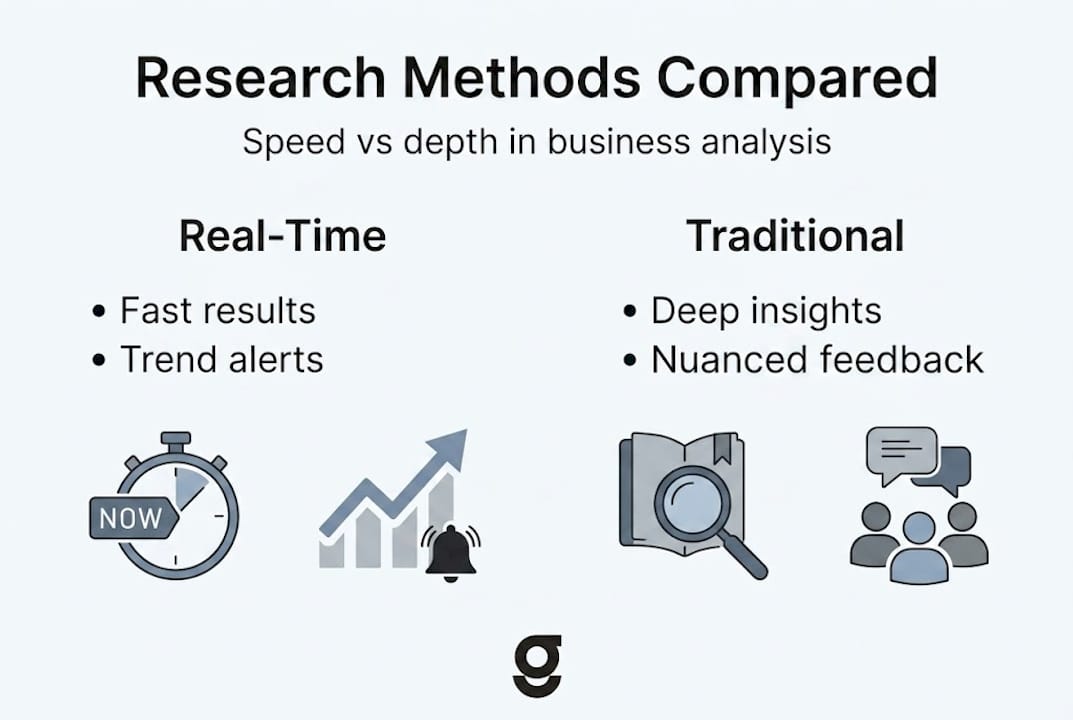
Think of it this way: real-time research tells you the forest is on fire. Qualitative research tells you why it started, which tree was the source, and what conditions made it possible. You need both to respond effectively and prevent it from happening again.
The practical framework is simple. Use continuous monitoring to generate triggers. Use structured interviews or focus groups to interpret those triggers with emotional and contextual depth. Then feed those findings back into your real-time models to improve their accuracy over time. Teams that follow this cycle when choosing research methodology systematically outperform those locked into either extreme.
Accelerate your insights with Gather's AI-native solutions
Real-time research is only as valuable as the platform running it. Fragmented tools, manual synthesis, and disconnected data sources create the exact bottlenecks you are trying to eliminate.
Gather's AI-native research platform automates the entire research lifecycle, from study design and AI-moderated interviews to real-time structured analysis and board-ready reporting, all within a single engine. Whether your team needs to test a new concept, monitor campaign sentiment, or segment live audiences, Gather connects directly to your CRM and existing data sources to deliver insights in days. Explore real-time research use cases tailored to marketing and business teams, or download the 2026 Customer Research Study to see how leading teams are closing the gap between data and decision.
Frequently asked questions
How does real-time research analysis differ from traditional market research?
Real-time research delivers insights as data flows in continuously, while traditional research relies on structured collection periods followed by deeper analysis, making it stronger for nuance but slower to respond.
Can real-time research replace traditional methods for all business decisions?
No. Real-time methods excel at trend detection and rapid feedback loops, but for strategic questions that require emotional depth, hybrid approaches consistently yield more reliable and complete results.
What are the most common pitfalls with real-time research analysis?
High data volume, noisy or unrepresentative sources like social media, and legacy system integration failures are the most frequent issues, all of which improve significantly with quality controls and hybrid validation methods.
Are there proven results for using real-time research in marketing?
Yes. Case studies including the Comcast deployment show double-digit familiarity lifts and 40% time savings compared to traditional research approaches, demonstrating measurable business impact.