

TL;DR:
- Traditional market research is slow, costly, and causes missed opportunities and strategic misalignment.
- AI-driven research speeds insights from weeks to hours, reducing costs by over 70%.
- Integration and human oversight are essential for reliable, actionable intelligence from AI tools.
Market research used to mean long timelines, big agency invoices, and insights that arrived after the decision window had already closed. That's no longer acceptable. Streamlining market research can compress timelines from weeks or months into hours, giving marketing and business leaders the intelligence they need when it actually matters. This guide breaks down the real costs of legacy approaches, shows you what AI-driven research delivers in practice, and gives you a concrete framework for building faster, smarter, and more reliable insight capabilities inside your organization.
Table of Contents
- The hidden costs of traditional market research
- AI-powered market research: Speed, scale, and smarter ROI
- Integrating platforms: Reducing silos to gain holistic insight
- Best practices for implementing streamlined market research
- What most leaders miss about streamlining market research
- Next steps: Explore AI-driven research solutions
- Frequently asked questions
Key Takeaways
| Point | Details |
|---|---|
| AI slashes research time | AI platforms cut market research from weeks to hours, enabling faster decisions. |
| Costs drop dramatically | AI-driven tools lower qualitative research costs by 95%, making insights accessible. |
| Holistic perspectives | Integrating research platforms reduces silos, yielding more actionable, cross-team intelligence. |
| Human insight remains essential | AI augments, not replaces, expert analysis—reliable outcomes require balanced adoption. |
The hidden costs of traditional market research
Most business leaders think of market research expenses in terms of the invoice they receive at the end of an agency engagement. That invoice is just the visible part of the problem. The real costs are buried in what doesn't happen while you're waiting.
A typical traditional research project moves through sequential stages: briefing an agency, agreeing on methodology, recruiting participants, running fieldwork, and then waiting weeks for a final report. That process routinely takes six to twelve weeks. By the time insights land, the product launch has been rescheduled, the competitive landscape has shifted, or the budget conversation has moved on without the data you needed.
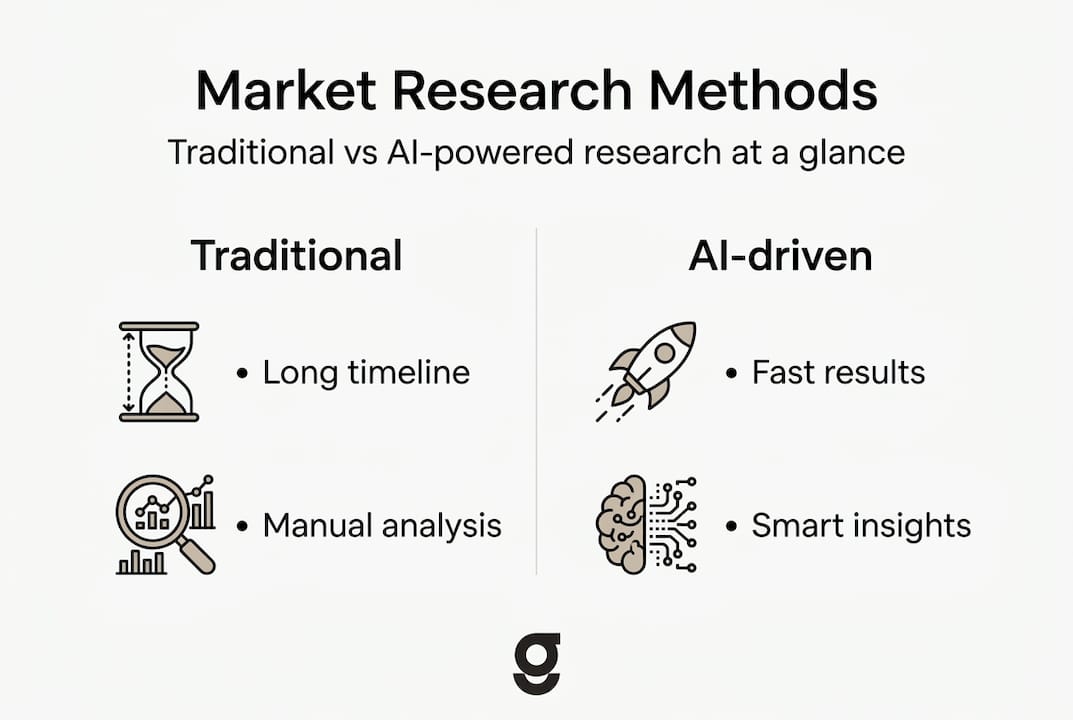
Consider what that delay actually costs a mid-size business. If a product team is waiting on consumer feedback before finalizing a feature roadmap, every week of delay is a week of engineering work being done on assumptions rather than evidence. Multiply that across several research cycles per year, and the opportunity cost dwarfs the agency fees.
The financial picture is equally grim when you add up direct costs. Traditional qualitative research, particularly depth interviews conducted by experienced moderators, typically runs between $500 and $1,500 per interview. Running 50 interviews to achieve statistical confidence in a qualitative sample can cost upward of $75,000 for that single study. AI-driven tools now deliver qualitative research at scale for roughly $20 per interview, a reduction of 95% or more.
Here is what leaders consistently underestimate when they calculate the cost of their current research setup:
- Delayed product decisions caused by waiting for reports that arrive after internal deadlines
- Misaligned budgets when research findings contradict assumptions that have already been baked into annual plans
- Lost competitive windows where a faster rival acts on similar intelligence while your team is still waiting on a deliverable
- Internal rework costs when teams pivot after receiving late-arriving data that contradicts earlier assumptions
- Recruitment bottlenecks that push timelines out even further when hard-to-reach audiences are involved
"The most dangerous moment in market research isn't when the data is wrong. It's when the data arrives right but too late to act on."
Exploring competitive research strategies that are designed for speed reveals just how much advantage organizations leave on the table when they accept slow research as a given. Understanding the rapid research process steps that modern teams now use makes the gap even more apparent. Speed isn't a luxury anymore. It's a core capability.
AI-powered market research: Speed, scale, and smarter ROI
Once you see what legacy research actually costs, the case for AI-driven alternatives becomes straightforward. The more interesting question is exactly what those tools deliver and how the comparison plays out across the dimensions that matter most to leaders.
According to Harvard Business Review, the primary reasons organizations are adopting AI research tools include the ability to speed up insight cycles for agile decisions in competitive markets, reduce costs and time by 70 to 96%, eliminate cross-team silos for more holistic views, run 200 or more interviews rapidly, and ultimately boost ROI through better strategic decisions and risk mitigation. That's not a marginal improvement. It's a category-level shift.
Here's how the two approaches compare across the metrics that matter most:
| Dimension | Traditional research | AI-powered research |
|---|---|---|
| Time to insights | 6 to 12 weeks | 24 to 72 hours |
| Cost per interview | $500 to $1,500 | $15 to $25 |
| Scalability | Limited by moderator capacity | 200+ interviews simultaneously |
| Analysis speed | Days to weeks | Real-time or same-day |
| Actionable output | Static PDF report | Structured, searchable insights |
| Iteration speed | New study required | Dynamic follow-up questions |
The table tells a clear story, but the real-world implications go deeper. When you can run 200 interviews in 48 hours instead of waiting six weeks to complete 40, you gain the ability to test multiple hypotheses in the same time it used to take to test one. That changes how product teams, marketing strategists, and executive leadership use research altogether.
AI for competitive intelligence is particularly powerful here because the speed advantage compounds. A team that can run weekly research sprints builds a living picture of the market rather than relying on a static snapshot taken six months ago. Paired with agile audience research practices, this creates a continuous intelligence loop that supports faster, more confident decisions at every level of the organization.
One area where the ROI case is especially strong is qualitative research at scale. Traditional thinking held that qualitative methods, specifically depth interviews and focus groups, couldn't be scaled without losing nuance. AI-moderated interviews with adaptive probing challenge that assumption directly. You get the depth and texture of qualitative inquiry at the volume that quantitative surveys used to require.
Pro Tip: Before selecting any AI research platform, audit how it handles insight synthesis. Platforms that only automate data collection without structuring outputs for decision-makers force you to recreate the analysis bottleneck you were trying to eliminate. Look for tools that deliver ready-to-present findings, not just raw transcripts.
Streamlining market research with integrated platforms takes the speed and cost advantages further by removing the friction between research execution and strategic application.
Integrating platforms: Reducing silos to gain holistic insight
Speed matters. But speed without integration creates a different kind of problem. When research outputs live in separate tools, teams end up working from different versions of the truth. Marketing builds its strategy on one data set while product uses another, and leadership synthesizes neither into their planning cycle. That's the silo problem, and it's more common than most organizations want to admit.
Siloed research doesn't just create coordination headaches. It generates blind spots. A customer satisfaction study conducted by the CX team may contain signals that are directly relevant to a pricing decision being made by the commercial team, but if those insights never reach the right stakeholders, they might as well not exist. The impact of silos on decision-making speed is well documented, with fragmented platforms consistently identified as a leading cause of delayed or poorly informed decisions.

Integrated research platforms address this by centralizing study design, execution, analysis, and reporting in a single environment. When your CRM data, POS transaction history, and research panel all connect to the same platform, you can design studies that target specific customer segments with precision and then route findings to every team that needs them simultaneously.
The benefits of genuine platform integration include:
- Unified data access that gives every team the same research foundation, eliminating competing interpretations
- Faster cross-functional alignment because insights are available to all stakeholders the moment a study is complete
- Targeted audience segmentation using existing customer data to reach exactly the right respondents, whether that's churned B2B accounts or high-value Gen Z consumers
- Reduced duplication when teams stop running separate studies on the same question because one team didn't know the other was already researching it
- Compounding intelligence as each study builds on prior findings in a shared repository rather than disappearing into a file folder
| Integration factor | Siloed approach | Integrated platform |
|---|---|---|
| Cross-team data access | Varies by team | Universal and real-time |
| Speed to insight sharing | Days to weeks | Immediate |
| Audience targeting precision | Limited | CRM and POS connected |
| Duplicate research risk | High | Significantly reduced |
| Strategic agility | Low | High |
Building scalable market intelligence requires this kind of infrastructure. Without it, even the fastest AI-driven research generates insights that get stuck in transit. The integrated research platform model solves this by making research a shared organizational asset rather than a departmental artifact.
Best practices for implementing streamlined market research
Knowing what streamlined research can deliver and actually implementing it are two different challenges. Many organizations invest in AI research tools and still fail to see the ROI because they skip the process changes that make technology effective. Here's how to do it right.
Step-by-step implementation plan:
-
Audit your current research stack. Map every tool, process, and vendor involved in your research cycle today. Identify where the delays occur and which steps add the most cost without adding proportional value.
-
Define your insight needs by decision type. Not every business question requires the same methodology. Match research approaches to specific decision categories, for example, product validation, audience segmentation, pricing sensitivity, or brand perception.
-
Select a platform that covers the full lifecycle. Prioritize solutions that handle study design, execution, analysis, and reporting in one environment. Fragmented tool stacks recreate the silos you're trying to eliminate.
-
Train teams on AI-augmented workflows. Technology adoption fails when teams don't understand how to work with AI outputs critically. Build literacy around what AI does well and where human review is essential.
-
Pilot on a contained use case first. Choose a single business question with a clear decision attached and run your first AI-powered study on that. Use the result to build internal confidence before scaling.
-
Establish a review protocol. Build in checkpoints where experienced researchers or analysts review AI-generated insights before they inform major decisions. This is not about slowing down but about maintaining quality control.
Common mistakes to avoid at each stage:
- Treating AI research outputs as final without human review
- Implementing new tools without retiring old ones, which adds cost and confusion
- Ignoring change management entirely and expecting teams to self-adopt
- Running AI-generated studies on questions that are too broad to yield actionable answers
- Skipping methodology selection and defaulting to surveys when depth interviews would deliver richer insight
The market research checklist framework is a practical companion to these steps, helping teams avoid the most common execution gaps. Choosing the right method for each business question is foundational, and guidance on research methodology selection can prevent costly misalignments before a study begins.
It's also critical to understand the risk dimension. The generative AI research landscape represents a $140 to $153 billion industry transformation, but the same analysis highlights real hype risks including hallucinated insights, adoption resistance from research teams, and over-reliance on automated outputs. AI is most powerful as an augmentation of skilled human thinking, not a replacement for it.
Pro Tip: Establish a "confidence scoring" practice for AI-generated insights. Flag outputs that come from smaller sample sizes, ambiguous question wording, or responses that seem inconsistent with prior research. Treat these with more scrutiny before allowing them to drive significant decisions.
Real-world market intelligence examples consistently show that organizations achieving the highest ROI from AI research are those that pair fast technology with disciplined human oversight, not those that remove human judgment from the loop entirely.
What most leaders miss about streamlining market research
Here's the uncomfortable reality: most leaders who adopt AI research tools are optimizing for the wrong thing. They measure success by how fast the report arrives and forget to ask whether the insight was worth acting on.
Speed is the entry-level benefit of streamlined research. The organizations that actually pull ahead are the ones that use speed to run more experiments, test more hypotheses, and build richer models of their markets over time. They treat fast research as an input to better thinking, not a substitute for it.
The generative AI research risk analysis makes this point explicitly. Hallucinations, over-reliance, and adoption resistance aren't just technical problems. They're symptoms of organizations that deployed AI without rethinking how insight actually connects to decision-making. The technology changed but the mental model didn't.
The leaders who build lasting competitive advantage treat AI as a partner for their analysts, not a replacement. They monitor outputs critically, invest in human expertise alongside technology, and design research programs that compound over time. A good customer research crisis study illustrates exactly what happens when the guardrails aren't in place. Speed without rigor doesn't just fail to deliver value. It can actively mislead.
The real question isn't "how fast can we get insights?" It's "how quickly can we make better decisions?" Those are not the same thing, and the difference is where competitive advantage actually lives.
Next steps: Explore AI-driven research solutions
If the gap between your current research timelines and what's now possible feels significant, that's because it is. Gather's AI-native research platform was built specifically to close that gap, automating study design, methodology selection, interview execution, and insight delivery in a single environment. You get board-ready, branded outputs in days rather than months, without agency dependency or lengthy procurement cycles.

To see how real organizations are applying these capabilities, explore Gather's market research use cases across product validation, competitive intelligence, audience segmentation, and brand tracking. For a deeper look at what the research landscape looks like in 2026, Gather's original 2026 study offers data-backed findings you can reference directly in internal strategy conversations. The tools exist. The question is whether you're ready to use them.
Frequently asked questions
How much time can AI-powered market research actually save?
AI tools can reduce processing time by up to 70%, compressing research cycles that once took weeks into work that's completed within hours or a single business day.
Is AI market research reliable for qualitative insights?
AI enables large-scale qualitative research with speed and consistency, but hype risks like hallucinations mean human oversight remains essential to catch errors and validate findings before they drive decisions.
What are the risks of over-relying on AI-driven market research?
Over-reliance can produce inaccurate or misleading outputs. The best practice is augmentation, using AI to accelerate and scale while keeping experienced human analysts in the loop to review and interpret results.
How does streamlining market research impact ROI?
Faster research cycles reduce direct costs dramatically while improving the quality of strategic decisions. AI-driven research tools boost ROI by enabling agile decisions, reducing research spend, and mitigating risk through better market intelligence.