

TL;DR:
- AI accelerates market research process from weeks to hours and reduces costs significantly.
- Preparing objectives, team, data access, and tool selection is essential for successful AI integration.
- Combining AI efficiency with human expertise ensures reliable insights and maintains ethical standards.
Imagine your competitor launches a product that perfectly addresses a gap you identified months ago, but your research findings are still stuck in analysis. Traditional market research can take 4 to 12 weeks and cost up to $100,000 per study, turning strategic decisions into waiting games. AI-powered workflows change that equation entirely, delivering insights in hours instead of weeks at a fraction of the cost. This guide walks you through diagnosing what slows your current process, setting up an AI-ready foundation, executing each phase of a modern workflow, and validating results so you can move fast without sacrificing accuracy.
Table of Contents
- What slows down traditional market research workflows?
- Preparing for an AI-powered research workflow
- Executing each phase: A step-by-step market research workflow
- Troubleshooting: Validating insights and overcoming workflow pitfalls
- Expected outcomes: What a modern AI-powered workflow delivers
- A fresh perspective: Why the hybrid model is the real future of market research
- Supercharge your workflow with Gather's AI-native market research platform
- Frequently asked questions
Key Takeaways
| Point | Details |
|---|---|
| AI accelerates research | Modern workflows using AI reduce market research time and cost by 25-60 percent. |
| Hybrid models work best | Combining AI tools with human expertise prevents bias and ensures reliable, creative insights. |
| Preparation is critical | Clear objectives, skilled teams, and proper validation steps help maximize workflow efficiency. |
| Faster insights drive strategy | Access to rapid, actionable research gives executives a substantial competitive edge in decision-making. |
What slows down traditional market research workflows?
Legacy research processes were built for a slower world. Understanding where the friction lives is the first step toward eliminating it.
The research process steps in traditional setups involve long chains of manual work: recruiting participants, designing surveys, collecting data, cleaning spreadsheets, and writing reports. Each handoff introduces delays. Stakeholder alignment meetings add more. By the time findings land in an executive's inbox, the market context has often shifted.
Here is how traditional and AI-powered research compare across the metrics that matter most to your team:
| Metric | Traditional research | AI-powered research |
|---|---|---|
| Timeline | 4 to 12 weeks | Hours to days |
| Cost per study | $15,000 to $100,000 | $500 to $5,000 |
| Data search time | High, manual effort | 60% reduction |
| Scalability | Limited by headcount | On-demand |
The bottlenecks that drive these gaps fall into a few consistent patterns:
- Manual data gathering requires researchers to pull from multiple disconnected sources, eating hours before any analysis begins.
- Sequential approval cycles mean that by the time research is greenlit, the window for action may have closed.
- Siloed tools and data force teams to reconcile incompatible formats, slowing synthesis.
- Budget ceilings limit how frequently teams can commission research, creating dangerous blind spots.
"The organizations that feel this pain most acutely are not the ones doing too little research. They are the ones trying to do the right amount of research in systems designed for a different era." This is exactly what AI research transformation is solving at scale.
Opportunity cost compounds every delay. A four-week lag in customer sentiment data is not just an inconvenience. It is a strategic liability.
Preparing for an AI-powered research workflow
Preparation determines whether AI accelerates your research or just complicates it. Rushing into AI tools without the right foundation is a common mistake that leads to noisy outputs and frustrated teams.
Start with four non-negotiables before any tool is deployed:
- Define sharp objectives. Vague questions produce vague answers. Nail down exactly what decision you need to make and what information would change it.
- Assemble the right team mix. You need both AI-literate analysts who can configure and interpret models, and domain experts who can gut-check outputs against business reality.
- Establish data access. AI tools are only as useful as the data they can reach. Connect your CRM, POS, and any behavioral datasets before you start.
- Select your tools intentionally. Match tools to research type: qualitative AI for interviews, quantitative AI for survey analysis, synthesis tools for cross-source integration.
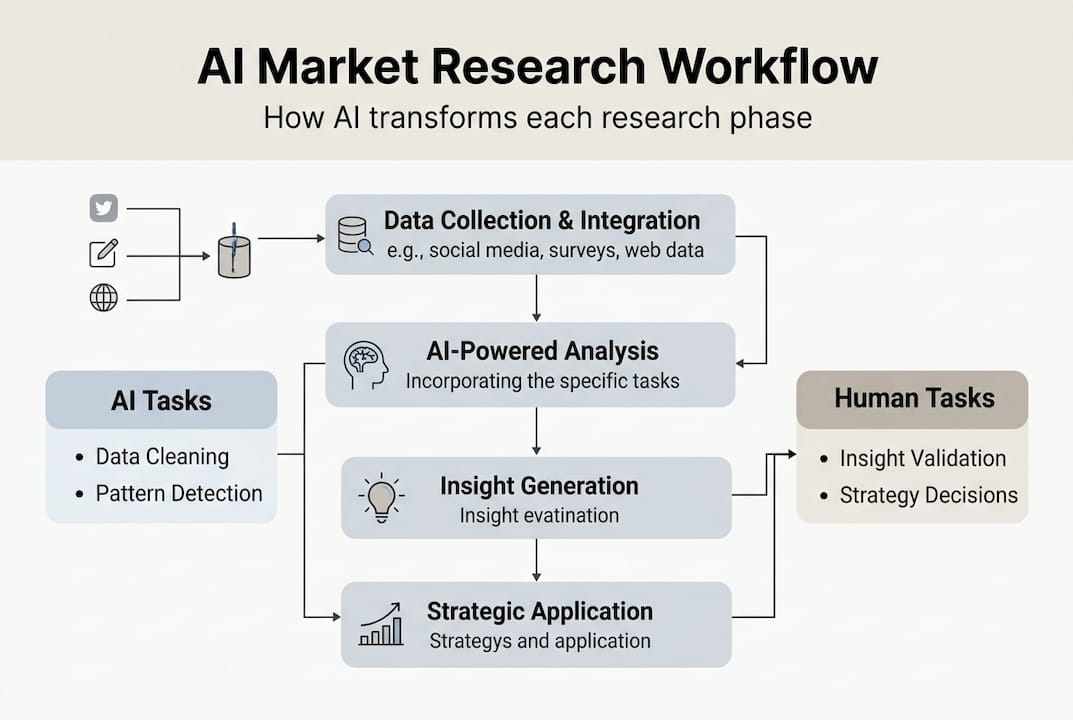
The most effective setup is a hybrid model where AI handles 80% routine work such as data cleaning, pattern detection, and initial coding, while your team focuses on interpretation, strategic framing, and ethical review.

Here is a comparison of where each approach adds the most value:
| Task | Best handled by AI | Best handled by humans |
|---|---|---|
| Survey analysis | Yes | No |
| Trend pattern detection | Yes | No |
| Empathy-driven qualitative probing | No | Yes |
| Strategic recommendation | No | Yes |
| Bias validation | Partial | Yes |
Pro Tip: Build a bias review checkpoint into your workflow before any AI output reaches decision-makers. Assign one team member to flag findings that seem counterintuitive or suspiciously clean.
For inspiration on how faster competitive intelligence looks in practice, look at teams that have rebuilt their workflows around AI-first principles. The efficiency gains are real, but only when preparation precedes execution. Review AI research workflow use cases to see which setup fits your organization's size and research cadence.
Executing each phase: A step-by-step market research workflow
With your foundation in place, here is how to carry out a seamless, AI-powered workflow step by step.
- Define the objective and scope. Write a one-sentence research question. Identify your target audience segment, your success metrics, and your delivery deadline. This document governs every subsequent decision.
- Design the study with AI assistance. Use AI to suggest methodology options based on your objective. Whether that is survey design, interview guides, or social listening parameters, AI can generate drafts in minutes rather than days.
- Automate data gathering. Pull from connected sources automatically. AI can scrape structured and unstructured data, run AI-moderated interviews with real participants, and consolidate multi-channel inputs simultaneously.
- Run AI-assisted analysis. Pattern recognition, sentiment analysis, thematic coding, and cross-segment comparison all happen in the background while your team reviews interim outputs. AI workflows deliver analysis that is 25 to 40% faster and at dramatically lower cost than traditional methods.
- Apply human interpretation. This is not optional. Someone with business context must review AI findings for logical consistency, strategic relevance, and potential blind spots before any recommendation is finalized.
- Package and share findings. Use automated reporting tools to generate board-ready summaries. Build in a structured feedback loop so stakeholder reactions feed into the next research cycle.
Pro Tip: Treat every research cycle as an iteration. Feed stakeholder questions back into the objective-setting phase so each study builds on the last rather than starting from zero.
A strong audience research workflow follows this exact logic: tight inputs, automated middle layers, and human-led outputs. For teams scaling this process across multiple markets, scalable market intelligence frameworks make the difference between a one-time win and a repeatable competitive advantage.
Troubleshooting: Validating insights and overcoming workflow pitfalls
Even with AI's speed, vigilance is crucial. Here is how to ensure your workflow delivers reliable results.
"AI can amplify existing bias in training data, and it lacks the human creativity and ethical judgment required for nuanced interpretation." This finding from Columbia Business School research reinforces why validation steps are not bureaucratic overhead. They are risk management.
The most common pitfalls in AI research workflows are:
- Training data bias: If your AI model was trained on data that overrepresents a specific demographic, its pattern recognition will reflect that skew.
- Overcondifence in automation: AI-generated summaries can sound authoritative while missing critical nuance. Always cross-reference with primary source quotes.
- Context collapse: AI excels at finding patterns across large datasets but can strip the emotional and situational context that makes qualitative research valuable.
- Undocumented sources: If you cannot trace where an AI-generated insight came from, you cannot defend it in a boardroom.
Practical validation steps to build into every workflow:
- Cross-check AI outputs against raw data samples before accepting findings
- Have a domain expert who was not involved in the analysis review conclusions independently
- Run the same question through two different methodologies and compare outputs
- Document every data source and transformation step for auditability
Review your approach to mitigating AI research bias and establish research compliance best practices as standing protocols, not afterthoughts. Consistency here is what separates trustworthy insights from expensive noise.
Expected outcomes: What a modern AI-powered workflow delivers
Once pitfalls are addressed, here is what executives can realistically expect from their upgraded workflow.
The numbers are striking. AI-powered research cuts costs by 60% or more compared to traditional methods, speeds up research cycles dramatically, and measurably improves strategic decision velocity. That is not a minor efficiency gain. That is a structural competitive advantage.
| Outcome | Traditional baseline | AI-powered result |
|---|---|---|
| Research cycle time | 4 to 12 weeks | 1 to 5 days |
| Cost per study | $15,000 to $100,000 | $500 to $5,000 |
| Insight frequency | Quarterly or annual | Continuous or weekly |
| Decision speed | Weeks post-report | Same day |
Beyond the metrics, the qualitative improvements matter just as much:
- Teams shift from reactive to proactive. Instead of scrambling to understand what just happened, you are monitoring signals in real time.
- Research becomes a habit, not a project. Lower cost and faster turnaround mean you can run studies whenever a business question arises, not just when budget allows.
- Stakeholders trust insights more when they arrive faster and with clear sourcing, which reduces the political friction around data-driven decisions.
Stat callout: Organizations that adopt AI-first research workflows report not only cost reductions but improved ROI on market intelligence budgets because insights arrive while they are still actionable.
For real examples of how this plays out across industries, explore market intelligence outcomes and review the AI research ROI case study that shows what these gains look like in a product roadmap context.
A fresh perspective: Why the hybrid model is the real future of market research
Here is the uncomfortable truth most AI vendors will not tell you: AI alone is not enough.
Pure AI research delivers speed and scale, but it regularly stumbles on context, empathy, and ethical nuance. Ask an AI to analyze customer churn data and it will identify patterns faster than any human team. Ask it to understand why a loyal customer felt betrayed enough to leave, and it will give you a probabilistic summary that misses the emotional texture entirely.
At the same time, pure traditional research is simply not viable at the pace markets now move. Waiting 12 weeks for a study to conclude before making a product decision is a form of organizational paralysis.
The research from Columbia Business School on generative AI is clear: AI delivers scale, traditional methods deliver depth, and the hybrid approach is optimal. The smartest organizations we see are not choosing between speed and quality. They are building systems where AI handles continuous monitoring and pattern detection while humans focus on creative synthesis and strategic framing.
What separates winners from laggards is not which tools they use. It is how frequently they iterate. One annual study, even an AI-powered one, is still a one-and-done approach. The advantage goes to teams that treat research as a continuous feedback loop. Explore the 2026 research study insights to see what leading organizations are doing differently.
Supercharge your workflow with Gather's AI-native market research platform
If the workflow described in this article sounds like where you want to be, Gather is built to get you there without rebuilding your entire research operation from scratch. Gather's AI-native platform automates study design, conducts AI-moderated interviews, delivers real-time structured analysis, and generates board-ready reports in days.
From integrating with your existing CRM data to supporting SOC 2 compliant research at scale, Gather handles the infrastructure so your team can focus on strategy. Review the 2026 research study for benchmark data, explore the full Gather AI research platform to see how it fits your workflow, and browse real-world use cases to find the fastest path to your first AI-powered insight.
Frequently asked questions
What is the biggest benefit of an AI-powered market research workflow?
AI workflows dramatically reduce turnaround time and cost, making it possible to generate actionable market insights in hours or days. Analysis that once took weeks now completes in a fraction of the time at 25 to 40% lower resource investment.
How can I prevent bias in AI market research results?
Use a hybrid workflow that validates AI outputs with human expertise and regularly audits models for data skew. AI lacks the ethics and creativity needed for nuanced judgment, which is why human review is non-negotiable.
What steps should I take to implement an AI-driven market research workflow?
Set clear objectives, assemble a team with both AI and domain expertise, then automate routine analysis while reserving interpretation for humans. The 80% routine with AI model is a proven starting framework.
Are AI-powered market research platforms suitable for small teams?
Absolutely. Automation and significantly lower per-study costs make AI platforms accessible to lean teams. Cost per study drops from $15,000 to $100,000 in traditional research to $500 to $5,000 with AI-powered tools, making frequent research viable even on tight budgets.
Recommended
- The Customer Research Crisis — 2026 Original Study | Gather
- How to select research methodology for fast insights
- How AI transforms competitive intelligence: faster insights
- Rapid audience research for agile marketing success
- Top AI applications for ecommerce sales & segmentation - Affinsy Blog | Affinsy