

TL;DR:
- Most marketers rarely conduct target audience research despite its link to higher success rates.
- Effective research combines multiple data sources, especially demographic and psychographic insights.
- Acting quickly on research findings, involving cross-functional teams, and focusing on motivation improve results.
A survey of 1,600 marketers revealed that 65% never or rarely research their target audience. Yet the teams that do invest in real research are over 3x more likely to succeed. That gap is staggering. Marketing and business leaders pour resources into campaigns, channels, and creative, but skip the foundational step that makes everything else work. This guide walks you through proven methods for target audience research, shows you where most teams go wrong, and gives you a clear path to turning insights into measurable business outcomes.
Table of Contents
- What is target audience research?
- Key methods and tools for audience research
- Demographics vs. psychographics: Avoiding false assumptions
- Applying audience research for business impact
- Why most audience research fails—and what top teams do differently
- Accelerate your research with Gather
- Frequently asked questions
Key Takeaways
| Point | Details |
|---|---|
| Data trumps guesswork | Investing in structured audience research leads to higher ROI and smarter strategy. |
| Combine research methods | Mixing qualitative and quantitative tools gives you the clearest, most actionable insights. |
| Focus on psychographics | Going beyond demographics with psychographic data delivers more relevant messaging and better results. |
| Turn insights into action | The value of research lies in quickly applying findings to strategy, messaging, and product development. |
What is target audience research?
Target audience research is the process of identifying, understanding, and segmenting the specific group of people most likely to engage with, buy from, or advocate for your product or service. It sounds straightforward, but most teams confuse it with casual observation or gut-feel assumptions. Real research is structured, data-driven, and repeatable.
The goal is to move beyond generic buyer personas built from guesswork and into detailed, evidence-based profiles that reflect how your audience actually thinks, behaves, and makes decisions. Done right, it tells you who your audience is, what they care about, where they spend time, and why they choose one solution over another.
Why does this matter for budget allocation? Because without it, you are essentially optimizing campaigns for the wrong people. Every dollar spent on a misaligned message or channel is a dollar that could have driven a conversion elsewhere. Target audience research removes that risk by grounding strategy in real signal, not assumption.
The foundation of good audience research is blending multiple data sources. Primary and secondary approaches each serve a distinct purpose. Primary research collects new data directly from your audience. Secondary research mines existing datasets to surface patterns. Combining both gives you a fuller picture faster.
Core methods include:
- Surveys: Scalable and fast. Great for quantitative validation of hypotheses.
- Focus groups: Surface qualitative depth and emotional nuance.
- CRM analytics: Reveal behavior patterns from existing customers.
- Social listening: Tracks organic conversations and sentiment in real time.
- Interviews: One-on-one format uncovers motivations that surveys miss.
- Secondary data: Industry reports and academic studies provide market-level context.
For teams exploring agile audience research, the goal is to run these methods in parallel rather than sequentially. Waiting for one study to complete before starting another adds weeks to a process that can be compressed dramatically with the right technology.
"Relying on a single method creates blind spots. The most actionable insights come from triangulating across multiple data sources, blending what people say with what they actually do."
Key methods and tools for audience research
Choosing the right mix of methods depends on your timeline, budget, and the type of questions you need to answer. Here is a breakdown of the main options:
| Method | Primary purpose | Speed | Relative cost | Best tools |
|---|---|---|---|---|
| Surveys | Quantitative validation | Fast | Low | Typeform, SurveyMonkey |
| Focus groups | Qualitative depth | Moderate | High | Zoom, dedicated panels |
| Social listening | Sentiment and trends | Real-time | Low to mid | Brandwatch, Sprout Social |
| CRM analytics | Behavior and history | Fast | Low (existing data) | Salesforce, HubSpot |
| Secondary research | Market context | Fast | Low | Statista, industry reports |
Modern tools have shifted the economics of audience research. AI-powered social listening platforms can analyze millions of conversations in hours. Analytics tools in e-commerce now integrate behavioral data with purchase history to generate audience segments automatically. Integrated CRM dashboards surface patterns that would take analysts weeks to find manually.
Here is where teams often go wrong: they pick one method and treat it as the full picture. Surveys tell you what people say they believe. Behavior data tells you what they actually do. Those two datasets frequently contradict each other, and that gap is where your most valuable insight lives.
Key use cases by method:
- Surveys: Use when you need to validate a hypothesis across a large sample quickly.
- Interviews: Use when you need to understand the emotional drivers behind a decision.
- Social listening: Use when you want unfiltered, unprompted audience opinion.
- CRM analytics: Use when you need to segment by purchase behavior or lifecycle stage.
- Secondary research: Use to establish market baselines before fieldwork begins.
For teams building a competitive research strategy, layering competitive intelligence on top of audience insights creates a powerful positioning advantage. A faster research checklist can help teams prioritize which methods to run first given time constraints.
Pro Tip: Never rely on a single research method. Combine at least two, ideally one quantitative and one qualitative, to surface insights that neither approach could reveal on its own.
Demographics vs. psychographics: Avoiding false assumptions
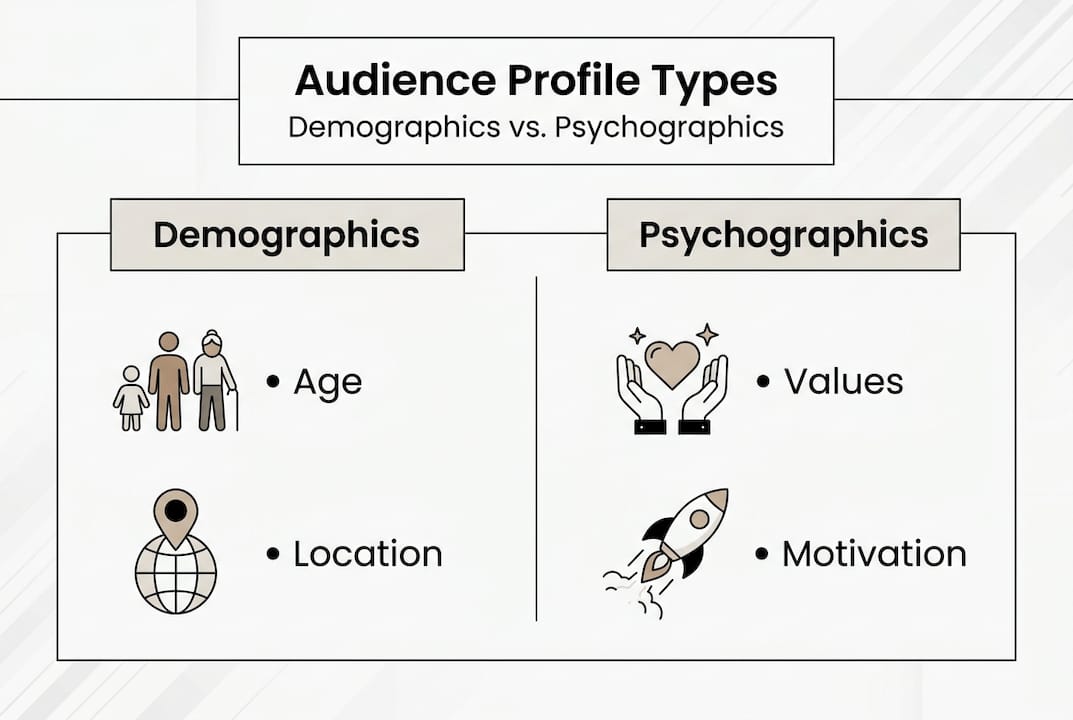
Here is the problem with most audience profiles: they stop at demographics. Age, gender, income, location. These are useful descriptors, but they explain very little about why someone buys.

| Demographics | Psychographics | |
|---|---|---|
| What it captures | Who your audience is | Why they buy |
| Examples | Age, gender, location, income | Values, beliefs, lifestyle, motivations |
| Best for | Targeting and reach | Messaging and creative strategy |
| Risk | False precision | Harder to measure at scale |
| When to use | Defining your addressable market | Crafting persuasive campaigns |
Consider this: two consumers, both 35-year-old urban professionals earning $90,000 a year. Demographically identical. One prioritizes convenience and speed. The other values sustainability and ethical sourcing above price. Send them the same campaign message and you will convert one and alienate the other.
Psychographics reveal that people with identical demographic profiles can have completely opposite values and purchasing triggers. Demographic data creates false positives by suggesting uniformity where genuine behavioral divergence exists.
"Demographics tell you who is in the room. Psychographics tell you what they actually care about. You need both, but persuasion runs on psychographics."
This is not a theoretical distinction. Cambridge Analytica's controversial influence work demonstrated that psychographic profiling can be used to predict and shift behavior far more effectively than any demographic model. The lesson for ethical marketers is not to copy the tactic but to recognize the underlying truth: motivation drives action, not identity category.
The practical fix is simple. Before you design any demographic filter for a campaign or research study, map out the "why they buy" questions first. What problem are they trying to solve? What do they fear? What do they aspire to? These questions lead you to the psychographic profile, which then informs how you shape the message.
For a structured approach to this process, the marketing research process steps framework provides a clear sequence from question design to insight application. Pairing it with an understanding of 2026 marketing strategy shifts adds timely market context.
Pro Tip: Map out at least five "why they buy" questions before you design your demographic targeting filters. This forces you to think about motivation first and identity second.
Applying audience research for business impact
Gathering data is only half the job. The real leverage comes from converting insights into strategic action across your business.
Here is a step-by-step process to do that:
- Segment your audience using the combined demographic and psychographic data you have collected. Create distinct profiles for each meaningful group.
- Refine your messaging for each segment. Speak to their specific motivations, not a generic version of your value proposition.
- Optimize your channels by matching where each segment spends time with where you invest media budget.
- Test your assumptions with A/B experiments tied to specific segment hypotheses.
- Iterate continuously. Audience behavior shifts. Research is not a one-time event but an ongoing intelligence function.
Teams that follow this process consistently report measurable business outcomes:
- Higher campaign ROI by eliminating spend on low-fit audiences
- Lower customer acquisition costs through precise targeting
- Increased customer lifetime value by aligning product experience to core motivations
- Faster campaign cycles because messaging decisions are grounded in evidence
The 65% of marketers who skip audience research are not saving time. They are spending more to get less. Teams that research properly concentrate budgets on the highest-value segments and compound that advantage over time.
One best practice most teams overlook: involve product, sales, and customer success teams in the insight review process. These functions sit closest to customer behavior and can validate or challenge research findings before they drive expensive decisions. Insights shared only within marketing often lose critical real-world context.
Compliance also matters here. Any research involving personal data must follow applicable privacy regulations. Responsible market research compliance practices protect both your participants and your brand. Connecting research findings to market intelligence and ROI frameworks makes the business case clear and trackable. For data analysis best practices, online marketing data methods offer a practical reference.
Why most audience research fails—and what top teams do differently
Here is the uncomfortable truth: most teams do not have a research problem. They have a synthesis problem.
Data gets collected. Reports get filed. And then nothing happens. The insight never reaches the product team, never informs the next campaign brief, never changes a single targeting decision. This is how 65% of marketers end up in the group that never actually uses audience research, even when they technically ran a study.
Top-performing teams do something different. They close the insight-to-action loop by treating research as a shared organizational asset, not a marketing department deliverable. Findings go to product, sales, and leadership. Decisions get made within days of data collection, not weeks.
The two traps we see most often are analysis paralysis, waiting for perfect data before acting, and over-indexing on demographic data because it is easier to collect than psychographic signal. Both lead to the same outcome: slow decisions built on incomplete understanding.
Our view, shaped by working with teams across industries: act on 70% of the right insight rather than waiting for 100% certainty. The teams that win are the ones who move fast, test, and refine. You can read more about what drives high-impact research in our original customer research study.
Accelerate your research with Gather
You now have a clear foundation for what makes target audience research work, from the right mix of methods to the psychographic depth that moves campaigns from mediocre to compelling. The next challenge is speed. Traditional research timelines eat weeks your competitors are using.
Gather's AI research platform automates the entire research lifecycle, from study design and respondent recruitment to AI-moderated interviews and structured insight delivery. What used to take months now takes days. Explore the customer research use cases that match your team's goals, or review our latest customer research to see the insights our platform generates. When you are ready to move faster on audience intelligence, Gather is built for exactly that.
Frequently asked questions
What is the first step in target audience research?
Start by defining clear research objectives and compiling existing data to identify knowledge gaps. This ensures your primary and secondary methods are targeted at questions that actually matter for your strategy.
Why is audience research more effective when using psychographics?
Psychographics reveal the motivations and values that actually drive purchase decisions, making your messaging far more persuasive than demographics alone. Psychographics outperform for conversion because they explain the "why" behind behavior, not just the "who."
Can small teams do advanced audience research without big budgets?
Yes. Combining free or low-cost survey tools with social listening and existing CRM data gives small teams surprisingly robust insights without requiring agency budgets or large panels.
What is a common mistake in audience research?
Relying only on demographic data leads to misaligned messaging because people with identical demographics often have completely opposite psychographics, meaning the same campaign can resonate with one group and actively repel another.