

TL;DR:
- Targeted market research focuses on specific segments, saving time and reducing costs.
- Using primary and secondary methods together yields deeper, more actionable insights.
- Continuous, smaller studies outperform one large, infrequent research project for competitive advantage.
Most marketing teams assume effective market research requires massive budgets, months of fieldwork, and an army of analysts. That assumption is wrong, and it's costing businesses real competitive ground. Targeted market research flips the script by directing your resources precisely where they matter most, at the exact customer segments and strategic questions that drive growth. Instead of casting a wide net and hoping something sticks, you zoom in on high-value opportunities with surgical precision. This article breaks down what targeted market research is, which methods work best, how to choose the right level of focus, and how to turn your findings into decisions that actually move the needle.
Table of Contents
- What is targeted market research?
- Essential methodologies: How targeted market research works
- Precision vs. broad targeting: When to go narrow or wide
- From research to action: Validating, segmenting, and optimizing decisions
- Why most market research misses the mark (and how to get it right)
- Level up your market research with Gather
- Frequently asked questions
Key Takeaways
| Point | Details |
|---|---|
| Focus your research | Targeted market research saves resources and uncovers powerful, specific insights that general research might miss. |
| Mix methods for rigor | Combining surveys, interviews, and reports validates findings and creates a strong foundation for decisions. |
| Act on results swiftly | Turn insights into marketing actions quickly and update targeting as market conditions evolve. |
| Choose precision for ROI | Niche targeting delivers higher ROI, while broad approaches can expand awareness but dilute resources. |
What is targeted market research?
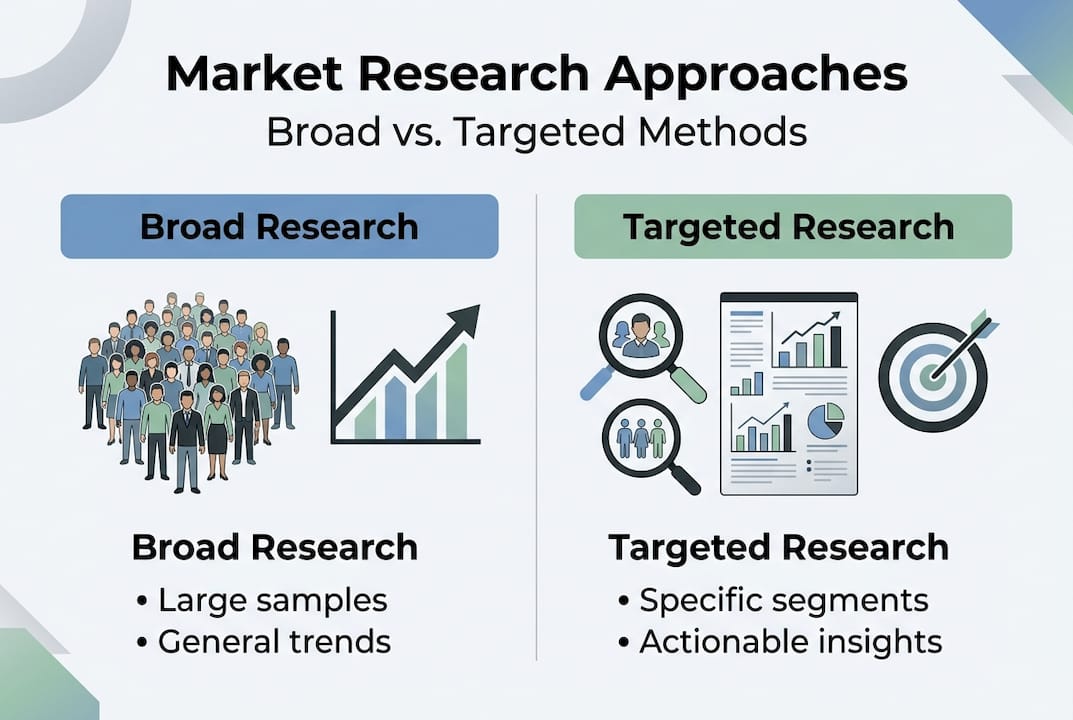
Targeted market research is the practice of concentrating your research effort on a specific customer segment, competitive question, or strategic opportunity rather than studying the entire market at once. Think of it as the difference between a floodlight and a laser. A floodlight illuminates everything around you, but a laser cuts straight through.
In broad market research, you survey wide populations, gather general trends, and build an aggregate picture. That's useful for annual reviews or category entry, but it's too slow and too expensive for most of the decisions your team faces week to week. Targeted research narrows the scope deliberately, letting you answer questions like "Why are our Gen Z users churning?" or "What would make B2B procurement managers switch vendors?" with far more accuracy and speed.
| Factor | Targeted market research | Broad market research |
|---|---|---|
| Scope | Specific segment or question | Entire market or category |
| Timeline | Days to weeks | Months |
| Cost | Lower | Higher |
| Insight depth | Deep and actionable | Wide but often shallow |
| Best for | Campaign validation, product launches | Annual strategy, category mapping |
The value is immediately practical. Marketing research strategies built around focus consistently outperform generalized studies because decision-makers get relevant answers fast. Key benefits include:
- Cost savings: Fewer respondents and a tighter scope reduce spend significantly.
- Speed: Focused studies complete faster, enabling quicker go-to-market cycles.
- Relevance: Insights apply directly to the decision at hand, not to an abstracted average customer.
- Higher ROI: Resources flow to segments with the greatest return potential.
The most effective approach combines both primary and secondary research. Primary methods like surveys, focus groups, interviews, and observation generate original data. Secondary methods like industry reports and competitor analysis provide context. Used together in sequence, they give you both the landscape and the ground-level detail you need.
"Targeted market research isn't about doing less research. It's about doing the right research at the right depth for the decision you actually need to make."
Understanding research methodology selection early prevents wasted effort and ensures every data point you collect moves your thinking forward.
Essential methodologies: How targeted market research works
Knowing what targeted market research is only gets you so far. The real skill is knowing how to execute it efficiently, starting with picking the right methods.

Primary research generates data directly from your target audience. Surveys are the most widely used quantitative tool: 85% of researchers rely on online surveys as their primary quantitative method. They scale quickly, are cost-effective, and produce data you can compare over time. Focus groups and in-depth interviews add the qualitative dimension, revealing the why behind the numbers. Observation methods, like session recording or ethnographic research, capture behaviors people can't or won't self-report.
Secondary research provides the context you need before you design a single survey question. Industry reports, academic studies, and competitor analysis tell you what's already known, saving you from rediscovering the obvious. Start here.
| Method | Type | Strength | Best use case |
|---|---|---|---|
| Online surveys | Primary | Scalable, quantitative | Segment sizing, preference ranking |
| In-depth interviews | Primary | Deep insight | Motivation, barrier discovery |
| Focus groups | Primary | Social dynamics | Messaging and concept testing |
| Industry reports | Secondary | Context setting | Trend identification |
| Competitor analysis | Secondary | Benchmarking | Positioning gaps |
The recommended sequence for targeted research looks like this:
- Define the business question you need answered and the segment it applies to.
- Run secondary research to establish what's already known and identify gaps.
- Design primary research using that context to sharpen your survey or interview guide.
- Execute with your target segment using screener questions to qualify participants.
- Analyze and cross-validate findings across methods before drawing conclusions.
Using a market research checklist at each stage prevents you from skipping critical steps under deadline pressure. It also keeps your methodology defensible when you present findings to leadership.
Pro Tip: Triangulate at least two methods before acting on insights. If your survey shows 70% of users want feature X, but your interviews reveal they wouldn't actually pay extra for it, you've caught a critical disconnect that a single-method study would have missed. Understanding the full research process steps helps you build that triangulation into your workflow from the start.
Precision vs. broad targeting: When to go narrow or wide
Not every research question calls for a laser. Sometimes you genuinely need the floodlight. The key is knowing when each approach serves you better.
Precision targeting works best when you have a defined segment with high revenue potential, a specific decision to validate, or a problem isolated to one group. A SaaS company investigating why enterprise accounts churn doesn't need to survey casual free-tier users. The insight lives in a narrow slice of your customer base.
Broad targeting earns its place when you're entering a new market, launching a brand campaign, or benchmarking overall category sentiment. Awareness, reach, and positioning work best when tested against a diverse, representative sample.
The targeting criteria you use matter as much as the scope. Consider:
- Demographics: Age, gender, income, job title. Useful but increasingly insufficient on their own.
- Psychographics: Values, attitudes, lifestyle preferences. These predict behavior better than demographics alone.
- Behavioral signals: Purchase history, usage frequency, churn risk score. The strongest predictor of future action is past action.
Precision targeting maximizes ROI for niche segments while broad targeting builds scale and awareness. Choosing the wrong one wastes budget fast.
Pros and cons of each:
- Precision targeting: Higher relevance, lower waste, better conversion rates, but limited reach and higher risk of tunnel vision.
- Broad targeting: Greater awareness, more diverse feedback, better for discovery, but lower signal-to-noise ratio and higher cost per actionable insight.
"Aggregated data tells you what happened. Granular, segment-level data tells you what to do about it."
Leveraging market intelligence for ROI means knowing when your business question demands depth versus breadth, and building your research scope around that decision rather than your budget or timeline alone. Use granular data analysis to surface the segment-specific patterns that aggregate numbers hide.
From research to action: Validating, segmenting, and optimizing decisions
Gathering insights is only half the job. The other half is turning those insights into decisions that produce measurable results. This is where most research investments either pay off or go to waste.
Here's a proven sequence for moving from data to action:
- Segment your audience using research-validated criteria, behavioral signals, and psychographic clusters.
- Map insights to decisions by connecting each key finding to a specific campaign, product, or positioning choice.
- Test before you scale: Run a limited campaign or A/B test with the target segment to validate the insight in the real world.
- Measure and compare results against a control group or historical baseline.
- Iterate based on results, refining your segment definition and messaging as new data arrives.
Consider a real-world scenario: a retail brand discovers through targeted research that its most profitable segment, women aged 35 to 50, prioritizes sustainability over price. The team pivots its email campaign to lead with environmental messaging instead of discount offers. Using rapid audience research methods, they validate the pivot in two weeks before full rollout.
The revenue impact of getting this right is significant. Targeted adjustments in the marketing mix can yield substantial weekly revenue gains, and top-performing teams are 2.5 times more aligned between strategy and execution when they validate granularly rather than relying on gut instinct alone.
Pro Tip: Treat your segments as living definitions, not permanent labels. Markets shift, customer priorities evolve, and the behavioral signals that defined your best segment last year may not apply today. Build a quarterly review of your segment criteria into your faster market research process to stay ahead of those shifts.
Why most market research misses the mark (and how to get it right)
Here's the uncomfortable truth: most market research doesn't fail because of bad data. It fails because teams treat research as a one-time event rather than a continuous practice.
The typical pattern looks like this. A team commissions a large study, receives a detailed report, presents the findings at an all-hands meeting, and then files it away while moving on to the next quarter. Six months later, they're making decisions based on data that no longer reflects the market.
The teams that actually build competitive advantage through research do something different. They run smaller, more frequent studies. They use methodological rigor by triangulating methods, validating insights with experiments, and evolving their segments dynamically as markets shift. A focused 200-person survey run quarterly beats a 2,000-person study run once every two years, because the world moves faster than annual research cycles can track.
The contrarian truth is that less can be more. Smaller, repeated studies give you fresher signals, faster feedback loops, and more opportunities to catch a market shift before your competitors do. Use your market research checklist as a living document, not a project artifact.
Level up your market research with Gather
You now understand targeted market research from definition to execution. The next question is how to run it at the speed your business actually demands.
Gather's AI-native research engine automates the entire process, from study design and methodology selection to AI-moderated interviews and board-ready reporting, in days, not months. You can explore use cases tailored to your industry and team size, or start with a customer research study to see how targeted insights translate into real business decisions. If your current research process is too slow, too expensive, or too disconnected from action, Gather is built to fix exactly that.
Frequently asked questions
How does targeted market research improve ROI?
By focusing resources on high-potential segments, targeted market research delivers more relevant insights, drives more effective campaigns, and generates higher return on investment. Precision targeting maximizes ROI for niche segments, while broad targeting builds scale and awareness.
What are the most effective methods for targeted market research?
The most effective methods are online surveys, interviews, focus groups, and competitor analysis, ideally used together to validate findings. Primary and secondary approaches work best when combined in sequence.
How do you know if a target segment is viable?
A segment is considered viable when strong data shows 68% or more of surveyed individuals indicate purchase intent or meaningful engagement with your offering.
What's the biggest pitfall in market research today?
Teams often rely on a single method or outdated data, missing critical market shifts. Successful teams triangulate methods and refine their segments continuously rather than treating research as a one-time project.