

TL;DR:
- Clear alignment and structured question types are essential for effective business analysis.
- AI tools significantly reduce analysis time and improve insight accuracy.
- Cross-department collaboration and rapid iteration enhance decision-making speed and reliability.
When a mid-sized company spends three weeks defining what they actually want to know before any real research begins, that is not a planning problem. That is a question analysis problem, and it costs real money. Vague or poorly structured business questions cause teams to collect the wrong data, chase irrelevant trends, and present findings that no one can act on. This guide walks you through a structured, AI-driven process that transforms even the most complex business questions into clear, actionable market insights, quickly and with far less friction than traditional approaches.
Table of Contents
- What you need before you start: Preparing for business question analysis
- Step-by-step business question analysis process
- Choosing the right analysis methods and tools
- Avoiding common pitfalls and validating findings
- Moving beyond the basics: What most guides miss about business question analysis
- Ready to streamline your business question analysis?
- Frequently asked questions
Key Takeaways
| Point | Details |
|---|---|
| Clarify business problems | Clear question types and objectives set the stage for actionable analysis. |
| Follow a structured process | A 7-step approach streamlines business question analysis from start to finish. |
| Leverage AI solutions | Modern AI tools rapidly transform questions into market insights with less manual effort. |
| Validate and avoid bias | Validation and documented assumptions prevent wrong decisions from unchecked data or scope creep. |
| Empower business teams | Involving marketers and cross-functional teams improves analysis quality and speed. |
What you need before you start: Preparing for business question analysis
To streamline business question analysis, let's start by clarifying what you need in place before diving in.
Before you touch any data or tool, alignment is everything. The single biggest reason analysis projects stall is that different stakeholders have different ideas about what the question actually is. Your marketing team might want to know why a campaign underperformed. Your product team wants to know whether a new feature drove that performance. Finance wants to know if revenue targets are at risk. Without a shared starting point, you end up running three different analyses and reconciling them later at great cost.
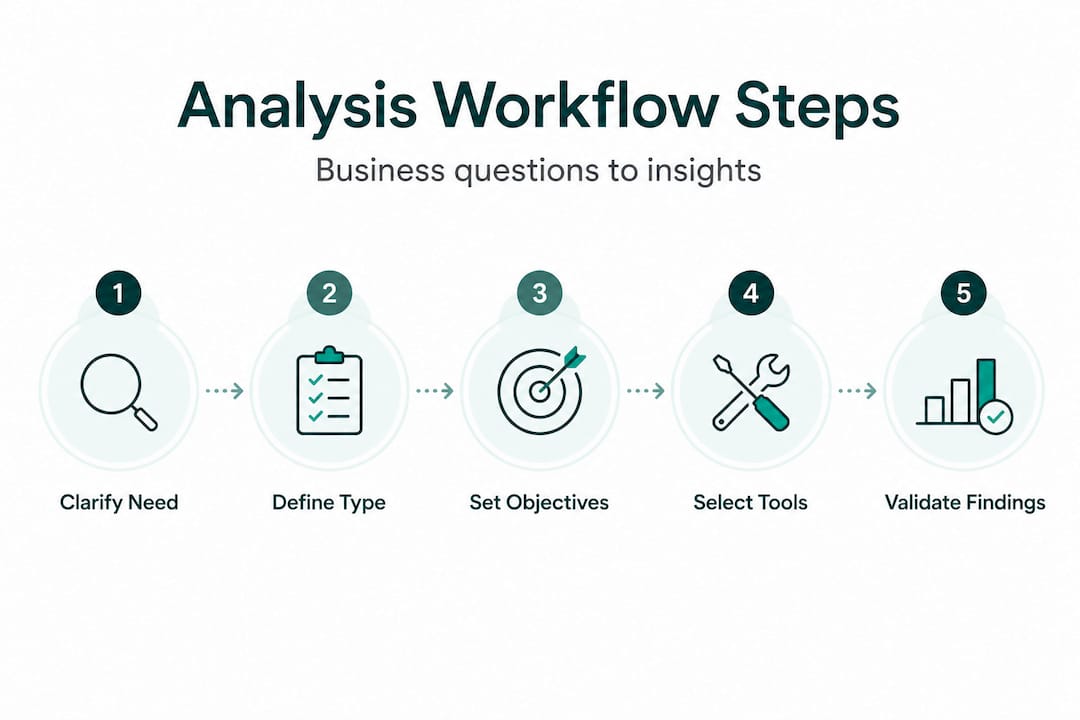
The first task is categorizing your business question. The analysis process begins with an "Ask" phase: defining the problem clearly using four question types.
| Question type | Core question | Example |
|---|---|---|
| Descriptive | What happened? | What were our Q1 sales by region? |
| Diagnostic | Why did it happen? | Why did the Northeast underperform? |
| Predictive | What might happen? | What will Q3 look like if trends hold? |
| Prescriptive | What should we do? | Should we reallocate budget to the West? |
Most teams jump straight to prescriptive questions without earning the right to that answer. If you skip descriptive and diagnostic analysis, your prescriptions are guesses dressed up as strategy.
Once you know your question type, set SMART objectives. SMART stands for Specific, Measurable, Achievable, Relevant, and Time-bound. A SMART objective for a diagnostic question might be: "Identify the top three reasons for a 15% drop in Northeast retail sales within four weeks." That framing tells your team exactly what success looks like. Without it, projects drift.
Before the analysis begins, check your market research checklist to confirm that data access, stakeholder buy-in, and scope are locked in. Also make sure your objectives are aligning with broader marketing goals, not just operational convenience.
Here is what you need in place before launching:
- A defined business problem statement agreed on by all relevant stakeholders
- Data access confirmed including CRM exports, POS data, or any third-party databases
- A designated analysis lead with authority to make scope decisions
- Tool access for AI platforms, survey tools, or analytics dashboards
- A realistic timeline with milestone check-ins built in
Pro Tip: Bring in cross-functional stakeholders in the very first meeting, not after you have already defined the question. Sales, product, and customer success teams often have frontline context that reframes the problem entirely. That one conversation can save you two weeks of misdirected research.
Step-by-step business question analysis process
With prerequisites handled, it's time to walk through the actionable steps for transforming your business questions into market-ready insights.
A structured workflow prevents the two most common failure modes in analysis: going too broad too fast, or getting lost in data without a clear destination. Following a defined marketing research process ensures every step builds on the previous one.
The full market analysis process for generating actionable insights involves seven core steps, each of which maps directly to a question type and technique:
-
Define purpose. Restate your SMART objective. What decision will this analysis support, and who makes it? Tie the analysis back to a specific business outcome, not a general curiosity.
-
Research the industry state. Pull secondary data on market size, growth rates, and major shifts. Use AI-assisted tools to aggregate industry reports, news, and regulatory changes quickly. This step answers descriptive questions at the macro level.
-
Identify your target customer. Go beyond basic demographics. Map psychographics (values, pain points, motivations) and behavioral patterns (purchase frequency, channel preferences). For mid-sized companies, segmenting existing CRM data is often faster and more reliable than starting from scratch.
-
Analyze the competition. Use a structured competitive analysis template to document competitor positioning, pricing, market share, and product gaps. This is also where competitive research strategies like social listening and review mining add real value.
-
Assess trends. Look for emerging shifts in consumer behavior, technology adoption, or regulation that could affect your market position. AI tools can scan large data sets for trend signals in hours instead of weeks.
-
Build a sales forecast. Use your competitive and trend data to model realistic revenue scenarios. Combine top-down sizing (total addressable market times expected share) with bottom-up approaches (unit sales times average price) to triangulate your projection.
-
Identify barriers to entry. Understand what makes your market hard to enter or exit. This context shapes how you interpret competitive threats and where you should invest defensively.
Here is how question types map to analysis techniques across those steps:
| Business question type | Primary analysis technique | AI acceleration opportunity |
|---|---|---|
| Descriptive | Data aggregation, dashboards | Automated report generation |
| Diagnostic | Root cause analysis, cohort analysis | Pattern detection in large datasets |
| Predictive | Regression, trend modeling | Real-time scenario modeling |
| Prescriptive | Conjoint analysis, sentiment analysis | Recommendation engines |
Companies using AI-assisted research tools cut analysis timelines from months to days. That compression is not just a speed advantage. It means your insights are more current when decisions actually get made.

Choosing the right analysis methods and tools
To make the steps effective, it's critical to choose analysis methods and tools that match your business questions and resources.
Not every question needs a survey, and not every data gap requires expensive primary research. The U.S. Small Business Administration recommends using secondary data for broad, quantifiable questions about trends and demographics, then layering in primary research through surveys, focus groups, or interviews when you need specific audience reactions that secondary sources cannot provide.
Primary research is high effort and high specificity. You get exactly the data you need for your exact audience, but it takes time and money to collect. Secondary research is fast and broad. It answers market-level questions well but rarely goes deep enough for nuanced customer behavior insights. The smartest approach is to use secondary data to frame the problem and narrow your hypotheses, then run targeted primary research to validate them.
For AI-driven business insights, modern platforms are closing the gap dramatically. Google Cloud Cortex Framework unifies data in BigQuery so marketing and sales teams can query across systems without needing a data engineer in the room. Tools like MIRA AI and Ask Mitoto allow non-technical users to ask natural language questions and receive structured dashboards and insights instantly. This is a fundamental shift: the ability to interrogate your own business data in plain English removes one of the biggest bottlenecks in analysis.
Beyond AI analysis tools, consider these criteria when choosing your method:
- Speed requirement. If a decision needs to be made in 10 days, a six-week ethnographic study is not the right tool.
- Question specificity. Broad trend questions fit secondary research. "Why did our churned users leave last quarter?" requires primary interviews or survey analysis.
- Audience accessibility. Can you reach your target segment through existing CRM data? If yes, AI-moderated surveys are faster and cheaper than recruiting from scratch.
- Confidence threshold. High-stakes decisions like market entry or pricing resets require triangulated methods. Lower-stakes optimizations can rely on faster, lighter approaches.
- Integration capability. Tools that connect directly to your CRM, POS, or sales platform eliminate data translation errors and save hours of manual work.
Pro Tip: Before selecting a tool, ask whether it can connect to your existing AI for competitive intelligence infrastructure. Platforms that operate in silos create reconciliation problems downstream. The goal is a connected data ecosystem where every insight feeds back into the next question.
Avoiding common pitfalls and validating findings
No process is foolproof. Here's how to avoid the most costly mistakes and ensure your findings are solid.
Even experienced analysts make preventable errors. The most common and damaging pitfalls in business question analysis are vague questions, confirmation bias, and scope creep. A vague question produces unfocused data. Confirmation bias causes teams to find what they already believe. Scope creep turns a two-week project into a three-month one that no longer answers the original question.
Here is a practical list of pitfalls and how to prevent each one:
- Vague problem statement. Rewrite every question until it passes the SMART test. If you cannot describe what a successful answer looks like, the question is still too vague.
- Confirmation bias. Before analysis begins, document your current assumptions in writing. Then actively seek data that challenges them. Assign someone the role of "devil's advocate" reviewer.
- Scope creep. Define a formal scope document at kickoff. Any new question that arises mid-project gets logged and addressed in a separate phase, not folded into the current one.
- Unvalidated data sources. Before drawing conclusions, verify that your data sources are current, representative, and methodologically sound. Outdated industry reports can send your strategy in entirely the wrong direction.
- No documentation of assumptions. Every analysis rests on assumptions. Write them down. This makes your work repeatable, and it makes it auditable if a decision gets challenged later.
Critical warning: Unchecked confirmation bias is the silent killer of market analysis. When teams design research to validate decisions already made, the output is not insight. It is expensive theater. Businesses that act on biased analysis do not just waste research budgets. They make wrong market moves based on false confidence, and those mistakes compound.
For validation, triangulation is the most reliable approach. Use at least two independent methods to test any major finding. For example, if customer interviews suggest price sensitivity is driving churn, validate that hypothesis against purchase data and competitive pricing benchmarks before treating it as fact. Top-down and bottom-up market sizing is another classic triangulation technique: if both methods produce similar numbers, your estimate is credible.
Reviewing market intelligence best practices can also help you build systematic validation into your workflow rather than treating it as an afterthought. Formal validation checklists, peer review of analysis logic, and market research validation protocols all reduce the risk of acting on flawed conclusions.
Moving beyond the basics: What most guides miss about business question analysis
Most guides treat business question analysis as a technical problem. Get the steps right, use the right tools, avoid the obvious biases, and you will get good insights. That framing is incomplete.
The deeper issue is organizational. In most mid-sized companies, analysis capability is concentrated in a small technical team, which means the people closest to the market (customer-facing marketers, regional sales managers, account leads) are waiting for someone else to answer their questions. By the time insights arrive, the business context has shifted. The decision window has closed. Teams have already moved forward on instinct.
The real competitive advantage is not better methodology. It is speed combined with democratization. When marketers can run a targeted analysis on their own, without waiting for a data science queue, the entire organization becomes more responsive. Market intelligence examples from high-performing companies consistently show that the ones who win are not necessarily the ones with the most sophisticated models. They are the ones who act on decent insights faster than competitors act on perfect ones.
Iteration matters more than perfection. A 70% confident insight acted on in 48 hours almost always beats a 95% confident insight delivered three weeks later. This is not an argument for sloppy research. It is an argument for building fast feedback loops: run analysis, share findings, act, observe results, refine the question, and repeat. Each cycle makes the next one faster and more accurate.
The other overlooked truth: cross-department collaboration is not a nice-to-have. It is a structural requirement for good analysis. When product, marketing, and sales each run their own analysis in isolation, they will often reach contradictory conclusions from the same underlying data. A shared analysis workflow, with shared tools and shared question frameworks, is what turns scattered data into coherent strategy.
Ready to streamline your business question analysis?
With actionable steps and insider perspective covered, here's how you can move forward even faster.
Gather is built specifically for marketing and business teams that need to move from complex business questions to board-ready insights without waiting months for agency deliverables. The Gather platform automates the entire research lifecycle, from study design and methodology selection through AI-moderated interviews, real-time analysis, and automated reporting.
Whether you are diagnosing churn, sizing a new market, or pressure-testing a pricing change, Gather connects directly to your existing CRM and POS data to run targeted research across the exact audience segments that matter. You can review AI-driven use cases to see how teams like yours are turning research cycles from months into days. For a deeper look at what the data says, explore an original Gather study that shows what modern, AI-native research actually delivers in practice.
Frequently asked questions
What are the main types of business questions in analysis?
The main question types are descriptive (what happened), diagnostic (why), predictive (what might happen), and prescriptive (what to do). Each type maps to a different analysis technique and level of complexity.
How does AI speed up the business question analysis process?
AI tools like Cortex unify data across platforms and allow natural language queries that generate dashboards and insights instantly, cutting weeks off traditional manual research timelines.
What steps are essential for effective market analysis?
A complete market analysis covers seven steps: defining purpose, researching the industry, identifying target customers, analyzing competitors, assessing trends, forecasting sales, and evaluating barriers to entry.
What are common mistakes in business question analysis?
The most frequent errors are vague questions and scope creep, along with confirmation bias and failure to document assumptions or validate data before acting on findings.
Which research methods should I use for my business questions?
Secondary data works best for broad trend and demographic questions, while primary research methods like surveys and interviews are better suited for specific customer reactions and behavioral insights.