

TL;DR:
- Rapid research insights significantly shorten traditional research timelines from weeks to days using AI tools.
- They enable faster, cost-effective, and scalable decision-making for marketing and business teams.
- Combining rapid insights with deep, strategic research offers a balanced approach to staying competitive.
The old assumption that thorough market research requires months of planning, fieldwork, and analysis is quietly costing brands competitive ground. Rapid research insights use AI-assisted methodologies to compress traditional research cycles from months or weeks to days or hours, enabling agile marketing and strategic decisions that match the pace of real markets. For marketing and business leaders who need to move fast without sacrificing quality, this shift is not just convenient. It is increasingly essential. This guide walks you through what rapid research actually looks like, why it changes business outcomes, and how to use it wisely.
Table of Contents
- What are rapid research insights and how do they work?
- The business impact: Why fast insights matter for teams
- How AI supercharges research at scale
- The limits and pitfalls: When rapid research is (and isn't) the right fit
- A fresh perspective: Why balancing speed and depth is the real secret
- Take your insights further with Gather's AI research engine
- Frequently asked questions
Key Takeaways
| Point | Details |
|---|---|
| Faster research cycles | AI-driven insights turn weeks of research into actionable data in just hours or days. |
| Competitive strategic edge | Rapid insights help teams adapt, validate, and outperform competitors in fast-moving markets. |
| Balanced approach wins | Combining fast, AI-powered insights with deep research creates the most value. |
| Know the limits | Rapid insights are best for tactical questions; foundational research still needs depth and expert review. |
What are rapid research insights and how do they work?
Let's get specific about what we mean. Rapid research insights are not simply "faster surveys." They are a fundamentally different approach to gathering, processing, and acting on customer and market intelligence. Instead of a linear, slow-moving research process, rapid research uses AI at every stage to collapse timelines without cutting corners on rigor.
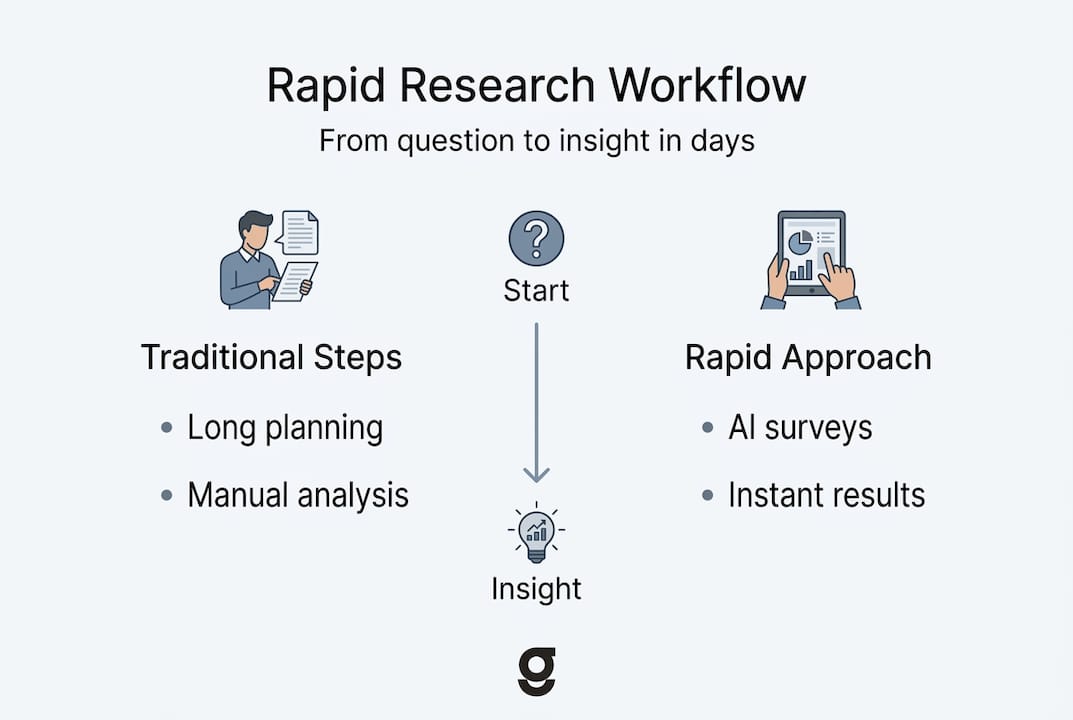
The rapid research process steps follow a distinct flow: define the business question, design the study using AI-assisted tools, recruit and screen participants automatically, execute interviews or surveys with AI moderation, analyze data in real time, and deliver structured reports. What traditionally took six to twelve weeks can now be completed in two to five days.
Here is what the key mechanics look like in practice: AI-automated survey design, participant screening, AI-moderated interviews with adaptive probing, thematic clustering of responses, real-time analysis, and automated reporting. Each component is designed to remove the manual bottlenecks that inflate timelines in traditional research.
A practical example: Imagine your team launches a new ad campaign on Monday and wants audience reaction data by Thursday to inform a budget decision. With rapid research, an AI platform can design a targeted interview guide, recruit screened participants from a connected CRM or panel, run adaptive interviews, cluster themes automatically, and generate a board-ready report in time for your Thursday meeting. That is not a hypothetical. Teams using AI-native platforms are already doing exactly this.
How rapid and traditional research compare
| Dimension | Traditional research | Rapid AI research |
|---|---|---|
| Timeline | 6 to 12 weeks | 2 to 5 days |
| Cost | High (agency fees, manual labor) | Significantly lower |
| Scalability | Limited by human capacity | Scales automatically |
| Iteration speed | Slow, one study at a time | Continuous, agile cycles |
| Report format | Custom, slow to produce | Automated, branded, board-ready |
The benefits stack up quickly. Faster timelines mean you can test messaging before a campaign goes live, not after. Lower costs mean you can run more studies, not just one major annual project. Scalability means a mid-sized team can access the kind of research depth that once required a large agency.

AI also changes the quality of insights, not just the speed. Adaptive probing, for instance, allows an AI interviewer to follow up dynamically based on what a participant says, surfacing nuance that a rigid survey would miss. AI in client acquisition has shown similar gains in personalization and responsiveness, and the same logic applies to research.
Pro Tip: When defining your research question, be as specific as possible before the AI takes over. The more precise the input, the more actionable the output. Vague questions produce broad themes; sharp questions produce decision-ready findings.
The business impact: Why fast insights matter for teams
Once you understand the mechanics, it is important to see why rapid insights are more than just a speed upgrade. They genuinely shift business outcomes.
Speed in research is not a cosmetic benefit. It changes what is possible strategically. Real-time responsiveness in fast markets delivers a competitive edge, enabling continuous validation and more agile strategies over slower traditional approaches. That is a meaningful operational shift for any team trying to compete in rapidly changing categories.
Consider ad testing. A traditional approach might test creative assets over three to four weeks, receive results, and then brief the team to make changes, losing another two weeks before redeployment. A rapid research model runs the same test in 72 hours, delivers findings the next day, and gets revised creative back in market within the same week. The compounding effect of that kind of iteration speed is enormous over a quarter or a year.
Rapid vs. traditional research: Business impact comparison
| Business outcome | Traditional research | Rapid AI research |
|---|---|---|
| Campaign iteration cycles | 1 to 2 per quarter | 4 to 6 per quarter |
| Decision confidence | High but slow | High and immediate |
| Stakeholder alignment | Delayed by timelines | Supported by real-time data |
| Market responsiveness | Reactive | Proactive |
For competitive advantage in research, the ability to continuously validate assumptions is a strategic differentiator. Teams that run rapid research regularly are not just faster. They are better calibrated to actual customer sentiment, making fewer expensive assumptions.
Here are the core operational benefits rapid research delivers for marketing and business teams:
- Faster campaign decisions: Test messaging, creative, or positioning before committing full budgets.
- Continuous product feedback: Gather user reactions at each development milestone, not just at launch.
- Real-time competitive tracking: Monitor how customer perceptions shift as competitors move.
- Reduced research waste: Smaller, more frequent studies replace one massive annual study that is outdated before it is finished.
- Broader stakeholder access: Automated reports mean research reaches finance, product, and leadership without weeks of translation.
The marketing ROI impact of data-driven decisions is well documented, and rapid research dramatically increases how often teams can make data-backed calls. For mid-sized organizations, that means closing the research capability gap with larger competitors without hiring a full internal research team.
How AI supercharges research at scale
With the business case clear, let's look at how AI fundamentally changes the scale and depth of modern research. This is where the mechanics get genuinely interesting.
Traditional qualitative research, like in-depth interviews, has always been expensive to scale. Running 50 interviews manually requires recruiting, scheduling, interviewing, transcribing, coding, and analyzing, often a full team effort over several weeks. AI changes all of that. AI scales qualitative research affordably for mid-sized teams, integrates with CRM systems for targeted access to actual customers, and drives higher ROI via faster iterations.
Here is a step-by-step look at how an AI-powered research workflow actually operates:
- Define the business question. The team identifies the core decision to be made, such as whether a new feature resonates with power users.
- AI generates the study design. The platform suggests methodology, question format, and interview structure based on the objective.
- Participant targeting via CRM integration. The platform pulls a targeted segment, for example, churned users from the past 90 days, from your connected customer data.
- AI-moderated interviews run at scale. Participants complete adaptive interviews at their convenience. The AI probes based on individual responses, not a rigid script.
- Thematic clustering happens automatically. Responses are grouped by emerging themes in real time, without manual coding.
- Automated reporting delivers structured findings. A branded, board-ready report is generated with key themes, verbatim quotes, and strategic recommendations.
"The real power of AI in research is not that it replaces human judgment. It is that it removes every low-value manual step between a question and an answer, so human judgment is applied where it matters most."
Modern AI technologies enabling this workflow include large language models for interview moderation, natural language processing for thematic clustering, and machine learning for participant screening. These are not experimental tools. They are production-ready capabilities embedded in platforms built specifically for marketing and research teams.
The CRM integration point deserves special attention. One of the biggest weaknesses in traditional research is that participants are often strangers recruited from panels with no relationship to your brand. When your research platform connects to your actual customer database, you can target specific segments such as high-value customers, recent churners, or first-time buyers and get feedback from people whose opinions genuinely matter to your business.
AI for competitive intelligence follows a similar pattern, where automation removes the grunt work of data collection so analysts can focus on interpretation and strategy. The same principle governs faster insight delivery: reduce friction between data and decision.
Pro Tip: Connect your research platform to your CRM before you need a study. Having the integration ready means you can launch targeted research within hours of identifying a business question, not days of data preparation.
The limits and pitfalls: When rapid research is (and isn't) the right fit
Even fast insights are no silver bullet. Knowing when to use rapid research, and when not to, is what separates high-performing teams from those that waste resources chasing speed for its own sake.
Rapid research delivers optimal value in specific scenarios. Best-fit use cases include tactical decisions like campaign testing, quick pivots based on market shifts, and ongoing validation throughout a product or campaign cycle. It is not a replacement for deep strategic studies, and risks include unclear objectives leading to non-actionable output, as well as over-automation without human oversight.
Where rapid research excels:
- Testing ad copy or creative before full campaign deployment
- Gathering quick product feedback between development sprints
- Understanding customer reactions to a competitor's move or a market event
- Validating messaging with a new audience segment before entering a market
- Checking in on customer sentiment after a service change or pricing update
Where traditional research remains essential:
- Foundational brand studies that require longitudinal tracking and statistical validation
- Complex segmentation studies requiring large sample sizes and cross-tabulation
- Academic or regulatory research requiring strict methodological documentation
- Brand equity measurement across years, where consistency of method matters
The biggest mistake teams make with rapid research is launching a study before they have a clear, answerable business question. An unclear objective produces broad findings that no one knows how to act on. Selecting fast research methodologies starts with being ruthlessly specific about what decision the research will inform.
Over-reliance on automation is the second major pitfall. AI can cluster themes and generate reports, but it cannot always catch subtle nuance, cultural context, or the kind of insight that requires a trained researcher to recognize. The best teams treat AI-generated reports as a starting point for human interpretation, not a final answer.
Analytics for campaign optimization reinforce a related point: data tools perform best when paired with human expertise that knows what questions to ask and which signals to prioritize.
A smart blended approach looks like this: use rapid research for ongoing tactical decisions and validation cycles, while reserving traditional methods for the foundational strategic work that requires depth, longitudinal data, and rigorous methodology. The two approaches complement each other rather than competing.
Pro Tip: Before launching any rapid study, write a single sentence that completes this prompt: "This research will help us decide..." If you cannot finish that sentence clearly, your objective is not ready yet.
A fresh perspective: Why balancing speed and depth is the real secret
The debate about speed versus depth in research is largely a false choice. Most teams frame it as a binary: either you move fast and sacrifice rigor, or you go deep and accept the wait. Neither extreme serves modern businesses well.
What leading teams have figured out is that rapid insights and deep research serve different questions at different timescales. Rapid research handles the ongoing, tactical layer of intelligence, the kind that drives better decisions at the campaign and product level week over week. Deep research handles the foundational strategic layer, the work that anchors brand positioning, segmentation, and long-range planning.
The real competitive advantage belongs to teams that run both, not teams that choose one. Rapid research without strategic anchoring produces reactive, disconnected insights. Strategic research without rapid validation produces beautiful documents that are already outdated by the time they are presented.
The hard-won lesson is this: rapid insights thrive when they are paired with clear objectives and a human expert who knows what to do with the output. AI is extraordinarily good at removing friction, automating repetitive tasks, and surfacing patterns at scale. It is not good at knowing what matters to your business. That judgment still belongs to people.
Speed without direction is just noise. Direction without speed is just planning. The teams winning in 2026 are doing both at once.
Take your insights further with Gather's AI research engine
The principles in this article only create value when you have the tools to act on them. Rapid research is not a manual process you can bolt onto your existing stack. It requires a platform built from the ground up to handle the entire research lifecycle automatically.
Gather is an AI-native research platform designed specifically for marketing and business teams that need board-ready insights in days, not months. From AI-moderated interviews and adaptive probing to real-time thematic analysis and automated reporting, Gather handles every step so your team can focus on decisions, not logistics. Explore the full range of research use cases to see how teams like yours are running faster, smarter research at scale. You can also access Gather's 2026 original study to see rapid research insights applied to real market intelligence.
Frequently asked questions
What are the main benefits of rapid research insights?
Rapid research insights help teams make faster, more informed decisions by delivering actionable data in days rather than weeks or months, enabling continuous iteration and reducing the cost of strategic uncertainty.
In what situations should teams avoid relying on rapid research?
Rapid research is less suitable for deep foundational studies that require comprehensive longitudinal analysis, large statistically validated samples, or rigorous methodological documentation for regulatory or strategic purposes.
How does AI make rapid research possible?
AI automates the most time-consuming steps, including survey design, participant screening, adaptive interview moderation, thematic clustering, and report generation, shrinking a multi-week timeline to just a few days.
Can rapid research insights increase marketing ROI?
Yes. By enabling more frequent iteration and real-time campaign testing, rapid research allows teams to optimize spending faster. Higher ROI via faster iterations is a documented outcome for teams integrating AI-powered research into their regular workflows.