

TL;DR:
- Effective market research relies on combining secondary data, qualitative insights, and quantitative validation.
- Following a structured, step-by-step workflow speeds insights and ensures decision-making accuracy.
- Rapid, verified research using AI tools provides faster, more reliable results than slow, exhaustive studies.
Market research can make or break a strategic decision, yet most teams still treat it like a slow-moving project rather than a competitive weapon. When leadership needs answers in days, not months, outdated workflows create real risk: missed product launches, misdirected budgets, and strategies built on assumptions instead of evidence. This guide walks you through the complete market research process, from choosing the right methodology to verifying your findings, so you can move faster without sacrificing accuracy. Whether you're targeting B2B decision-makers or exploring a new consumer segment, every step here is designed to deliver results your leadership team can act on immediately.
Table of Contents
- Understand market research fundamentals
- Define your objectives and planning prerequisites
- Execute step-by-step market research
- Troubleshooting, common mistakes, and verification
- Our hard-won lessons: Why speed and verification matter most
- Leverage rapid research solutions with Gather
- Frequently asked questions
Key Takeaways
| Point | Details |
|---|---|
| Choose the right methodology | Start with secondary research for context, then use primary data to fill gaps for rapid insights. |
| Set clear objectives | Define precise goals and requirements before launching any market research initiative. |
| Follow a proven workflow | Use a step-by-step approach blending qualitative and quantitative phases to maximize accuracy and speed. |
| Always validate your results | Double-check findings for errors, bias, or poor data quality to ensure actions are based on trustworthy evidence. |
| Leverage technology for speed | AI-powered research platforms can deliver faster, more reliable insights and higher ROI than traditional methods. |
Understand market research fundamentals
Knowing which research tool to reach for first is half the battle. Many teams waste weeks collecting data that already exists, or they jump straight into surveys before they understand what questions actually matter. Before any project kicks off, it pays to anchor your team in the core research types and how they work together.
Primary vs. secondary research
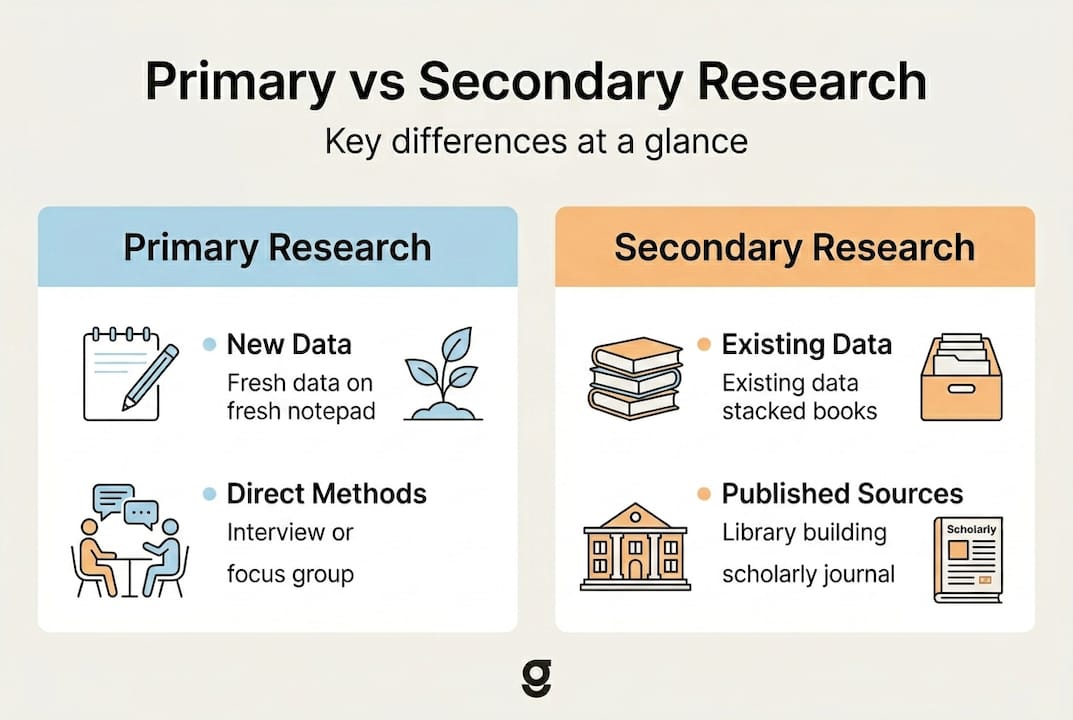
Primary and secondary research form the two pillars of any solid market intelligence strategy. Primary research involves collecting new data directly from your audience through surveys, in-depth interviews, focus groups, or direct observation. Secondary research draws on data that already exists, including government reports from sources like the Census Bureau and Bureau of Labor Statistics, industry publications, competitor filings, and third-party research reports.
The most common mistake teams make is treating these as separate tracks instead of complementary phases. Secondary research gives you the baseline context and helps you ask smarter primary research questions. Think of it as doing your homework before the interview.
Qualitative vs. quantitative methods
Beyond the primary and secondary split, you need to decide whether you're chasing why or how many. Qualitative research, such as in-depth interviews and focus groups, reveals motivations, emotional triggers, and the reasoning behind behavior. It's powerful for generating hypotheses and understanding nuance. Quantitative research, think large-scale surveys and statistical analysis, tells you how widespread a behavior or opinion is across a population.
A practical rule: use qualitative methods first to surface hypotheses, then use quantitative methods to test and validate them at scale. This sequence saves you from building expensive surveys around the wrong questions.
Comparison of approaches
| Method | Type | Best for | Key limitation |
|---|---|---|---|
| Surveys | Quantitative | Measuring prevalence | Misses motivation |
| In-depth interviews | Qualitative | Exploring reasoning | Hard to scale |
| Focus groups | Qualitative | Group dynamics, reactions | Risk of groupthink |
| Secondary data | Mixed | Baseline context | May be outdated |
| Observation | Qualitative | Real behavior in context | Time-intensive |
Common pitfalls to avoid
- Skipping secondary research because it feels less exciting than original data collection
- Using leading survey questions that push respondents toward a preferred answer
- Treating a small qualitative sample as statistically representative
- Ignoring existing CRM or POS data that could instantly answer parts of your question
- Failing to document methodology, making it impossible to replicate or audit findings later
Before jumping into execution, run through a solid market research checklist to make sure your foundation is solid. Teams that invest in strong marketing research strategies from the start consistently surface more reliable insights in less time.
Define your objectives and planning prerequisites
Once you know the methodologies, the next step is aligning your research project with clear objectives and practical planning. Vague research questions produce vague results. The sharpest research projects start with a precisely defined problem statement, not a broad topic.
Set precise research questions and measurable goals
A strong research objective follows a simple formula: Who do we need to understand, what decision does this research inform, and what does success look like? For example, instead of "understand customer churn," reframe it as "identify the top three reasons B2B subscribers in the mid-market segment cancel within 90 days, so we can redesign the onboarding experience."

Measurable goals give your team a clear finish line. Define upfront whether you need statistical significance, a specific number of completed interviews, or a confidence interval for your survey data. This saves you from the classic "let's collect a little more data" loop that eats weeks off your timeline.
Identify core stakeholders and necessary tools and resources
Every research project has at least three types of stakeholders: the people who commission the research, the people who will act on the findings, and the people who will execute the project. Getting all three aligned before fieldwork begins prevents the painful situation where a completed study sits on a shelf because nobody owns the implementation.
On the tools side, consider what you need for each phase. Surveys typically require a platform, respondent panel, and an analyst. Interviews need a screener, a moderator guide, a recording and transcription tool, and someone to synthesize findings. Secondary research requires access to credible databases and a way to organize and compare source quality.
Benchmarking data: what ROI to expect
Understanding what good looks like helps you set realistic expectations and make the case for investment. Tech-enabled research investments show that 87.9% of such projects deliver over 100% ROI, with 70% reaching payback within six months. GenAI-assisted marketing research delivers an average of 3.2x ROI, with content-focused applications reaching 4.1x. E-commerce email research consistently delivers $36 to $42 per dollar spent.
These numbers matter when you're justifying a research budget or arguing for faster, tech-assisted methods over traditional agency approaches. Understanding the marketing research process steps in detail makes it easier to estimate costs and timelines per phase. For regulated industries, factoring in market research compliance requirements early avoids costly rework.
Requirements table
| Phase | Tools needed | Materials required | Estimated time |
|---|---|---|---|
| Secondary research | Database access, spreadsheet | Source log, comparison framework | 3 to 5 days |
| Survey design | Survey platform, panel | Screener, questionnaire | 5 to 7 days |
| Qualitative interviews | Video/audio tool, AI transcription | Moderator guide, consent forms | 7 to 14 days |
| Analysis and reporting | BI or AI reporting tool | Coding framework, report template | 5 to 10 days |
Pro Tip: Define a "minimum viable insight" for your project before you start. Know exactly what finding would be sufficient to make the decision at hand. This keeps scope from expanding indefinitely and helps you move faster without sacrificing the quality that matters.
Execute step-by-step market research
Your objectives are mapped; now it's time to follow a proven sequence. Here's a step-by-step workflow for maximum clarity and impact. Teams that skip steps or move phases out of order consistently produce lower-quality insights, regardless of how sophisticated their tools are.
The proven research workflow
Following best practice guidance from the SBA, always start with secondary research to establish your baseline before investing in primary data collection. Use qualitative exploration to surface hypotheses before deploying quantitative methods to validate them at scale.
- Conduct a secondary research sweep. Pull existing reports, competitor data, government statistics, and internal data from your CRM or POS system. Build a source log that tracks origin, date, and relevance. Identify gaps that secondary data cannot fill.
- Draft your research questions. Based on your secondary research gaps, write specific, answerable questions. Avoid compound questions like "Why do customers leave and what would make them stay?" Split these into separate inquiries.
- Design your qualitative phase. Write a moderator guide for interviews or focus groups. Aim for 8 to 12 in-depth interviews per major audience segment to reach thematic saturation. Use open-ended prompts that invite storytelling rather than yes or no answers.
- Execute qualitative fieldwork. Record and transcribe sessions. Use AI-assisted analysis where possible to identify patterns across transcripts faster. Look for recurring themes, surprising statements, and emotional language.
- Design your quantitative survey. Build your survey based on qualitative hypotheses. Use scales, ranking questions, and multiple-choice formats to generate statistically analyzable data. Aim for a sample size that supports at least 95% confidence for your key segments.
- Field your survey and monitor quality. Watch completion rates and flag suspicious response patterns in real time. Build in attention checks to filter out low-quality respondents.
- Analyze and synthesize. Use crosstabs to compare segments. Look for statistically significant differences. Pair quantitative findings back to qualitative quotes to make data human and board-ready.
- Present findings with clear decision implications. Every insight should connect to an action. Avoid reporting results that don't link to a concrete business recommendation.
Smart research methodology selection at the start of this sequence saves significant time downstream. Teams leveraging AI competitive intelligence tools report dramatically faster synthesis cycles. For fast-moving projects, rapid audience research techniques can compress timelines without compromising sample quality.
Pro Tip: If you're using AI-moderated interviews, the analysis phase can shrink from weeks to hours. Platforms that combine real-time transcription with automated theme extraction eliminate the most time-consuming bottleneck in qualitative research. AI-driven marketing acquisition research confirms that teams using AI tools in fieldwork see dramatically faster time-to-insight.
Troubleshooting, common mistakes, and verification
Now that your research is underway, anticipating challenges and verifying results is vital for reliability. Findings that haven't been validated aren't insights; they're hypotheses. The difference matters enormously when strategy decisions hang in the balance.
Most frequent market research pitfalls
- Confirmation bias in question design. Teams unconsciously write questions that point toward the answer they want. Have a neutral third party review your screener and survey before fielding.
- Small qualitative samples treated as representative. Five interviews is enough to explore a territory, not to claim a definitive finding. Be honest about what each method can and cannot support.
- Ignoring data quality signals. Straight-lining (selecting the same answer for every question) and implausible completion speeds are red flags. Remove these responses before analysis.
- Conflating correlation with causation. Survey data shows associations, not proof of cause and effect. Be precise in how you describe what the data shows versus what it implies.
- Siloed findings. Market research that never gets integrated with internal sales, CRM, or product data loses half its value. Connect external findings to internal reality before reporting.
- Outdated secondary sources. Using a 2019 industry report in a 2026 strategy deck is a credibility risk. Check publication dates and prioritize sources from the last 12 to 24 months.
Verification steps for actionable insights
Before presenting findings to leadership, run through this verification checklist. Confirm that your sample matches your target population on key demographic and behavioral dimensions. Cross-reference your primary findings against at least two secondary sources. Stress-test your top insights by asking what alternative explanations could produce the same result. Have at least one person not involved in data collection review the analysis for logic gaps.
"The quality of a strategic decision is only as good as the quality of the data behind it. Rigorous verification, not just data volume, is what separates market intelligence from market noise."
Tracking the market intelligence ROI of your research efforts also helps build organizational muscle over time. The best teams document what worked, what didn't, and how long each phase took, creating a feedback loop that makes every subsequent project faster. Reviewing real market intelligence examples from comparable companies can also help calibrate what good verification looks like in practice.
The financial case for doing this right is compelling. Tech-enabled research consistently delivers over 100% ROI, and AI-powered marketing tools are accelerating that return by reducing the manual labor involved in analysis and reporting.
Our hard-won lessons: Why speed and verification matter most
Here's a perspective most research guides won't give you: the obsession with exhaustive data collection is often the enemy of good strategy. Marketing teams chase statistical perfection while the competitive window closes. We've seen companies spend four months on a research project that addressed a decision that needed to be made in six weeks.
The real trade-off isn't speed versus quality. It's iteration speed versus false confidence. Rapid, well-verified, iterative research beats one massive slow study almost every time. Why? Because markets move. A finding from month three of a six-month study may be outdated by the time the report lands.
Verification, not volume, is where the real leverage sits. A smaller, rigorously verified dataset is far more valuable than a massive, sloppy one. We've found that the teams who build in verification checkpoints at every phase, not just at the end, catch errors early and present findings with genuine confidence rather than manufactured certainty.
What busy marketing professionals actually need is not a research methodology textbook. They need a clear-eyed process, the discipline to stop collecting data at the right moment, and the tools to synthesize quickly. Reviewing a real customer research crisis study illustrates exactly how much faster and more actionable this approach becomes when you commit to it fully.
Leverage rapid research solutions with Gather
The workflow described in this guide is powerful, but it still depends on how fast your tools can keep up with your questions.
Gather's AI-native research platform automates the most time-consuming phases of market research: study design, interview execution, real-time analysis, and reporting. Instead of coordinating agencies, managing transcription vendors, and waiting weeks for a report, your team gets board-ready insights in days. Gather integrates directly with your CRM and customer data, enabling precisely targeted research across any segment you care about. Explore the research use cases to see how teams like yours are cutting research timelines from months to days, and check the customer research crisis analysis for a compelling before-and-after look at what rapid, verified research can deliver.
Frequently asked questions
What is the difference between primary and secondary market research?
Primary research collects new data directly from sources like surveys or interviews, while secondary research uses existing published data such as government reports or industry studies. Both types work best when used together in sequence.
How can I ensure my market research yields reliable results?
Always validate your sources, use a mix of qualitative and quantitative approaches, and double-check for bias and data quality issues throughout fieldwork. Following best practice methods means starting with secondary data before moving to primary collection.
What tools are commonly used for fast market research?
Surveys, in-depth interviews, focus groups, and AI-powered analysis platforms are the most widely used approaches. Survey-based methods are used regularly by 85% of researchers, and tech investments in research consistently deliver strong returns.
What is a typical ROI for marketing research investments?
Tech-enabled research typically delivers over 100% ROI, with 70% of projects reaching payback in under six months and GenAI-assisted approaches averaging 3.2x ROI. The returns are strongest when research is tied directly to a specific business decision with measurable outcomes.