

TL;DR:
- Qualitative research uncovers motivations and insights behind customer behaviors, informing better strategies.
- Combining AI and human analysis accelerates qualitative research, enabling rapid, in-depth market insights.
- Purposeful sampling and tailored methods ensure richer findings and more effective marketing decisions.
Qualitative research has a reputation problem. Many marketers assume it means months of focus groups, piles of transcripts, and vague takeaways that never make it into a real strategy deck. That assumption is wrong, and it's costing teams real competitive advantage. When done well, qualitative research is one of the fastest ways to understand why customers behave the way they do, not just what they do. Dove's landmark Real Beauty campaign, for example, used focus groups to refine messaging that resonated globally. This article clears up the confusion, explains the core methods, and shows you how to apply qualitative research for faster, sharper strategic decisions.
Table of Contents
- What is qualitative research?
- How qualitative research delivers actionable insights
- Key methods: Interviews, focus groups, and observations
- Scaling qualitative research: Human, AI, and hybrid approaches
- A fresh perspective: Rethinking how marketers use qualitative research
- Next steps: Tools and platforms to accelerate qualitative research
- Frequently asked questions
Key Takeaways
| Point | Details |
|---|---|
| Depth over numbers | Qualitative research uncovers customer motivations and pain points that quantitative data often misses. |
| Rapid actionable insights | Modern methods and AI enable marketers to quickly translate qualitative findings into strategic actions. |
| Choose methods wisely | Selecting the right qualitative technique—interview, focus group, or observation—makes insights more relevant. |
| Hybrid approaches win | Combining human expertise with AI-driven tools provides both depth and speed in qualitative research. |
What is qualitative research?
Qualitative research is the practice of understanding motivations, attitudes, and context. Rather than collecting numbers and percentages, it collects stories, explanations, and reactions. It answers the question "why" instead of "how many." That distinction matters enormously for marketers and business strategists who need to know not just that customers are churning, but why they are leaving.
The core approaches include:
- In-depth interviews: One-on-one conversations that surface personal motivations and nuanced opinions.
- Focus groups: Facilitated group discussions that reveal social dynamics and emotional reactions to concepts or messaging.
- Open-ended surveys: Written responses that capture opinions without constraining answer choices.
- Observation and ethnography: Watching customers interact with products or services in natural settings to capture real behavior.
Qualitative research explores the "why" behind consumer behaviors, making it fundamentally different from quantitative data. A survey might tell you that 60% of users abandon your checkout page. A qualitative interview tells you they felt confused by the shipping options. One points to a problem; the other tells you how to fix it.
For marketing teams, the applications are broad. Product development teams use qualitative methods to identify unmet needs before committing to a roadmap. Campaign strategists run concept tests to see which messages land emotionally. Customer experience leads map the journey and spot friction points that data dashboards miss entirely.
The Dove Real Beauty campaign is a textbook example. Before launching, the team ran focus groups that revealed women felt alienated by traditional beauty advertising. That insight, qualitative in nature, shaped a campaign strategy that drove significant brand equity over the following decade. Without those conversations, the campaign might have looked like every other beauty ad.
Think of qualitative research as the layer beneath your analytics. Your dashboards tell you what happened. Qualitative research tells you why it happened and what to do next. That combination is what separates reactive marketing from genuinely strategic marketing. A well-structured market research checklist can help you decide when qualitative methods belong in your process and when other approaches make more sense.
How qualitative research delivers actionable insights
Understanding what qualitative research is gets you halfway there. The harder question is how to turn open-ended conversations into clear strategic actions. The process is more structured than most marketers expect.
Here is a practical sequence for generating actionable findings:
- Frame a sharp business question. Vague questions produce vague answers. Start with something specific: "Why are B2B customers choosing a competitor after their first renewal cycle?"
- Select the right participants. Choose people who reflect the actual decision-making context, not just whoever is easy to recruit.
- Conduct the sessions. Whether interviews or focus groups, use probing follow-ups to move past surface-level answers.
- Analyze for patterns. Look for themes that appear repeatedly across participants. One comment is anecdote; five is a pattern.
- Translate patterns into actions. Map each key finding to a specific business or marketing decision.
"Businesses that invest in qualitative research gain the real motivations driving customer behavior."
This process accelerates strategic pivots because it produces context, not just data points. A quantitative report might flag that onboarding completion rates dropped 20%. Qualitative sessions with churned users reveal that the third step in your onboarding flow assumes technical knowledge most users don't have. You can fix that in a sprint. Without the qualitative layer, your team might spend weeks testing button colors.
Qualitative research uncovers pain points and tests concepts in ways that are essential for business strategy. Depth, context, and specificity are what separate actionable findings from interesting-but-useless ones. A finding like "customers feel confused during signup" is actionable. "Customers have mixed feelings" is not.
For teams moving fast, rapid audience research techniques can compress timelines significantly without sacrificing the depth that makes qualitative data valuable. Pairing that speed with AI-driven approaches to improving customer insights creates a powerful combination for marketing teams operating under real deadline pressure.

Key methods: Interviews, focus groups, and observations
Knowing that qualitative research is useful is one thing. Knowing which method to deploy in a given situation is where strategy actually lives. Each main method has a distinct profile of strengths and trade-offs.
| Method | Best for | Strength | Limitation |
|---|---|---|---|
| In-depth interviews | Deep motivations, sensitive topics | High depth, personal nuance | Time-intensive to scale |
| Focus groups | Messaging tests, concept reactions | Emotional responses, group dynamics | Social pressure can suppress honest answers |
| Observation | Real-world behavior, UX research | Captures actual behavior, not reported behavior | Requires access and context |
Focus groups reveal emotional reactions, interviews uncover deep motivations, and observation captures the real-world context that neither of the other two methods can fully replicate. Understanding those differences helps you avoid the common mistake of using one method for all situations.
Key guidance for selecting the right approach:
- Use interviews when you need to understand personal decision-making processes, especially in B2B contexts where buying decisions are complex.
- Use focus groups when testing new campaign concepts, product messaging, or visual identity where group reaction matters.
- Use observation when you suspect reported behavior differs from actual behavior, which it often does in UX and retail research.
Pro Tip: Stop fixating on hitting a specific sample size. In qualitative research, you reach "saturation" when new participants stop introducing new themes. That could happen at 8 interviews or 20, depending on how homogeneous your audience is. Chasing a fixed number without tracking saturation wastes budget and time.
Purposeful sampling is another underused lever. Rather than recruiting whoever responds fastest, purposeful sampling for diversity means deliberately selecting participants who represent different perspectives, roles, or experiences. The result is richer findings and fewer blind spots. Review your market research sampling checklists to build this rigor into your recruitment process before it becomes an afterthought. Aligning your sampling approach with your marketing research process steps ensures every method choice serves the strategy.
Scaling qualitative research: Human, AI, and hybrid approaches
Traditional qualitative research is powerful but slow. Running 30 interviews, transcribing them, coding themes, and synthesizing findings can take six to eight weeks. For a marketing team making decisions on a two-week sprint cycle, that timeline is a non-starter.
This is where modern approaches change the equation significantly.
| Approach | Speed | Depth | Cost | Nuance |
|---|---|---|---|---|
| Human-only | Slow | Very high | High | Excellent |
| AI-driven | Very fast | Moderate | Low | Risk of losing subtlety |
| Hybrid | Fast | High | Medium | Strong with validation |
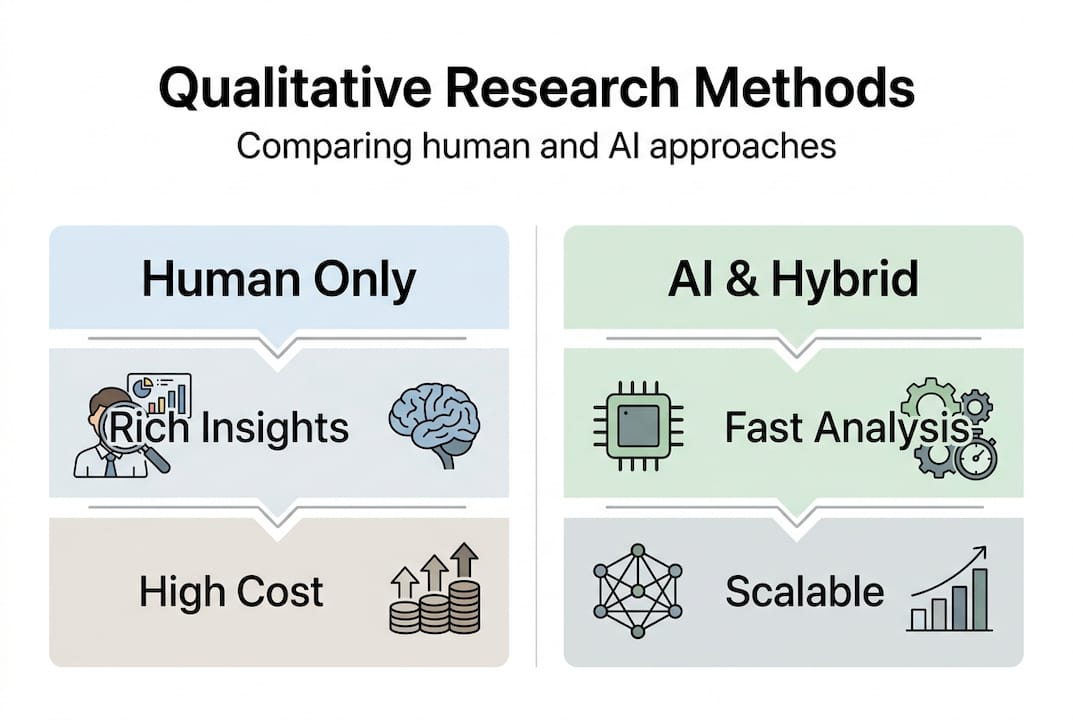
Traditional qualitative research offers depth but resists scaling. AI accelerates scale but risks losing nuance. Hybrid models offer a middle path that neither approach achieves alone.
Here is how to build a hybrid qualitative process that works in practice:
- Use AI to run initial discovery at scale. AI-moderated interviews can engage hundreds of participants simultaneously, generating a broad dataset of themes and patterns.
- Apply human analysis to validate and deepen. Have skilled researchers review the AI-generated themes for context, contradiction, and emotional subtlety.
- Build your strategic recommendations from both layers. The AI gives you coverage; the human analysis gives you confidence.
Pro Tip: Never let AI be the only interpreter of qualitative data when the stakes are high. AI excels at pattern recognition across volume. It can miss the sarcastic comment, the hesitation in a voice, or the meaning that only makes sense given the respondent's professional background. Use AI to broaden discovery, then validate with human judgment.
For teams evaluating this approach, exploring AI in qualitative research and reviewing resources on scalable market intelligence will clarify where automation genuinely helps and where human expertise remains essential. When selecting between methods, a framework for selecting fast research methods can reduce the decision fatigue that often slows teams down at the start of a project. AI is also reshaping competitive intelligence for marketers who need to move faster than their competitors.
A fresh perspective: Rethinking how marketers use qualitative research
Here is the uncomfortable reality: most marketing teams underuse qualitative research not because they don't value it, but because they've accepted a false trade-off between speed and depth. That trade-off no longer exists.
The belief that qualitative research takes too long for agile teams is based on a model that was true a decade ago. Modern hybrid methods, combined with purposeful sampling and multi-level analysis, can produce rich, board-ready insights in days rather than weeks. The teams still waiting for a three-month research cycle are leaving strategic opportunity on the table.
"The most effective marketers blend deep human insight with rapid AI-driven discovery."
What separates good qualitative research from great qualitative research is analytical discipline, not just data volume. Applying multi-level analysis means examining findings at the individual, group, and organizational level rather than treating all responses as equal. An insight from a C-suite buyer carries different weight than one from an end user. That distinction matters for strategy.
Marketers who treat qualitative research as a one-time validation step rather than an ongoing intelligence practice miss its real value. Embedding purposeful sampling in research cycles and combining technology with expert analysis is what builds the kind of market understanding that compounds over time. That compounding edge is what turns good marketing into durable competitive advantage.
Next steps: Tools and platforms to accelerate qualitative research
Qualitative research has moved far beyond slow, manual processes. The right platform makes the difference between insights that arrive too late and insights that shape your next campaign.
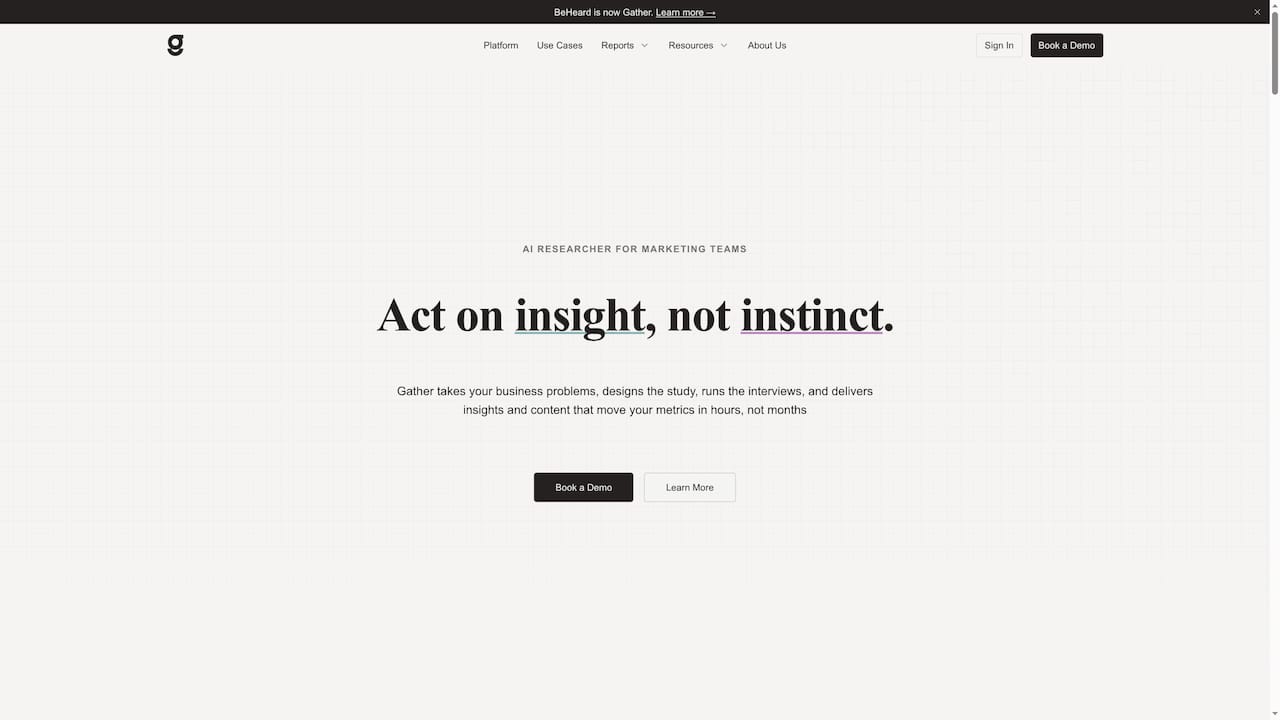
Gather is built specifically for marketing and business teams that need fast, reliable qualitative insights without the agency lag. The platform automates study design, runs AI-moderated interviews, and delivers structured analysis with automated reporting, all in one place. Whether you're researching churned customers, B2B buyers, or Gen Z segments, Gather connects directly to your existing data sources to target the right participants fast. Explore Gather use cases to see how teams like yours are applying it, review the full Gather platform capabilities, or access the customer research report to benchmark your current research practice.
Frequently asked questions
What makes qualitative research valuable for marketing strategy?
Qualitative research uncovers the motivations and pain points that drive customer decisions, helping marketers build messaging and campaigns that connect at the right level rather than guessing.
How do marketers choose between interviews, focus groups, and observation?
The best method depends on the goal. Interviews offer depth, focus groups surface emotional group reactions, and observation captures what customers actually do versus what they say they do.
Can qualitative research be scaled for rapid insights?
Yes. Hybrid human-AI models allow marketers to scale qualitative research without sacrificing the depth and context that make findings actionable for strategic decisions.
What is purposeful sampling and why does it matter?
Purposeful sampling means selecting participants deliberately to represent diverse perspectives, which produces richer findings and reduces the blind spots that come from convenience-based recruitment.